
Money Research Collective’s editorial team solely created this content. Opinions are their own, but compensation and in-depth research determine where and how companies may appear. Many featured companies advertise with us. How we make money.
America’s Best Banks Are Competing for Customers. That’s Good News for Your Money
By Jordan Chussler MONEY RESEARCH COLLECTIVE
These three trends are driving the current evolution of banking. Better yet, they have the potential to benefit you financially.

Since the first online-only bank in the U.S. opened its virtual doors in 1995 to the acceptance of crypto payments in 2026, the banking industry has experienced seismic shifts over the past three decades.
There are currently 4,238 FDIC-insured banks and 4,250 federally insured credit unions. Although those numbers are down sharply from a 1921 high of about 30,000, the products and services these institutions offer today lend themselves to a highly competitive landscape. Everyone is vying for their piece of the 96% of U.S. households with a bank or credit union account, and that means they’re under pressure to innovate, improve and ingratiate themselves with consumers.
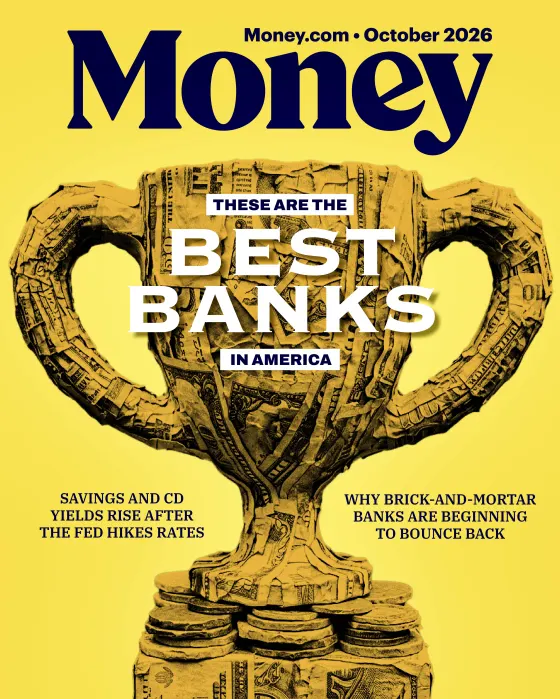
To help you take advantage of this, Money analyzed 116 financial institutions for this year’s iteration of the Best Banks in America. Our selections are tailored for students, seniors, small businesses, members of the military, geographic regions and more.
In addition to focusing on the highest available rates, low-to-no fees and customer satisfaction rankings, we also uncovered three major trends driving the current evolution of banking.
Must Read
- You're probably eligible to save money on car insurance. Compare rates for your ZIP code with this free — and fast — tool from Money.
- Investors have historically used gold to hedge against inflation — and that trend still continues today. Get in on the action with American Hartford Gold's free guide.
- Meet your financial goals faster: Take this free, no-obligation quiz to get matched with an advisor today.
A higher-rate environment makes savings extra-attractive
With inflation remaining stubbornly above the Federal Reserve’s 2% long-run target, the central bank increased interest rates in September for the first time since July 2023. The Fed’s benchmark, the effective federal funds rate, now stands at 3.88%.
While this means borrowing is becoming more expensive, it’s good news for Americans who want to put their money to work in deposit accounts.
The federal funds rate is correlated with the annual percentage yields (APYs) offered by financial institutions. When the Fed hikes rates, cash alternatives — including high-yield savings accounts, certificates of deposit (CDs) and money market accounts — become more attractive as banks subsequently increase their yields.
While the returns offered by these products lag those offered by the stock market, their lower risk profiles are precisely what makes them a productive supplement to equity investments.
“We view them as short-term capital preservation tools,” Charles J. Princiotto, president and cofounder of Sound Ridge Private Wealth, writes in an email to Money. “They’re a great fit for near-term liquidity needs, like a home down payment you plan to make in the next year or two.”
Since rates ticked up in September, APYs have followed suit. In the week after the Fed meeting, more than 84% of all rate changes by financial institutions moved CD rates higher, according to the marketplace CD Valet. The future is bright for savers, too, if inflation persists and unemployment stay stable.
According to the CME FedWatch Tool, the expectation for another rate hike at the Fed’s October meeting stands at 53.7%, with that figure increasing to 96% for the December meeting. If the central bank does hike rates again this year, APYs for deposit accounts are likely to increase further heading into 2027.
Banks’ crypto adoption is accelerating
The traditional financial system is slowly dipping its toes into the world of decentralized finance.
In May, SoFi — in partnership with Mastercard — announced that it launched a stablecoin settlement system directly to consumers. The digital infrastructure uses cryptocurrencies fixed to the U.S. dollar.
Basically, SoFi (with Mastercard) is now capable of settling transactions paid in crypto via the traditional financial system. The online bank is migrating its entire $25 billion debit and credit card program to blockchain-based settlement using SoFiUSD, making it the first 1:1 U.S. dollar-backed stablecoin issued by a bank.
Now, “any merchant can receive settlement funds instantly in a SoFi bank account and withdraw to cash around the clock at zero cost,” SoFi CEO Anthony Noto said in a news release. “That means businesses have faster access to their money via the speed of blockchain, with the safeguards of a bank.”
Financial institutions are also beginning to roll out tokenized deposits — or digital representations of traditional fiat deposits that live on-chain — as well as institutional blockchain networks and stablecoin integration.
JPMorgan Chase’s Kinexys platform, for instance, has scaled regulated blockchain-based transactions to a daily average volume of $7 billion. The bank joined Bank of America, Citi, Wells Fargo and over a dozen other financial institutions in a June announcement of a joint initiative to put commercial bank deposits on-chain with a prospective launch date in the first half of 2027.
These are major developments because they expand the utility and convenience of crypto for those who own digital assets.
The rise of the multi-bank ecosystem
In-person banking is experiencing a revival, with about 110 new brick-and-mortar branches opening between October 2025 and June 2026, according to an analysis of FDIC data by the National Community Reinvestment Coalition.
That trend is growing. JPMorgan Chase is planning to open 500 new branches, with 160 coming in 2026 alone, while PNC is opening 300 new branches by 2030. Bank of America is expanding, too, with 165 new financial centers by year’s end.
But as much as Americans still appreciate in-person services, younger customers are also embracing another approach to banking. Multi-banking is the practice of managing several bank accounts across multiple financial institutions, often in one centralized dashboard or app.
“Technology has removed much of the friction,” Princiotto says. “And opening an account is now so easy that it’s natural for this trend to grow quickly.”
According to JD Power, the average retail bank checking account customer now maintains three deposit accounts at different banks, credit unions or fintech platforms. That approach helps consumers take advantage of competitive APYs for various banking products across brick-and mortar, online and hybrid institutions.
As a result, transferring money between banks is an increasingly common habit, with 20% of retail bank customers reporting that they have done so within the past three months. That behavior is most prominent among Americans under the age of 40.
That optionality and competition is good for consumers, according to Princiotto. And they have helped fuel the rise of multi-banking apps that provide centralized convenience.
Monarch Money, for example, allows households to access accounts from various providers all in one place, syncing in real time so customers can check their balances, see their transaction history and monitor their spending across different banks and credit unions. Empower allows users to link multiple bank accounts, brokerage accounts and retirement accounts into a single, real-time dashboard.
These trends — and others identified in Money’s Best Banks selections — are reshaping the industry as Americans continue to look for ways to maximize their banking benefits in 2026, 2027 and beyond.
“Consumers today are very well-informed,” Princiotto says. “They know they have options, and they’ll seek out institutions that specialize in what they need or that fit their particular situation.”
Never miss a Money story.
Since joining Money in 2023 as an investment editor, Jordan has specialized in a wealth of finance topics, ranging from traditional equities (stocks, mutual funds and ETFs), income investment vehicles and alternative assets to retirement savings, fixed-income securities and commodities, specifically focusing on gold and other precious metals. He takes pride in combining his personal interests and professional experience in finance and education to help readers increase their financial literacy and make better investment choices. Jordan has worked in digital publishing for 18 years after graduating from Lynn University as a member of both the Kappa Delta Pi International Honor Society and the U.S. Achievement Academy's All-American Scholar Program. In November 2025, Jordan received his Certified Personal Finance Counselor (CPFC) designation. He previously served as managing editor of Weiss Ratings, where he worked alongside a team of investment writers, editors and analysts to produce educational finance content and daily, weekly and monthly market news alerts. As a contributing writer for BetterInvesting Magazine, Jordan covered topics focused on the fundamentals of investing, technical and fundamental analysis, mutual funds, debt securities, dividend investing, retirement savings strategies and passive income generation. His bylines can also be seen on Yahoo Finance, Nasdaq.com, Apple News, Investing.com, MSN Money, 24/7 Wall St., MarketBeat, TipRanks, Money Crashers, The Miami Herald and a dozen other newspapers.