Are mountain lions a threat in California? How to weigh the latest warnings
AI-generated summary reviewed by our newsroom.
- Sheriff warned, then officials said the lions had moved on.
- Officials concluded the lions posed no threat and had moved on.
- California issued 158 nonlethal and 62 lethal mountain lion permits last year.
Lassen County Sheriff John McGarva posted on social media earlier this month that mountain lions posed an imminent threat to public safety in a remote area near Susanville, sending the news ricocheting around the state and terrifying residents already on edge after months of attacks by wolves on cattle in neighboring Sierra County last year.
But state biologists and game wardens who scoured the area in recent days insisted that the mountain lions who live in the area posed no threat, and last week McGarva told The Sacramento Bee that federal officials agreed, saying the animals spotted on residents’ trail cameras had moved on.
The high level of concern raised by McGarva — along with the quick and unquestioning response among news outlets and some residents — highlights the anxiety among many Californians about the state’s twin goals of protecting predator species while also assuring the safety of people, pets and livestock.
“The residents who contacted me were really concerned that there was going to be an incident,” McGarva said. “That particular resident had come within 15 feet of a mountain lion late last year on his property — and this was more than they had seen in the past.”
McGarva said photographs that a neighbor had sent him appeared to be images of five mountain lions traveling more closely than would be normal for the generally solitary animals. Mountain lions, with the general exception of females with cubs or yearlings, tend to travel and hunt alone, scientists say.
They ventured near the door of a home and lounged on the property underneath a second-story deck. But they did not attack any animals or people, and by the time a representative of the U.S. Department of Agriculture arrived to try to chase them away with dogs, they were already gone, McGarva said.
California is a vast state that prides itself on stewardship of the environment, whether in the wooded areas around Susanville that biologists say provide prime mountain lion habitat, or the dry Southern California forests and brushy areas where the animals were earlier this year declared threatened under the state’s endangered species law. But as the populations of protected predators including mountain lions, wolves and bears has grown under strict regulation, so have incidents of animals threatening people or livestock.
Living with predators, dying from attacks
A 21-year-old man was killed and his younger brother severely wounded in a mountain lion attack in El Dorado County in 2024, and in 2023 a Downieville woman was harassed, killed and eaten by a black bear.
Last year, a single pack of gray wolves was responsible for killing about 100 calves in the high rangeland of Sierra County, in a hunting spree that also brought them close to homeowners’ doorsteps, frightening residents and costing millions to ranchers and the state.
The incidents piled up as state officials considered protections for still more predators: a plan to limit the hunting of coyotes was shelved amid opposition last fall, and this week lawmakers moved forward on a proposal to study the reintroduction of grizzly bears.

The state’s top environmental official, Secretary of Natural Resources Wade Crowfoot, called the situation a crisis at a legislative hearing on the state’s predator management challenges last fall — on the very day that a mountain lion roaming an urban part of San Francisco was captured and tranquilized.
California has programs in place meant to help navigate the challenges of living with wild predators, but the tools available to its game wardens and others are limited, and vary depending on the animal. A program aimed at managing what scientists call human-wildlife conflict has not been fully funded since 2023 under the state’s budget plan.
Local law enforcement officials, including sheriffs like McGarva, say they have had to step in to fill the breach, devoting hours of time day and night responding to incidents involving wild predators while also dealing with crime and other threats to public safety.
How mountain lions differ from wolves
In the case of mountain lions, this has meant balancing a different set of issues than the wolves presented, experts say.
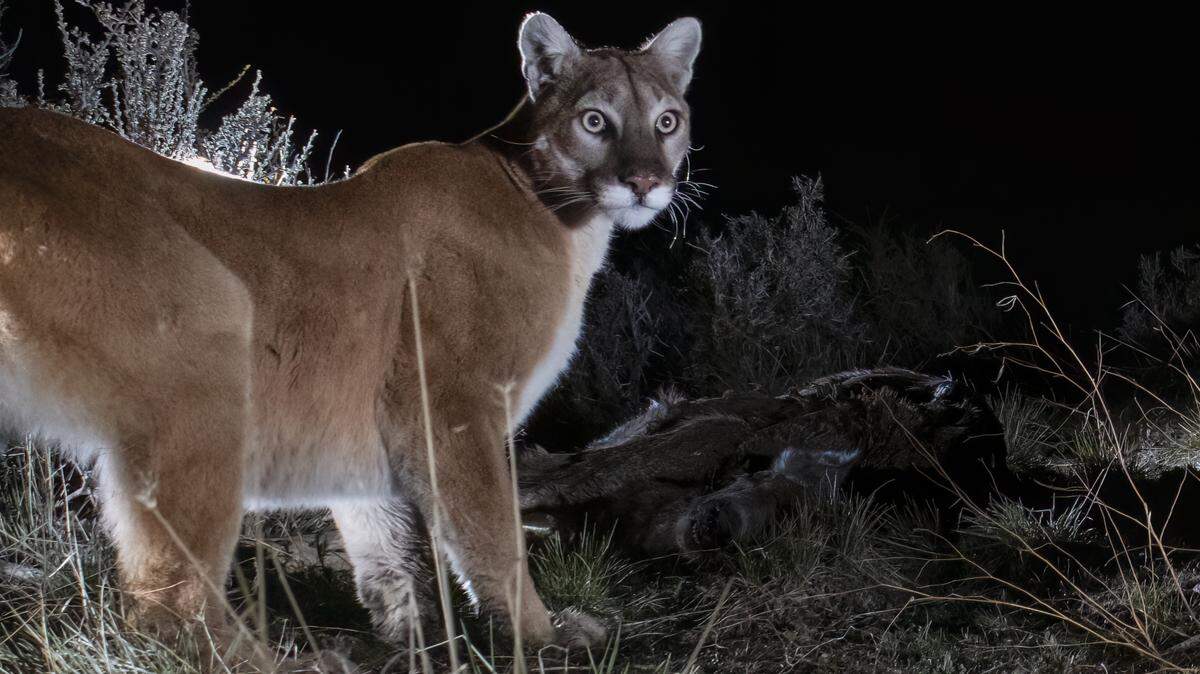
Unlike wolves, which can work together to bring down large prey, mountain lions generally hunt alone. Their most common prey are deer, and they can feed on a single carcass for up to a week before moving on, said Justine Smith, a researcher at UC Davis. She studies predator-prey interactions and mountain lion behavior and, in general, she said, an adult mountain lion feeds on about 40 deer per year.
Wolves are known as coursing predators, meaning that packs chase their prey for long distances, said Daniel Macon, a University of California livestock and natural resources advisor for the Central Sierra region. In the case of livestock, this results in stress-related damages as well as animals mauled or killed by wolves, he said.
Mountain lions, by contrast, are ambush predators, hiding and then leaping upon prey that come near them, he said.
They are less likely than wolves to attack commercial livestock, and they tend to be afraid of dogs, which can be used as deterrents to keep them away, Macon said.
But the danger if a mountain lion does attack is real.
“I certainly wouldn’t begrudge anyone for being fearful of a mountain lion,” Smith said. “I don’t think there could be anything more natural than being afraid of something that if confronted could kill you.”

Last year mountain lions attacked two people in California, neither fatally: an 11-year-old girl in Malibu and an unidentified person in Trinity County, state records show. In 2024, a 5-year-old boy was mauled but not killed in Malibu State Park in Los Angeles County. That was also the year that Taylen Brooks, 21, was killed and his brother Wyatt Brooks, 18, severely injured in a mountain lion attack in El Dorado County.
Mountain lions near Susanville
Mountain lions in the Gold Run area about six miles outside of Susanville area attacked and killed seven feral or outdoor cats that a neighbor was feeding outside last August, said California Department of Fish and Wildlife spokesperson Peter Tira. Two human-owned animals were killed by mountain lions in the area in 2024, and one in 2023, he said.
The homeowner whose outdoor or feral cats were killed was issued a permit by the state to haze the lions aggressively, driving them away using dogs or other methods, but on the condition that household members stop feeding them outdoors, Tira said.
The homeowner did not stop the feeding, however, even though such activity is believed to attract mountain lions, he said. State wildlife officials concluded that the group, perhaps drawn to the area by outdoor pet food and the presence of smaller domestic cats, had not attacked anyone or anything.
The state was working closely with McGarva and homeowners, but officials stood by the conclusion that the lions were not a threat, Tira said.
“It’s not a crime to be a mountain lion in mountain lion country,” he said.
‘A wildlife highway’
About 4,200 mountain lions are in California, according to the state’s latest estimate. About 1,400 live in Southern California and along the Central Coast, while the rest are in the northern part of the state, according to a report last December that examined whether the big cats needed environmental protections.
Known in some areas as pumas or cougars, male mountain lions in California can weigh up to 170 pounds, with a shoulder height of 30 inches. Their tracks can be up to 4 inches wide.
Wildlife photographer Randy Robbins has lived among them all his life.
A resident of the Gold Run Road area where the lions that triggered McGarva’s post were wandering, Robbins has dotted his property with cameras aimed at capturing photos of animals.
“Picture a very rural road on a canyon bottom with a creek,” he said of the neighborhood where he has lived for the past 12 years. “It is a wildlife highway in that area.”
But Robbins said seeing a mountain lion is relatively rare, and expressed skepticism that five of the animals were traveling together earlier this month.
“On my 8 acres along the same creek I will get a mountain lion, maybe every six to eight weeks,” he said. “On a good run. In a few months period I might get it twice.”
Some of his neighbors, he said, feel strongly that the state is not aggressive enough in its efforts to protect people and agricultural businesses from wolves, mountain lions and other predators. So the presence of mountain lions earlier this month, he said, became a good excuse to draw attention to the issue.
“Everybody knows there’s not any kind of imminent threat,” he said.
Seeking solutions
The state first moved to protect mountain lions in 1972 with a hunting moratorium, imposed amid concern that their population was declining. In 1990, voters passed a ballot initiative which banned the sport hunting of mountain lions but established exceptions that included allowing them to be killed if they were perceived to be an imminent threat to public safety. The ballot initiative also allowed the predators to be killed if they damaged livestock or other property, or attacked people.
In February, the California Fish and Game Commission voted to extend additional protections to the Southern California and Central Coast populations, where their numbers are smaller. Climate change is fueling wildfire and their habitat is more likely to be encroached on by suburban and exurban development.
California’s rules regulating when mountain lions can be killed or extensively harassed are not nearly as strict as those limiting similar actions against wolves, because wolves are considered an endangered species. Residents who believe that a mountain lion poses a threat can apply for permits to use lethal or nonlethal actions against them.
Last year, the state issued 158 permits to haze or remove mountain lions using nonlethal methods, and 62 using lethal methods, state records show. Of those, just 19 were actually killed, the state said in a report issued on Jan. 13.
Unless the threat is imminent, a homeowner is sometimes required to take additional steps before hazing the lion, which may include removing outdoor pet food, covering pet enclosures or using deterrents such as dogs to frighten them away.
But some residents of mountain lion country say California should be doing more to protect residents and livestock. On Monday, a bill by State Sen. Marie Alvarado-Gil, R-Jackson, called Taylen and Wyatt’s Law, advanced in the legislature that would require the state to expand its programs aiming to prevent conflict between humans and mountain lions.
McGarva said the state’s approach is too reactive, relying on mountain lions to strike first before allowing community members and local officials to take action. In his social media statement, he used specific language from the ballot initiative protecting mountain lions by saying that they posed an “imminent threat to public safety,” the law’s trigger to allow lethal removal.
The sheriff said that since making the posting he has learned more about the situation, including the possible presence of outdoor pet food that might have been attracting the mountain lions. But given what he knew at the time, and the risks if a mountain lion does attack people, he would still have alerted the public.
“It was the right decision at the time,” he said. “I’m glad it worked out as well as it did. And hopefully we won’t have to do it again.”
This story was originally published May 24, 2026 at 7:00 AM with the headline "Are mountain lions a threat in California? How to weigh the latest warnings."