
Merced families cope with ALS
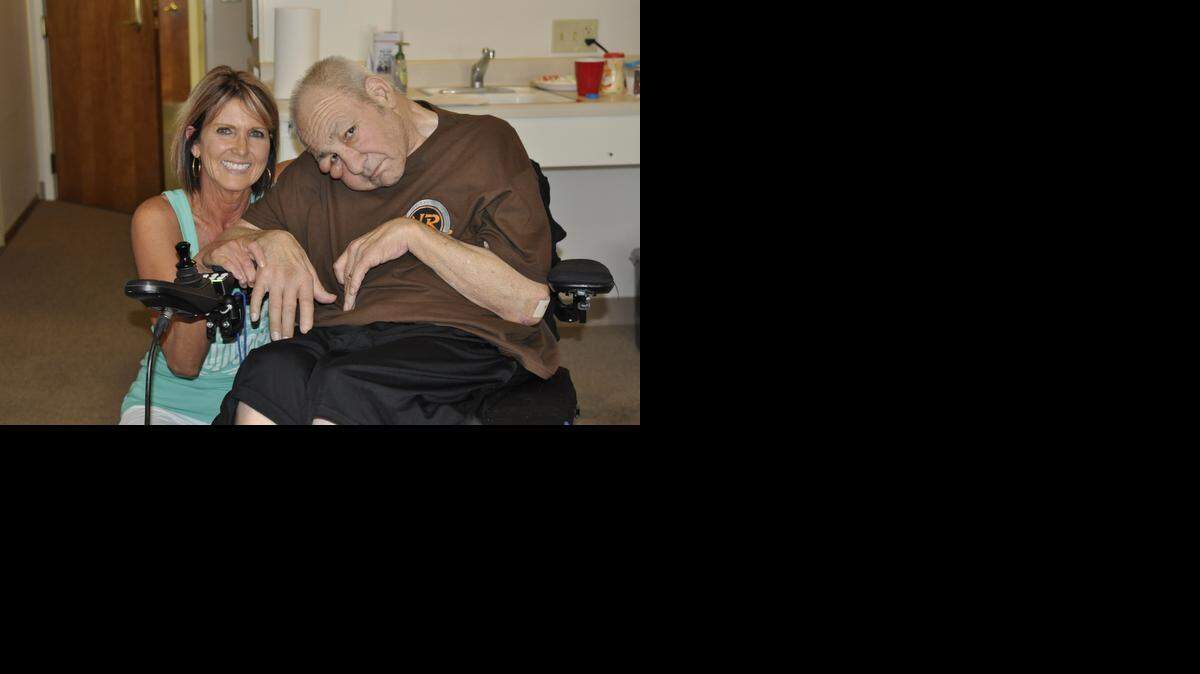
For Merced County resident Mike Dragovich, it started with continuous twitching in his left arm.
His legs wouldn’t do what he wanted them to do. He had been a truck driver for decades, but one day found himself unable to get into and out of the truck’s cabin.
After months of testing and an ineffective lower-back surgery, Mike Dragovich was diagnosed with ALS.
ALS, short for amyotrophic lateral sclerosis and also referred to as Lou Gehrig’s disease, destroys motor nerve cells in the brain and spinal cord, causing progressive paralysis and death. About 5,600 people in the U.S. are diagnosed with ALS each year, according to the ALS Association, and the average ALS patient lives from two to five years after their diagnosis. Little is known about the disease.
Dragovich, 68, was diagnosed with the neurodegenerative disease in December 2010. Since then, his wife and primary caregiver, Sharon Dragovich, has witnessed how the disease has completely transformed her husband. Mike Dragovich, who was once an energetic motorcycle and NASCAR enthusiast, now uses a wheelchair and hardly ever smiles, his wife said.
Until May of this year, he lived at home under the care of his wife. However, as his condition worsened, Sharon Dragovich realized she would need additional help to properly care for him. After researching facilities that could accommodate an ALS patient, Sharon transferred her husband to Park Merced Assisted Living.
“At home it would require around-the-clock care,” Sharon said. “It would take me and at least two other people to take care of him 24 hours, seven days a week.” And hiring at-home help becomes very expensive, she said.
At Park Merced Assisted Living, care for Mike costs about $4,000 a month, which is less expensive than paying for at-home care and related expenses, according to the residence’s executive director, David Massa.
Dragovich is currently the only resident at Park Merced with ALS. Because of his limited range of motion, three to four people are required to transfer, bathe and assist him with most daily activities.
“Mike’s case is a little bit unique in that we have activities for our residents, but Mike doesn’t participate in them because of his restrictions,” Massa said. “He is confined to a wheelchair – that’s his life, that’s his world. He needs assistance to do anything that the rest of us consider to be typical.”
Massa said it is important for families to ask for and accept help in taking care of ALS patients.
“The families are affected so severely by this. A lot of the focus is on the patient, but this really wreaks havoc for the caregiver and family,” Massa said. “It’s important for the family to realize that they need help because you can drive yourself nuts physically and emotionally if you think you can do it all by yourself.”
Glenn Reed, 82, of Merced, recalls the dedication it took to care for a loved one with ALS. His wife, Mae Reed, was diagnosed with ALS and lived with the disease for about three years before she died in 2011.
“Our lives completely changed,” he said. “She couldn’t do much, and I couldn’t leave her, so we just stayed at home all the time.” Over the three years, Reed saw his wife rely on a cane and then a wheelchair before becoming bedridden.
“She couldn’t walk, she couldn’t talk and she had a feeding tube implanted in her stomach,” Reed said. “But she understood everything. She didn’t have a problem with her cognitive ability.”
Similarly, Janet Sherman, 94, whose husband died from ALS at the age of 49, remembers that her husband was alert and aware of his surroundings throughout the year he lived with the disease.
“He was diagnosed with ALS almost to the year before he died,” Sherman said. “But once he was diagnosed, we could look back and see that he had symptoms years before.” Her husband, Frannie Ray, sought medical attention after he began losing strength in his hands and his right foot.
“It was all very fast. He remained pretty independent most of the year, but it eventually got to the point where he couldn’t talk or swallow,” she said.
Currently, Riluzole is the only drug approved by the FDA to alter the course of ALS. “It’s a very expensive drug and it doesn’t work on everyone,” Sharon Dragovich said. “The doctors said it’s supposed to extend the patient’s life by two or three months, but there’s never a guarantee.”
Sharon Dragovich has become involved with raising money for the ALS Association. She recently raised $5,000 during an ALS ice bucket challenge fundraiser at Park Merced to celebrate her husband’s 68th birthday. The national association has raised more than $94 million this year through ice bucket challenges and other fundraisers.
“The money being raised I’m sure is not going to help my husband – he’s already had it for too long – but I do think it will help in the long run,” she said.
Besides the money, the ice bucket challenge is raising awareness, she said. “When my husband was first diagnosed, and we’d tell people what he had, people would ask ‘What is that?’ Some people were somewhat familiar with the term ‘Lou Gehrig’s disease’ but no one really knows what the disease does to you, so all this attention it’s getting helps educate people. It’s a positive thing.”
This story was originally published September 1, 2014 at 4:07 PM with the headline "Merced families cope with ALS ."