
Diana Serra Cary, last silent film era child star, dies in Gustine at age 101
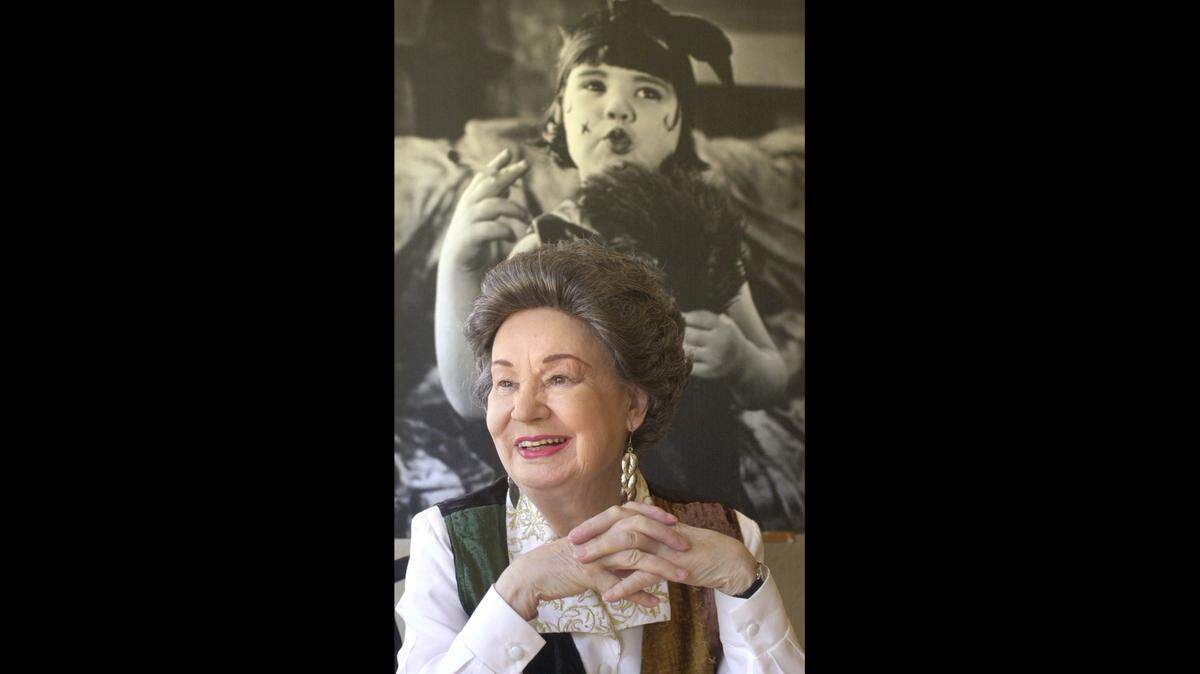
Diana Serra Cary, an author, film historian and probably the last surviving child superstar of the silent film era nearly a century ago, who spent decades coming to terms with a bizarre childhood of triumphs, heartbreaks and parents who squandered her fortune, died Monday in Gustine, California. She was 101.
Her death was confirmed by the Niles Film Museum, which did not identify a cause.
Cary had lived for many years in Gustine, California. She was born on Oct. 29, 1918, in San Diego.
Her name was Peggy-Jean Montgomery, and she was a precocious 2 1/2-year-old in 1921 when Century Studio cast her as Baby Peggy, opposite Brownie the Wonder Dog.
America soon fell in love with the chubby-cheeked little girl as she fled burning buildings, held thugs at bay with a pistol and clung to the underside of a train.
She told the Modesto Bee in 2002 that it took her years to get to the point that she felt comfortable as an adult and at ease with the brown-eyed, chubby-cheeked persona she’d embodied as a child.
“It took me a long time to get on good terms with Baby Peggy,” Cary said. “The fame of that 3-foot-tall kid dogs you for life, and you can’t shake her.”
By age 5 she had made more than 150 pictures, mostly short comedies and melodramas, for Century, Universal and Principal Pictures, and was a multimillionaire.
Fan mail surpassed 1.7 million letters a year. She went on national tours, adorned magazine covers and endorsed “Baby Peggy” dolls, jewelry and sheet music. And she waved an American flag standing beside Franklin D. Roosevelt at the 1924 Democratic National Convention in New York.
But she never got to play with other children, never went to school like her older sister, Louise. And with dire poverty, divorce and years of anonymity and psychological struggle over the horizon, she did not live happily ever after.
Like Jackie Coogan and Baby Marie Osborne, the other major child stars of the silent era whose fortunes were dissipated by guardians, Baby Peggy and her financial affairs were controlled by her parents, Jack and Marian Montgomery, who spent lavishly and set nothing aside for her education or her future.
“I had $2 million by the time I was 10 years old,” Cary told The Bee in 2002. “It’s all gone. I never saw a dime.”
As she grew older, her career faltered. Cary told The Bee she grew accustomed to being told, “Oh, you used to be so darling. My, how you’ve changed” or “How does it feel to be a has-been at 16?”
And she was exploited by three studios that worked her eight hours a day, six days a week — with no naps or lollipop breaks — to mass produce two-reelers known as “five-day wonders,” as well as many full-length tear-jerkers and potboilers that enthralled moviegoers to the tune of tinkling pianos.
In 1925, Baby Peggy’s career crumbled. A $1.5 million contract was canceled, and she was virtually blacklisted in Hollywood after her father, a cowboy stuntman and stand-in for the Western star Tom Mix, had a bitter falling out with a studio boss over her salary.
She made one last picture, “April Fool,” in 1926, and then found no more work in Hollywood. She was washed up, a 7-year-old has-been.
For several years after her film career faded, Baby Peggy performed on a grueling vaudeville circuit to support her parents in the style to which they had become accustomed. They squandered much of her $2 million fortune on hotels, luxury cars and travel. The rest was lost or embezzled by a step-grandfather who absconded, or it evaporated in the stock market crash of 1929. The home in Beverly Hills was sold, as were the cars, jewels and other luxuries.
As the Depression deepened, the family moved to a ranch in Wyoming. Dirt poor and struggling, they pawned everything of value. A friend lent the family $300, and against Peggy’s wishes they returned to Hollywood and put her back to work, now as a teenager in the talkies. From 1932 to 1938, she appeared in eight films as an anonymous extra or in small roles credited to Peggy Montgomery.
She hated it. “Fighting for $3 a day in the world of extras — it was dreadful,” Cary told The Wall Street Journal in 2012. “And it was also sort of shameful, because the people who were doing the extra work were the former silent stars, many of them that I knew, who were adults, and for them it was a very crushing blow. I thought of it as being a galley slave.”
The family resorted to food coupons from the Motion Picture Relief Fund. The Los Angeles School Board finally insisted that the girl attend classes, and she enrolled at Lawlor Professional School, which had flexible schedules for young actors, enabling her to continue working. Fellow students included Judy Garland and Mickey Rooney. Later, she went to Fairfax High School in Los Angeles.
After graduating, she eloped in 1938 with her first boyfriend, Gordon Ayres, a movie extra. They were divorced in 1948. She was a switchboard operator and a bookstore clerk, and then managed a gift shop in Santa Barbara. She told no one of her past, and took the name Diana Serra. In 1954, she married Bob Cary, an artist, and took his surname. They had a son, Mark. Her husband died in 2001. Besides her son, she is survived by a granddaughter, Stephanie.
The Carys settled in Cuernavaca, Mexico, where he painted and she became a freelance journalist, writing magazine articles. In 1970, they moved to La Jolla, part of San Diego, and she began a new career as a film historian. Her first book, “The Hollywood Posse” (1975), was a well-received account of stunt riders in film. Her second, “Hollywood’s Children” (1978), recounted the often troubling stories of child actors.
But it was the years of work on her memoir, “Whatever Happened to Baby Peggy? The Autobiography of Hollywood’s Pioneer Child Star” (1996), that proved therapeutic and redemptive. She reexamined her life in silent films, her parents’ conduct in frittering away her fortune, the studios’ harsh working conditions and the fates of child stars who, like her, were left impoverished, emotionally scarred and largely forgotten.
In “Jackie Coogan: The World’s Boy King: A Biography of Hollywood’s Legendary Child Star” (2003), she wrote about her old friend, who sued his mother and stepfather in 1938 for spending his more than $3 million in earnings on furs, diamonds, homes and expensive cars.
Prodded by the stories of Jackie Coogan, Baby Marie Osborne and other children whose Hollywood fortunes were squandered by parents or guardians, California in 1939 passed the Coogan Act, a law to safeguard part of a child actor’s earnings in trust, and provided for time off, schooling and limits on working hours.
For her 99th birthday in 2017, Cary self-published a first novel, “The Drowning of the Moon,” a historical tale set in the Mexican-American colonial empire of New Spain and featuring the noblewoman of a silver-mining dynasty facing civil war.
In recent years, Cary also appeared at silent film festivals, lectured, gave interviews and appeared in documentaries about her career.
The Modesto Bee contributed to this report.
This story was originally published February 25, 2020 at 11:38 AM.