
The history behind Merced’s K Street, the ‘forgotten Alameda’
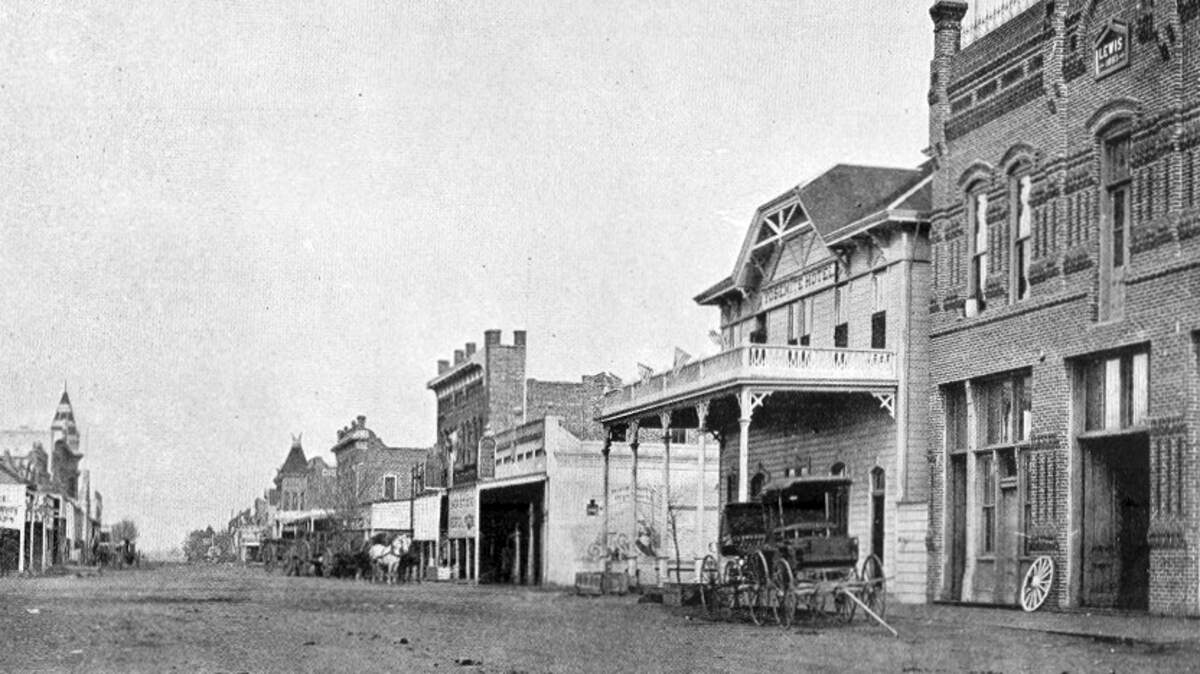
K Street had its prominence in Merced’s urban landscape as it was one of the first three streets bestowed with a special name other than its “birth” name.
In May 1887, the Merced County Board of Supervisors officially changed the name of K Street to Alameda Street.
While it is unclear why K Street was called Alameda, it could be that Alameda, (a Spanish word) evoked the California Mission era and reflected Merced residents’ plan for tree-lined streets to beautify their town.
Alameda Street, like other downtown letter streets, was an interesting mix of a busy business corridor and tranquil residential neighborhood.
Some of Merced’s most magnificent homes were constructed on its street corners, such as Greenbrier on 21st Street, Reilly House on 22nd Street, Dallas House on 23rd Street, and Rector House on 25th Street.
While these homes have become some of Merced’s best-preserved historical properties, their counterparts in the commercial district did not fare as well. Many are now gone and almost forgotten like the Star Hotel, Spears & McMurphy’s blacksmith shop, Yosemite Hotel, and Enterprise Feed Stable.
In the early 1880s, a two-story building was constructed on the northwest corner of 16th and Alameda streets. Over the next 20-some years, it housed various businesses, including a saloon, grocery store, print shop, post office, and Masonic Hall.
By 1907, it was already remodeled into a hotel called the Star Hotel. The hotel building lost its second story at some point and became the Star Club in the 1940s. It was torn down in 1962 as part of an urban renewal project.
The southeast corner of Alameda and Main streets was the site of Merced’s pioneer blacksmith and wagon shop known as Spears and McMurphy.
In 1876, John W. Spears and James H. McMurphy started the business in a town that was barely four years old and found that money was scarce. In order to establish their clientele, they offered their customers labor in exchange for their produce. The farmers who wanted to have their work done would bring in loads of tomatoes, apples, and other perishable items for payment.
It worked out perfectly since the wives of Spears and McMurphy manufactured some of the best ketchup in town. In addition to selling ketchup, the wives also sold dried fruits. Their earnings helped build up their husbands’ business.
But the partnerships did not last long. Sometime in the latter part of 1877, Spears purchased McMurphy’s interest and became the sole owner of the blacksmith shop until 1880 when he took in Elgin Lewis as his new partner. Spears did not stay in Merced long enough to see what happened to his building, which was gone by 1907.
Just as entrepreneurial as the Spears’ and McMurphy’s better halves was Elizabeth Smythe who ran the Yosemite Hotel across the street from the blacksmith shop on the northeast corner of Main and Alameda streets.
Elizabeth was born near Ottawa, Canada and came to California in 1856 by the way of the Isthmus of Panama.
She met and married Mathias Smythe in San Francisco. They came to the new town of Merced in 1872 and lived in a cottage on the southeast corner of Canal and 19th streets. It was in their home that the first mass was celebrated by Father McNamara in 1872. In the same year, her husband was appointed Merced’s first Justice of the Peace by the Board of Supervisors.
The Smythes built a hotel and restaurant on the 500 block of Main Street but sold it to J. M. Henry in 1875 before leaving town. Elizabeth returned to Merced with her three youngest children and ran a lodging establishment on Main Street in 1880.
She became the proprietor of Yosemite Hotel in 1886 and worked hard to raise her children. Her strength, independence, and resilience must have inspired her daughter, Belle, who ran a successful campaign in 1906 to become the superintendent of Merced County schools. Elizabeth retired from the lodging business around 1899. The hotel building was gone by the 1950s.
Another building that did not make it to the 1950s was Robert D. Hannah’s Enterprise Feed Stable on the southwest corner of 18th and Alameda Streets. Born in Randolph County, Missouri on November 28, 1853, Hannah came to Merced County with his family in 1871 and engaged in farming on Dry Creek. He moved to Merced in 1889 and worked as a teamster between Merced and Snelling.
In 1897, Hannah started his own livery stable, Mariposa Stable, on Main Street. In 1902, Hannah purchased the corner property on 18th and Alameda Streets and built a new livery stable with 56 stalls.
When cars became popular, Hannah sold his horses and turned the stable into an auto garage. In the early 1940s, when a modern service station replaced the Hannah Garage, it marked the end of the horse-and-buggy days as one of the last buildings of its kind disappeared.
Sadly, these early buildings that nurtured Merced as it grew from a railroad town to an urban center did not survive to be historical reminders of those who helped build Merced.
This story was originally published November 27, 2020 at 8:12 AM.