
Brigitte Bowers: Little truth to myriad theories of drought’s cause
It’s a 200-year drought. It’s a 20-year drought.
Cooling patterns in the Pacific Ocean are responsible.
Nuclear fallout from the 2011 Fukushima power plant accident in Japan is responsible.
Overpopulation in California is responsible, and we should shut down any and all immigration into the state.
The rainy season isn’t over yet, and there is still hope. This year will be worse than any previous year, worse than anyone can even imagine.
Go online and type in “California Drought” and you can read dozens of suppositions about the causes of the drought, the severity of the drought, the expected length of the drought, and what should be done to minimize its effects.
As with any natural disaster – and everyone seems to agree, on at least some level, that this drought is a disaster – there are those who will use the drought as evidence to support xenophobia, or to refute or support theories about global warming, or to create doomsday scenarios designed to send readers huddling under their bed covers in a fetal position.
I suppose there is a little truth in many so-called theories about the drought. There are regions of California, including the San Joaquin Valley, that seem to have reached a point where population has strained natural resources to a new level of horror – sinking ground levels and 200-foot wells going dry.
Most climatologists seem to agree that California has always been involved in a drought cycle that is driven by cooling patterns in the Pacific. Most reasonable people will balk at an interpretation of the drought that connects the Fukushima meltdown with those cooling cycles.
And while many of us will agree that California might soon be reaching a population level that is unsustainable in light of available natural resources, only a very few anti-immigration zealots might suggest closing our borders as a possible solution.
In any case, with no promising relief on the horizon, it seems that all we can do is make water-conservation prominent in our consciousness and prepare ourselves for the possibility that the worse is, indeed, yet to come.
Those Internet articles were on my mind when, last Sunday, I suggested to my husband that we take our Great Pyrenees, Monty, for a walk out to the newly dog-friendly Lake Yosemite.
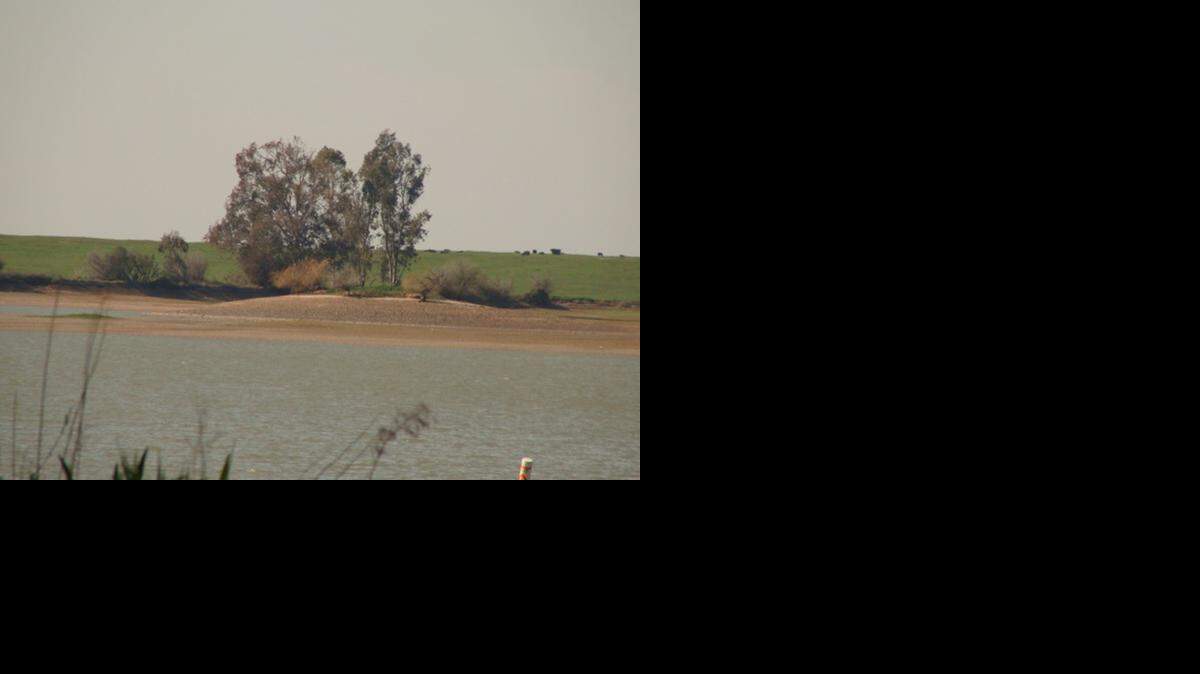
I’d seen in an email from a friend that the water level was so low that it was now possible to walk out to the small island on the east side of the lake, and having nothing much else to do, I thought I’d see for myself if this was true. It was.
The news from the Merced Irrigation District so far this year seems to be that the lake might very well not be filled. My family belongs to the sailing club that maintains the docks and clubhouse at Lake Yosemite, and every year for the past two decades the club has hosted a regatta in May.
Our club commodore recently received word from MID that it would be wise to cancel the regatta this year.
Though I have vivid memories of the mid-1970s drought – the toilets we were encouraged not to flush at school, the time an out-of-state visitor was offended when the waitress at a restaurant didn’t bring us water with our menus – I was not nearly as nervous about drought conditions then as I am now.
I was a teenager, living in blissful ignorance about the world outside of the small one I had constructed for myself, and I did not think much about our property’s well, though it might have been in jeopardy of going dry.
Now, the well on my small plot of land outside Atwater is constantly on my mind. I wake up wondering if water will flow from the taps, if the toilet will flush, if I will be able to make coffee. I go to bed thankful that I was able to wash my face and brush my teeth yet one more time.
I have tried getting an appointment to have our well inspected, but domestic wells are very low in the priorities of local well-digging operations. And so I wait and worry, wondering every time I turn the faucet to on what will flow, or will not flow, from it.
As I walked with Monty and my husband along the cement-hard bed of Lake Yosemite last Sunday, though, I was not thinking about my well. I was thinking about no sailing this year, and I was thinking about what might happen to the price of produce, and I was thinking about how unemployment in Merced County will probably soar this summer.
But I was also thinking, despite the drought and the anxieties it has created, that I love this state, this county, this town, and the lake, even when it is little more than a mud puddle. The pasture around the lake was green, the air was clear enough to see the blue outline of the Sierra in the distance, and Canada geese grazed nearby, content.
On the west side of the lake, a mating pair of pelicans swam in circles. I thought about how every summer, when we anchor by the island and swim to its shore, we find it covered with cracked eggs left behind by hatchlings.
“Where will they lay their eggs this year?” I wondered out loud to my husband. “They’ll be too vulnerable to coyotes and other predators on the island.”
“Oh, they’ll find a way. Probably lay them on top of the buildings around here,” he replied.
Some geese did that last year, so it seemed like a reasonable answer.
We stopped and talked to a man who, it turned out, knew some of the same people we did. And then we finished our walk, arriving finally at the island. I looked out over the lake and felt despair, but later I remembered previous droughts, and I realized that California always comes back from disaster stronger than it was before.
In the mid-1970s, we enacted water conservation efforts that are still in place today. We will figure out a way to conserve further, possibly because we will have no other option, and we will continue to be one of the best places in the world in which to live.
Brigitte Bowers is a lecturer in the Merritt Writing
Program at UC Merced.
This story was originally published March 6, 2015 at 2:18 PM with the headline "Brigitte Bowers: Little truth to myriad theories of drought’s cause."