
Sarah Lim: Photography captures the way Mercedians were
“There’s an early-afternoon calm in our town: a buzzin’ and a hummin’ from the school buildings; only a few buggies on Main Street – the horses dozing at the hitching posts” – Thornton Wilder’s “Our Town.”
Merced at around the turn of the 20th century was much like Thornton Wilder’s fictional town of Grover’s Corners.
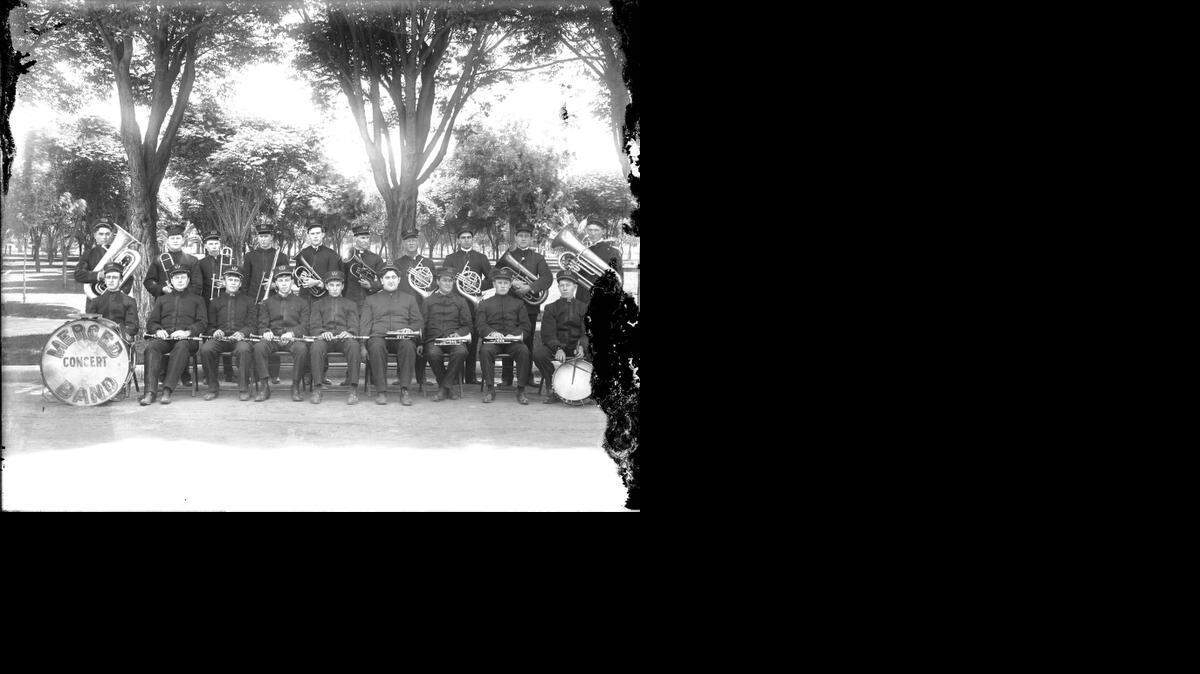
While Wilder presented his fictional small town through the lives of everyday people, one Merced photographer, in particular, captured our town in the same era through the still images of people and landscapes. Thanks to the generous donation of Dave Grandt of Oakland, these vintage glass plate negatives recently returned to Merced after decades of absence.
Last summer when I wrote about this collection of glass plates, I explained how modern day high-tech equipment such as the Epson scanner helped to solve several century-old photo mysteries by disclosing the details of glass plates not normally visible through regular printing techniques. At that point, I did not have sufficient evidence to identify the correct photographer.
Then I received another donation of the glass plate negatives from Grandt later last year and became more intrigued about this photographer who appears to be one of the most prolific photographers in Merced in the first decade of the 20th century. A total of more than 200 plates are attributable to this photographer of portraits as well as landscapes.
There were a number of photographers in Merced in that time period: Warren Thornton Hohenshell, Enoch Marvin Brickey (his photos of Catalina Island were mixed with Grandt’s donations), George Paris Clark, James Hegyessy, John Burkhart Hemminger, Oscar Don Loftus and Edmund Franklin Martin. By researching various primary and secondary sources, I was able, through a process of elimination, to narrow it down to Hegyessy and Hohenshell.
Since, Hegyessy left Merced around 1905 and Hohenshell came to town about that time, this collection could be either of theirs. There are three reasons why I believe this collection is Hohenshell’s. First, I came across a glass plate that, despite its horrible over-exposed condition of two totally unrelated scenes, shows the storefront that bears the name of Hohenshell Photographic Studio.
Hohenshell apparently purchased a photo studio at 520 K St. (now 1624 K St.) around 1905. This was a very well-established photo gallery built by pioneer photographer E. R. Higgins in 1878. Higgins had produced some of the earliest views of Merced including the Merced County Courthouse (shown in my last column), Merced Bank, as well as the El Capitan Hotel on Front (16th) Street. All of these photos are from 1879.
Higgins left Merced after 1880 and became a well-known photographer in Fresno.
Hohenshell came to Merced in 1905 from Lake Elsinore and worked at the K Street location. As several photos show scenes from K Street including a cowboy and several scrounging dogs, it appears K Street was the most photographed street from this collection.
This was unusual since K Street was more of a side street, not a popular business corridor like Canal Street and Main Street. It makes sense that K Street would be well-photographed since Hohenshell’s studio was on this same street.
The second reason to conclude that these are Hohenshell’s glass plate negatives is that three photos from this collection have been identified as Hohenshell’s work from three different sources.
A picture of a steam-powered harvester operating a field in Merced County was the source of a century-old postcard that is stamped “W. T. Hohenshell, Merced, Cal. Portraits and Views.” This is one of several Merced postcards from collector Grey Roberts’ collection which are all stamped with this credit line. The second photo is a picture of a rose-covered home in Merced which was published in the Out West magazine in 1906. It appears the photo was taken in the summer of 1905 which was shortly after Hohenshell arrived in Merced. The third photo which also bears his name is a print in our Museum collection.
When I looked at the Murray-Vincent Company picture from the glass plate, I recognized that the exact photo is in our collection. As it turned out, the photo was mounted on a frame embossed with the name “Hohenshell.”
What was even more interesting about this photo is that, again, the business was on the corner of Main and K streets. If you look very carefully, amid the treetops, you can see “ell” –- which is the last three letters of “Hoheshell,” a snippet of the sign for his K Street photo studio.
With all this proof, one could still argue that James Hegyessy is the photographer since he was employed by the Merced Sun to take photos for the many promotional booklets put out by the newspaper. Yes, Hegyessy was active in Merced from 1900 to 1904; however, he would not have been around to take photos of many buildings and businesses that were constructed after 1904.
For example, Oscar Alexander Baker’s home (later known as Mansion House) was built in 1906, the Yosemite Valley Railroad Merced depot was erected in 1907, and the Immaculate Conception Catholic Church in Buhach Colony was constructed in 1909.
So for these three reasons, I am comfortable attributing this collection of glass plate negatives to Warren T. Hohenshell. Hohenshell’s glass plates provide a glimpse into the culture, as well as people and places of turn-of-the-century Merced.
Sarah Lim is museum director for the Merced County Courthouse Museum. She can be reached at mercedmuseum@sbcglobal.net.
This story was originally published February 13, 2015 at 4:03 PM with the headline "Sarah Lim: Photography captures the way Mercedians were."