
The legacy and contributions of Black American pioneers in Merced County
The Black Lives Matter movement has reignited the debate on various social and cultural issues.
As a result, I was recently motivated to re-examine the physical landscape of Merced County and its naming history.
Naming a place or building is often perceived as a laudable act to recognize an individual’s contributions, a humorous way to describe the area or structure — but seldom a sinister deed to exploit something or someone.
Black Rascal Creek in Merced, for example, has been a topic of discussion, but my research has revealed that its naming has no derogatory meaning.
The creek was named after the Black Rascal Hills, located somewhere between La Paloma Road and Merced River. The area was surveyed between 1853 and 1854, and this appears to be the earliest record of the Black Rascal Hills and Black Rascal Creek.
Although it is not definite how the area was named, it is highly likely that it earned its name because of its physical characteristics. In a report from California’s Bureau of Labor Statistics in 1884, it describes “the Black Rascal Hills being embraced in a belt of black adobe, hog-wallow, and gravelly lands….”
“Black” describes the color of the soil, “Rascal” refers to an animal which is a pig in this case, and “Hills” are the gravelly lands. That is, I think, how Black Rascal Hills got its name.
The naming of Black Rascal Hills and Creek predates the county’s organization.
Early beginnings in Merced County
When the county was carved out of Mariposa County in 1855, its settlers in the Snelling area were predominantly from the Southern states and often brought slaves with them, although California was a free state.
In addition, Black settlers came to Merced County as free men and women.
While the contributions of these Black settlers were not recorded in the history books or inscribed in monuments, they are still visible in other mediums such as maps, literary works, or movies.
One of the pioneering Black settlers has a parcel of land named after her on a subdivision map. “Aunt Harriet’s Addition to Snelling” refers to the area north of Emma Street between 4th and Montgomery Streets.
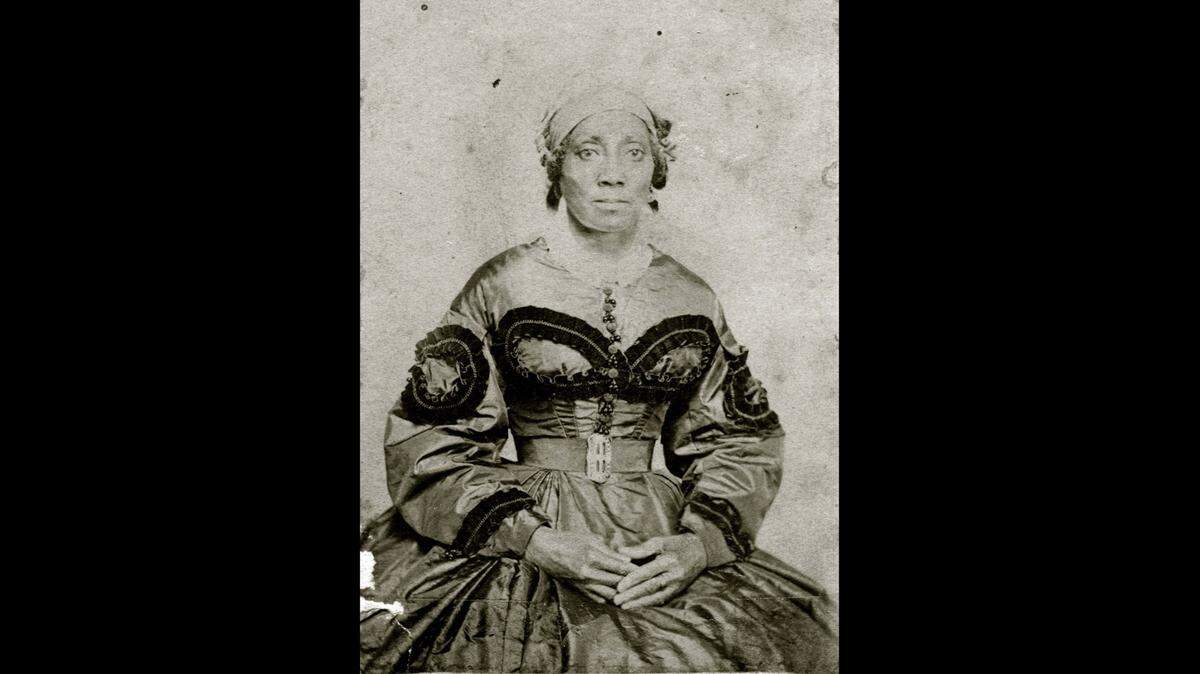
Harriet Russell, a former slave from Louisiana, came to California as a free woman with her daughter and settled in Snelling in 1857.
Working as a washer, Harriet actively engaged in land speculation. Between 1869 to 1871, she made 17 property transactions and did business with both white and Black landowners. When she died in 1897 at the age of 90, the Merced Express remembered her as “one of the oldest settlers in Merced County and laid off [sic] the first addition to Snelling which was called ‘Aunt Harriet’s Addition’.”
While Aunt Harriet’s legacy is memorialized on maps, William J. Creque’s talent as a poet is preserved in a book entitled “Poems: A Flash From Afar Ut Pignus Amicitiae.”
A West Indies-born waiter and handyman, William J. Creque penned this book and published it in San Francisco in 1908. It was dedicated to his beloved town, “The Fountain City,” a nickname for Merced.
It was unclear when and why Creque came to Merced, but by 1906 he was living in a cottage behind the residence of C.D. and Fannie Radcliffe. Creque loved poetry and wrote about Merced, Fresno, Yosemite, faith, family, and sailing on the sea.
The beauty of Merced’s physical landscape and seasons, the laughter of neighborhood kids, the challenging journey to America, and the tragic loss of his family inspired him to compose his sentimental verses. His success drew attention from the Fresno Republic that noted “many Fresno scenes tempt his Muse.”
A contemporary of Creque was Clara Webb, whose family was closely identified with tourism and the history of Merced County’s transportation.
While Clara Webb ran the operation of Webb Station on Coulterville Road, her husband William and sons Eddie and Joe all drove stage for the Stoddard family.
The Stoddard Stage operated 4-horse stages and made about 11 stops during a two-day trip from Merced to Yosemite Valley via the Coulterville Road. One of the stage stops was Webb Station near Merced Falls, where the travelers would rest and enjoy a delicious meal of southern fried chicken and biscuits before continuing on their journey.
Born into slavery in Alabama in 1846, William Webb settled in Merced County and married Clara Bettes of Hornitos. In 1888, William and Clara founded Webb Station. They had seven children, including Eddie and Joe. When William died in 1894, their youngest child was only 2 years old. Clara worked hard to support her family; “she was on her feet working the day she died in 1945,” said her son Joe.
The arrival of the automobile led to the end of the stagecoach. Joe left the stage business behind when he drove the last stagecoach into Yosemite in 1909; Eddie, on the other hand, continued to operate a stage business on his own, delivering mail between Coulterville and Merced before quitting in 1933. He then started to collect buggies, harnesses, and other horse-drawn era articles which were used in 12 motion pictures.
Although Webb Station is now gone, its presence remains on maps, tourism pamphlets, and magazines.
In recent history, Merced has recognized the contributions of local African American residents by naming a room in the Merced City Hall in honor of its former mayor Sam Pipes, a Merced city school after longtime educator Leontine Gracey, and MCOE headquarters as the Denard W. Davis Administration Building.
To learn more about African-American history in Merced County, please order a copy of “Black Gold: Faith, Strength, and Determination Shaping our Community” from the Courthouse Museum.