
The story and early history of Merced High that you haven’t heard
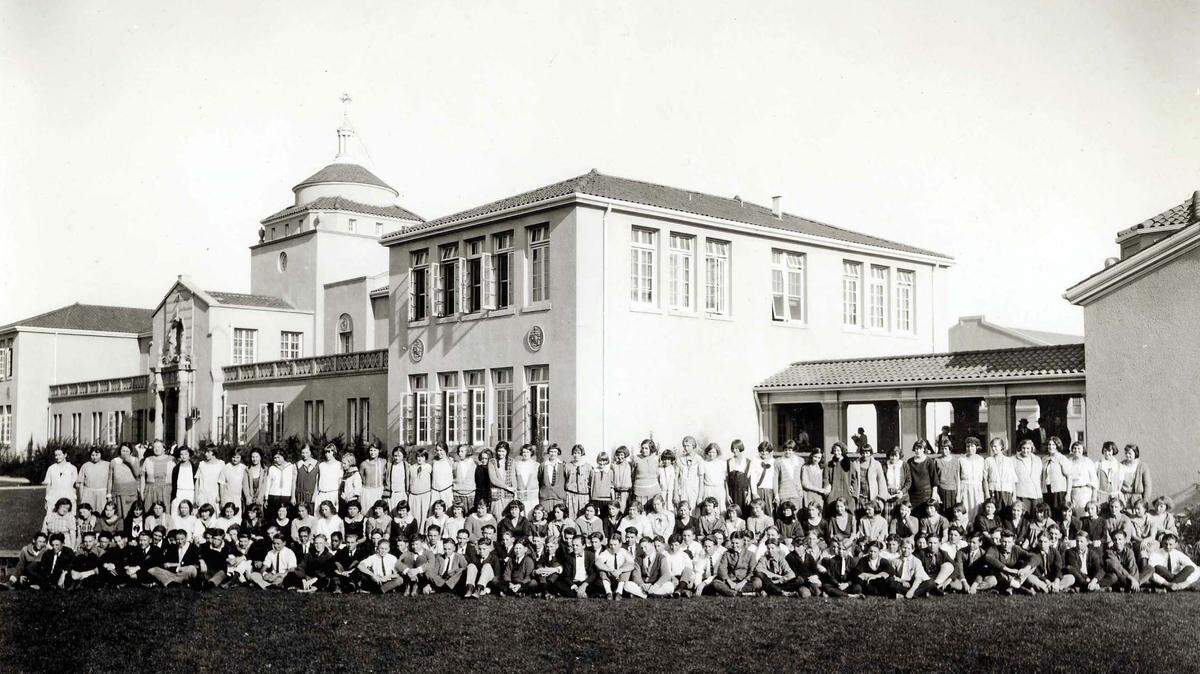
Many old-timers who went to Merced High School on G Street (also known as East Campus) have vivid memories of the beautiful campus, but they may not know the difficulties behind the building of the campus back in the day.
From inception in 1915 to dedication, it took five long years to erect this school. Its difficult beginning, for the most part, was attributed to the controversy regarding the site selection.
The original high school campus was on M Street between 21st and 22nd streets in the Courthouse Park. Built in 1897, it was the first high school in the county.
The Merced County Board of Supervisors commissioned architect Louis Stanwood Stone of Marysville to design the high school and oversee its construction.
The 13,182 square foot, three-story building in the Richardsonian Romanesque style was constructed by contractor John Miller.
In August 1915, Merced County High School reorganized into a union district school by legislative act and became Merced Union High School (later Merced High School).
The new high school district consisting of 37 elementary school districts elected its first board of trustees Aug. 28, whose top priority was to remedy the overcrowding at the current facility.
In June 1916, the trustees acquired 22 acres north of Bear Creek by G Grade (or G Street) for the new campus with the funds from the recently passed $150,000 high school bonds.
On Sept. 8, 1916 the trustees announced their acceptance of the plans drawn by Allison & Allison of Los Angeles for the new high school building proposed to be erected on the Bear Creek site.
According to plan, Alameda Street (or K Street) would be the main route to this remote new campus, and a bridge over Bear Creek would be built.
The site selection for Merced Union High School became a prolonged controversy since many opposed the Bear Creek site.
During one of the public meetings, mothers voiced their objections because they believed that it was too dangerous for their daughters to cross the Santa Fe Railroad track and the “tramp-infested” Bear Creek.
In addition, four other options were considered. One location suggested was the G Street site bounded by 18th, 20th, H, and G Streets.
Then, there was the three block site south of the Santa Fe Railroad reservation next to G Grade. President J. B. Olcese of the High School District Board of Trustees offered a free site on 11th Street between P and R streets.
The last recommendation was the expansion of the high school in the Courthouse Park by building on the land on M and N streets and 22nd and 23rd streets.
The Bear Creek site (outside city limits) backed by the School Board of Trustees and the G Street site (within city limits) backed by the Citizen Committee were the two leading contenders.
The Board of Trustees consisted of J. B. Olcese, T. W. Fowler, W. H. Robinson, G. H. Winton, and G. F. Morell. The Citizen Committee was represented by prominent Merced individuals including W. E. Landram, T. H. Scandrett, C. M. French, R. Barcroft, O. A. Baker, and M. D. Wood (Merced’s first mayor).
While the trustees paid $5,750 for the 22-acre Bear Creek site, they would have to pay three or four times that amount for the eight acres at the G Street site. However, the trustees failed to inform the public of the additional expenses to make the Bear Creek site functional and accessible such as utility hookups, street paving, and bridge building.
As the debate continued, the Superintendent of Schools called an election on Jan. 26, 1917 so the voters could decide whether to abandon the proposed Bear Creek site and buy the G Street site. The “yes” vote failed to obtain a two-thirds majority, and the selection of the Bear Creek site sustained.
The bitter fight over the school site, however, was not over. While the supporters publicly denounced the site that they opposed in the letters to the editor of the Merced Evening Sun, behind the scenes, the Citizen Committee worked diligently to change the school board trusteeship. On April 6, 1917, incumbents, T. W. Fowler and G. H. Winton, were voted out and replaced by J. F. Bedesen and W. S. Richey who advocated the G Street site.
In another attempt to reorganize the board, Trustee G. F. Morell was replaced by J. D. Wood, son of M. D. Wood. With the three necessary votes, the G Street site was chosen for the new high school building on October 6, 1917. Unfortunately, the site saga continued when W. A. Huffman filed an injunction suit against the trustees over the G Street site in January 1918 because Trustee Bedesen had a financial interest in one of the properties.
When the school board eventually settled on 17 acres in the Bradley Addition which was east of the G Street site between 18th and 20th Streets, the construction of the new school was further delayed by World War I and the 1918 flu pandemic. In September 1920, the Spanish Renaissance style school designed by Allison & Allison was finally ready for the students.
After serving Merced youth for 54 years, the main building and other structures on the campus were demolished in 1974 as they were deemed unsafe under the Field (earthquake) Act.
In a separate note, the Merced County Historical Society annual membership meeting on February 14 has been postponed to May. Please follow us on Facebook for updates on Museum programs and Society events.
This story was originally published January 31, 2021 at 5:00 AM.