
New 2022 calendar pays tribute to Merced County’s historic landmarks and sites
Editor’s Note: This is part one of a two-part series.
Merced will be celebrating its sesquicentennial anniversary in 2022. From a train town to the home of the first American research university of the 21st century, Merced is growing and developing while maintaining its historic charm.
Just look around you, history is everywhere, like the oldest church, the oldest fountain, and the oldest park. The Merced County Historical Society’s 2022 membership calendar pays tribute to Merced’s historic landmarks and organizations as it reaches a major milestone.
The story of Merced began with Bear Creek where a settlement was established before the town was laid out. The Bear Creek Settlement soon relocated to the new town site when Merced was established in 1872, and the creek served as the town’s northern limit.
Bear Creek was more than a physical boundary, it was also a popular recreational spot. Even before the American settlement, Native Americans lived, worked, and played along Bear Creek. Bear Creek is the oldest recreational spot in Merced.
In the membership calendar, January features the settlers rowing a little boat on Bear Creek between G and M streets on a nice sunny day in 1911.
When the railroad came through in 1872, Merced was built overnight with 17th Street as the main street and 16th Street as the front street. There were so many saloons along 16th Street, including the railroad company’s El Capitan Hotel bar, that the travelers who hopped off the train for a quick drink often missed their rides.
By the early 20th century, Merced had four railroads: Southern Pacific, SP Oakdale branch, Santa Fe, and Yosemite Valley.
The oldest railroad is the Southern Pacific RR (formerly known as Central Pacific RR) which was built in 1872, and its passenger depot in the early 20th century is the picture for February.
The railroad company originally wanted to make N and M streets Merced’s main business section. Because they asked for too much money for those lots, the frugal business owners decided instead to purchase cheaper properties on 17th and 16th streets.
This led to the development of Merced’s business district as we know it today. The calendar picture featured in March showcases the heart of downtown Merced at the intersection of 17th and L (or Canal) streets in which Cody’s Corner, O & G Building, Central Hotel, and Purington Building anchored the four corners.
Downtown Merced remains a charming historic district dotted with small local businesses.
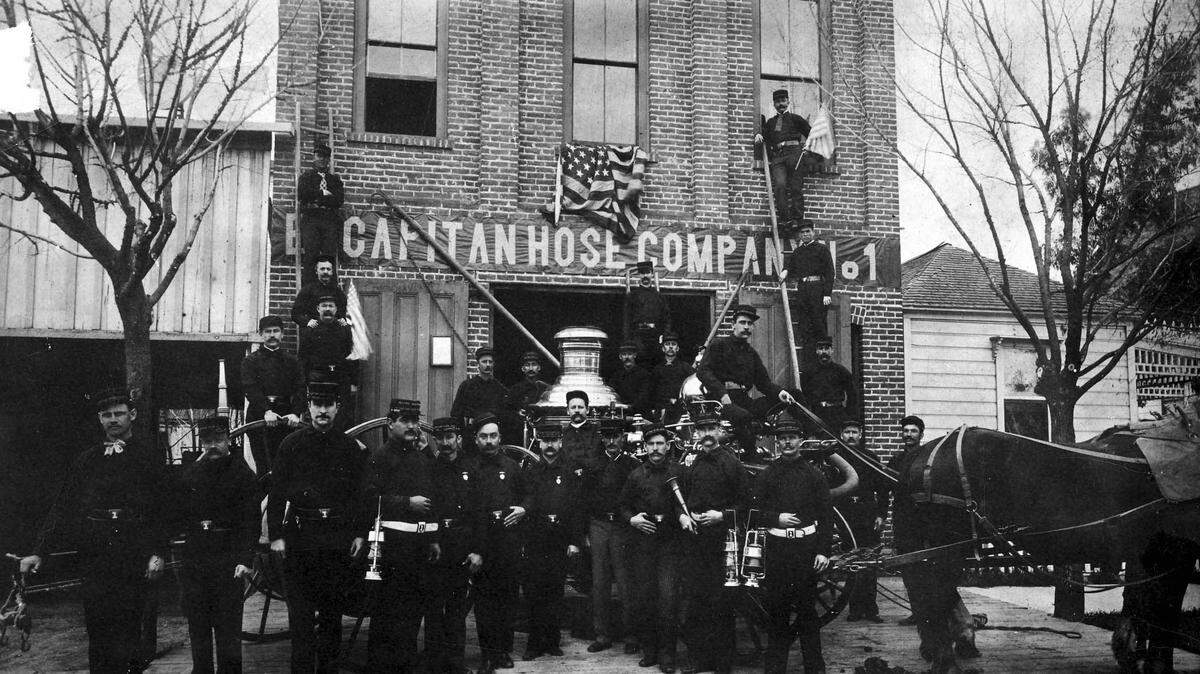
As a young community, Merced was often plagued by fire due to its wood-frame structures and lack of a firefighting system. A group of concerned citizens came together and organized Merced Engine Company No. 1 in 1873 which was renamed the Eureka Engine Company No. 1 in 1874, then the El Capitan Hose Company No. 1 in 1891.
When the Fire Department with paid staff was established in 1949, the El Capitan Hose Company No. 1 Volunteer Fire Department was incorporated into the department.
From a volunteer fire company to a modern fire and rescue organization, the Fire Department is the oldest municipal department in Merced, and the El Capitan Hose Company No. 1 is featured in the month of April in the Historical Society calendar.
The railroad company also had a hand in the making of Merced’s oldest park – the Courthouse Park. In February 1873, the Contract & Finance Company (the parent company of the Central Pacific Railroad Company) entered an agreement with the County of Merced to sell the county a tract of land between M and O streets and 20th and 22nd streets for one dollar. It was called the “Court House Square.”
The Courthouse, Jail, and other public buildings were to be erected in the square, and the remainder of the land should be used as a public park which “shall forever remain open to the full use and enjoyment of the people of said County of Merced,” according to the agreement.
The beautifully manicured Courthouse Park in the early 20th century is pictured in the month of May.
The month of June showcases the oldest building in downtown Merced. One would hardly imagine a large two-story landmark, occupying almost half of the block, was expanded from a small rectangular structure known as the Hunter Building.
Alexander Hunter, who had a blacksmith shop in the Bear Creek Settlement, relocated his business to 17th Street when the town was established. In 1878, a fire destroyed his wood-frame building; Hunter and his sons decided to erect a new brick building which was completed in 1879.
In 1893, Demetrio M. Bruschi of Coulterville purchased the building and renamed it Bruschi Building after an extensive renovation in which the second floor was remodeled into a hotel.
The Central Hotel opened its doors in 1900. Over the next century, this building would have gone through additional transformation but remains standing on the northeast corner of Main (or 17th) and Canal (or L) Streets.
Stay tuned for the second half of the story in my next column. You can receive a free 2022 calendar by becoming a member of the Merced County Historical Society today.
On a separate note, please join us for our 37th Annual Christmas Open House at the Courthouse Museum on December 5 from 1 to 4 p.m.
After skipping last year, the Christmas program has returned and will feature Central Presbyterian Church Handbell Choir, Harmony Valley Chorus, Sandra Stocking’s Flute Group, and Merced Baroque Sinfonia. The Open House is free to the public. For more information, please contact the Museum at (209) 723-2401.