
Sarah Lim: Historical Society Calendar celebrates Merced’s 150th anniversary
Editor’s Note: This is part two of a two-part series.
The first part of the Merced County Historical Society 2022 Calendar tells the story of the coming of the railroad and the founding of the town; the second part of the calendar focuses on the building of waterworks and the growth of the community.
By 1890, Merced had successfully transitioned from a railroad flag stop to the center of politics and commerce with a population of 2,009. One of the major developments in this era was the establishment of the first high school in the county. Merced County Union High School District was organized in 1895, and the first Merced high school building was completed in 1897 on M Street between 21st and 22nd Streets in the Courthouse Park.
After the high school moved to G Street in 1920, the old high school building housed various agencies through the years, including the County Library and California Highway Patrol. Depicting the last graduating class on the M Street location, the old high school is featured for the month of July in the Merced County Historical Society 2022 calendar.
Another major development during this period was the incorporation of Merced. If the coming of the railroad gave birth to Merced, then the building of the irrigation system marked its coming of age. The negotiation of a water contract with the Crocker-Huffman Land and Water Company was one of the reasons behind Merced’s incorporation in 1889.
The Crocker-Huffman Land and Water Company (formerly known as the Merced Canal and Irrigation Company) brought domestic water to Merced with the construction of Lake Yosemite. The company owned by Charles Crocker and Charles Henry Huffman purchased the water rights and infrastructure from the Farmers Canal Company in 1882 and built an extensive irrigation system to divert water from the Merced River to different parts of eastern Merced County.
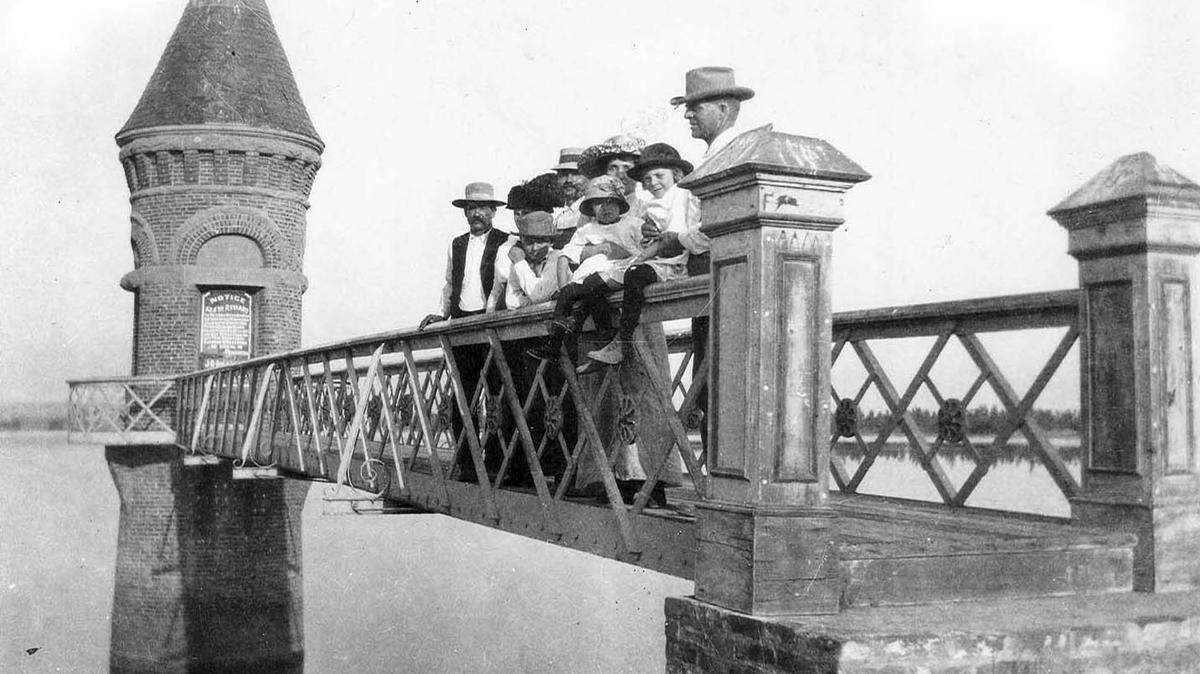
Lake Yosemite was integral to the development of the waterworks that Crocker and Huffman built. The 640-acre reservoir just northeast of Merced was completed in 1887 and dedicated in 1888. In 1889, the Crocker-Huffman Company started to deliver water to Merced via a cast iron pipeline. Lake Yosemite, the oldest man-made lake in Merced, is pictured for August in the Society calendar.
Charles Henry Huffman, the founder of Merced, was responsible not only for building Lake Yosemite, but also for giving Merced its nickname, “Fountain City.” In 1888, to honor his wife Laura, he had a fountain built in the public park next to El Capitan Hotel by the railroad.
Fountain City became the official nickname on March 10, 1888 when San Joaquin Valley Argus states, “Merced, when the improvements now being laid out are completed [sic] will be known by the cognomen of ‘Fountain City.’ An engineer is expected up this evening to survey and lay off the ground upon the reservation for a public park in the center of which will be a marble fountain with a base of granite……”
Laura Fountain has since been moved to its present location in Applegate Park. As the oldest fountain in Merced, Laura Fountain is shown for the month of September. Currently, the City of Merced and the Laura Fountain Restoration Committee are working collaboratively to raise money to return Laura Fountain to its former glory.
Water was so important to the development of Merced that L Street was renamed Canal Street. One of the historic buildings on Canal Street is the Independent Order of Odd Fellows Hall at the southeast corner of Canal and 18th Streets. The Merced I.O.O.F. (Lodge No. 208) was organized on September 12, 1872. For over three decades, the memberships introduced many resolutions to have a hall built but failed to get the required two-thirds vote until 1908.
The two-story brick building was completed in 1909 at a cost of approximately $25,000, including the cost for the lot and furnishings. One of the most important features of the lodge hall is the All-Seeing Eye in the center of the dome. The I.O.O.F. Hall, the oldest lodge building in town, is depicted for October in the Society calendar.
Just a block west of the Odd Fellows Hall is another historic building, Shaffer Building. Located at the northeast corner of 17th (or Main) and M Streets, Shaffer Building once housed an insurance company founded by Harold Stanley Shaffer and his nephew Hal Shaffer in 1912. In 1934, Shaffer Insurance was renamed as Fluetsch and Shaffer by Harold Stanley Shaffer’s son-in-law and new owner, John J. Fluetsch.
In 1966, the company became known as Fluetsch and Busby and was run by Peter Fluetsch, John’s son, and Ralph Busby, who joined the business in 1949. The office then moved to its current location at 725 W. 18th Street. Fluetsch and Busby Insurance, now led by the great-grandchildren of Harold Stanley Shaffer, is the oldest family-owned business in Merced and is featured for November in the Society calendar.
The month of December showcases the oldest church in Merced. The establishment of the Central Presbyterian Church marked an era of unification between two branches of the congregation in Merced: the First Presbyterian Church organized in 1873 and the Cumberland Presbyterian Church organized in 1876. The two churches became one in October 1912 and adopted the name of Central Presbyterian Church of Merced in February 1913. The new church at the southwest corner of Canal and 20th Streets was dedicated in 1917.
You can receive a free 2022 calendar by becoming a member of the Merced County Historical Society today. Additional calendars can be purchased in the Museum Gift Shop for $10. While you are at the Museum, don’t forget to check out our Christmas Tree exhibit. It is on display until December 30. For more information, please contact the Museum at (209) 723-2401.