
Heavy Valley fog can delay emergency responders
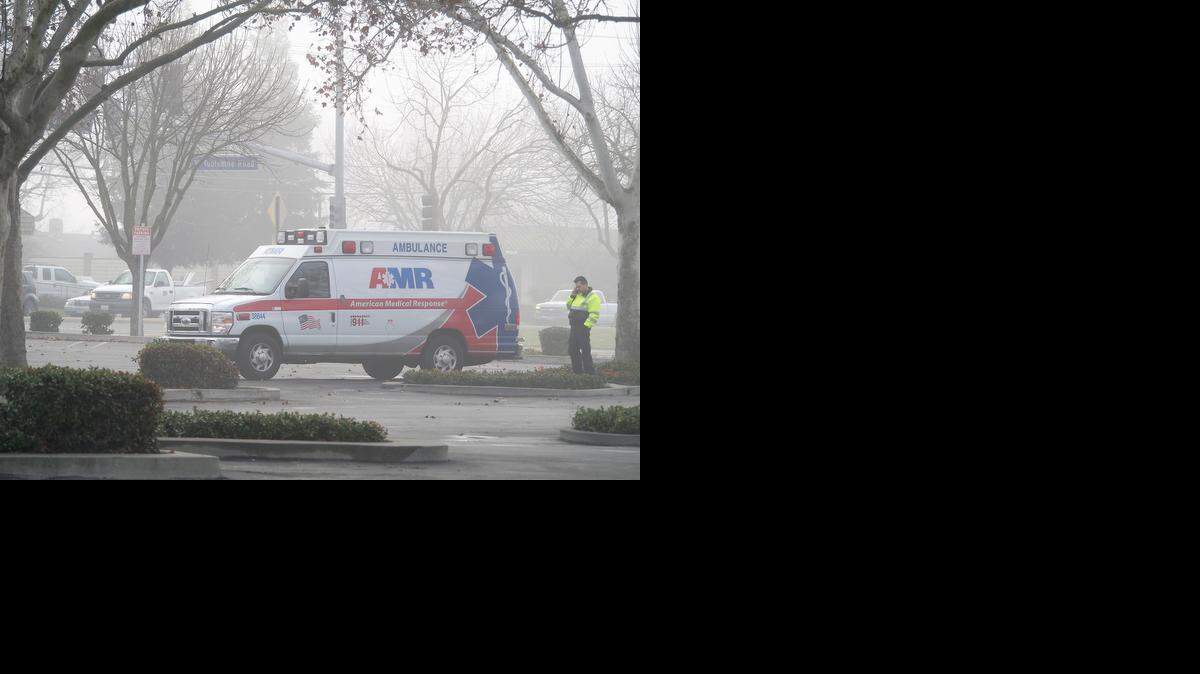
The same thick fog that makes the roads more dangerous also delays or prevents emergency responders from getting to accident scenes.
“Fog definitely slows down emergency responders, too, even when we’re driving Code 3 (lights and sirens going),” said Officer Eric Parsons, spokesman for the California Highway Patrol. “If the fog’s thick enough, we are going to have to slow down our response.”
The same holds true for local police and fire departments.
“The biggest thing is our response times are longer because we have to drive at slower speeds to ensure overall safety,” said Billy Alcorn, battalion chief with the Merced Fire Department.
The Fire Department also handles calls for medical emergencies. Alcorn said residents can help first-responders find the locations of emergencies in the thick morning fog.
“It never hurts for somebody to come outside and wave at us to let us know it’s the correct address. It can save time,” Alcorn said. “The fog has been much thicker in the morning, and it’s hard to read addresses. We want to ensure we don’t pass the house or an accident scene.”
Alcorn cautioned people to keep a safe distance from the street when they try to flag down first-responders. He also reminded motorists to slow down and stay a safe distance from the cars ahead.
Dense fog hampered the response of firefighters to a Monday morning fire in the Beachwood area that gutted 16 vacant mobile homes.
Flames were reported just after 8 a.m. at the mobile home area in the 3400 block of Beachwood Drive in Merced. Thirty firefighters responded to the blaze, which took about one hour to get under control. No injuries were reported.
“If the fog hadn’t been such a factor this morning (Monday), more people would’ve likely seen such a large fire and we likely would’ve received more reports sooner,” said California Department of Forestry and Fire Protection Battalion Chief Jeremy Rahn.
In general, Modesto Police Department spokeswoman Heather Graves said, while officers train to drive in all kinds of hazardous conditions, “we’re dealing with everybody else on the road who may not go slower or may not take precaution.”
Jessica Smart, spokeswoman for the Modesto Fire Department, agreed that the fog has slowed down response times in her agency. “We have to slow down and be more cautious, just like other motorists; this can cause slight delays in our emergency responses,” Smart said in an email.
The fog also can impact ambulance companies, but Riggs Ambulance Service Community Relations Manager Sonya Severo said the Merced-based crews are trained to drive in all types of weather conditions,
“At Riggs Ambulance Service, the safety for our crews, our patients and other motorists on the streets of Merced County is imperative,” Severo said in a statement. “We have trained our crews to show due regard at all times and continue to provide a high level of quality patient care in all weather conditions.”
In a Turlock crash, there was no indication the CHP was delayed in getting to the scene, but passers-by helped a driver from his car after it caught fire.
According to the CHP, the crash occurred at 7:15 a.m. on Fulkerth Road west of Faith Home Road near Turlock. Mikayla McSweeney, 21, of Turlock was driving a 2015 Lexus west on Fulkerth when she tried to pass a car ahead of her going in the same direction.
At the same time, Oscar De La Cruz, 39, of Turlock was driving a 1996 Plymouth east on Fulkerth. McSweeney pulled into the path of De La Cruz, and the cars collided.
The Plymouth caught fire; passers-by removed De La Cruz. He was taken by ambulance to Doctors Medical Center for treatment. McSweeney was not hurt in the crash.
At the time of the collision, the CHP said, visibility was reduced to 200 feet.
The fog kept a medical helicopter from responding to the scene.
“We have to have a set amount of visibility before we can take off or land,” said Bill Baker, regional business director for Mercy Air. The company operates medical helicopters in Merced and Modesto. “These aircraft are VFR – visual flight rules. We can’t fly through clouds or above clouds or over water.”
A decision on whether to fly comes from the pilot of the helicopter in conjunction with staff at an operational control center.
“They will look at the flight and make a determination,” Baker said. “It’s kind of a double-check system.”
The capricious nature of the tule fog so common in the Northern San Joaquin Valley each winter makes for conditions that can vary greatly by area.
“We could come in to work today and it’d be clear as day here, but all the flight requests are in an area it would be socked in,” Baker said. And those circumstances can change abruptly.
“It’s very sporadic, based upon what we’re seeing on the day or even on the hour,” Baker said.
Fog in rural locations such as the Turlock crash scene tends to be even denser than in town, and that creates more problems for first-responders.
Jason Sorrick, director of communications for American Medical Response, said ambulance drivers have to limit their use of emergency lights in dense fog “because it actually has a blinding effect on our crews.”
He suggested the people who call an ambulance to their home can flick their porch lights on and off as they hear the crew arrive, or stand in a safe spot outside and do the same thing with a flashlight pointed up or down.
“Obviously, we would not be able to see the light from a far distance, but it will help in avoiding having our crews pass your location,” he said. He also suggested callers provide as much accurate information to 911 as they can.
“Any identifying landmarks or other detailed information individuals can relay to emergency dispatchers can be helpful in finding their location,” Sorrick said.
Tricky conditions will remain for the immediate future, with the National Weather Service predicting dense fog in the night and morning hours throughout the Northern San Joaquin Valley through at least Thursday.
Despite the regular warnings from law enforcement, foggy days such as Tuesday still see more than a few drivers operating vehicles without lights on, or going too fast for conditions. So emergency responders have to take extra care.
“We have to make sure that we get there,” said Graves, “or we’re not going to be able to provide any help.”
Sun-Star staff writer Ramona Giwargis can be reached at
(209) 385-2477 or rgiwargis@
mercedsunstar.com.
This story was originally published January 13, 2015 at 8:50 PM with the headline "Heavy Valley fog can delay emergency responders."