
Make a deal on pay cuts or wait? California unions face a choice as budget deadline nears
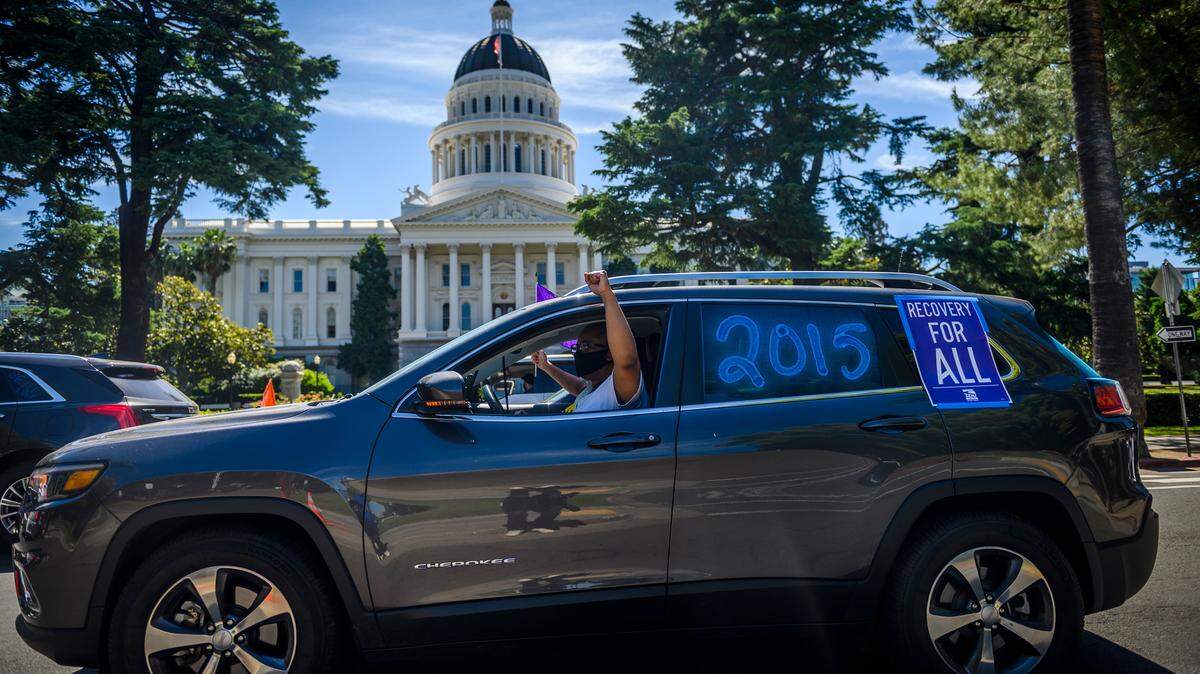
With a week left to reach a budget deal, Gov. Gavin Newsom and Democratic leaders in the Legislature stand on opposite sides of a $3.6 billion proposal to trim public employees’ wages.
Newsom plans to save the money by cutting state workers’ pay 10 percent and canceling raises scheduled for the next year. The Legislature isn’t counting on any wage savings in its plans to address a projected $54.3 billion deficit.
Caught in the middle are the workers. Their July pay could grow or shrink depending on what happens between lawmakers, the governor and their unions in the days remaining before a June 15 budget deadline.
Also in play is the state’s financial resiliency as it enters what is likely to be a prolonged period of uncertainty. Raises for workers would represent permanent new spending when lawmakers could soon be forced to find more ways to reduce expenses.
Newsom’s proposal, announced May 14, wasn’t pleasant for the state’s unions, but the table was set. His administration would attempt to bargain cuts with the unions, but if that failed, the Legislature would cut state worker pay unilaterally, likely by forcing workers to take two unpaid days off per month.
Senate leaders flipped the plan May 28, rejecting Newsom’s mandatory reductions. Assembly leaders followed suit last week. Legislators want the administration to keep negotiating with the unions over cuts, but their plan wouldn’t force any reductions and doesn’t presume any savings.
“What they’ve done has dramatically reduced (Newsom’s) leverage in negotiating with the unions,” said Michael Shires, an associate professor of public policy at the Pepperdine School of Public Policy.
Two paths
One of the proposals, or a combination of the two, is going to be included in the final budget.
The uncertainty leaves unions to weigh two different paths in negotiations scheduled for this week.
They can negotiate agreements that are better than Newsom’s two unpaid days off but would still involve some pain. Or they can wait and see what happens and risk getting stuck with the two days.
Yvonne Walker, president of SEIU Local 1000, has said the state’s largest union is continuing negotiations.
“As a union, our job is not to merely respond to the crisis in front of us,” Walker said in an emailed statement. “Our job is to act. Our job is to lead. We cannot sit back, wait, and hope for a positive outcome.”
Walker said the union, which represents about 100,000 public employees, made a counter-proposal of one day of unpaid leave combined with other changes. The proposal would suspend the contributions Local 1000 workers make to a retirement health care trust fund, which will reach 3.5 percent of their pay this year.
The union is also trying to keep some raises, while delaying others.
“If the Legislature’s version of the budget is successful, there will be no need for bargaining any mitigation efforts and our proposal reflects that potential outcome,” Walker added in the statement. “In the meantime, we are focused on dramatically reducing the impact of the proposed cuts by the state and protecting our members’ health, safety, and security as our ultimate goal.”
Steve Crouch, director of public employees for the International Union of Operating Engineers, is taking a different approach.
Crouch said the administration made his union the same offer of two unpaid leave days. He said he doesn’t plan to make a counter-offer until he sees where the Legislature and the governor’s differing proposals end up.
“I’m not going to offer any sacrifices if no sacrifices need to be made,” Crouch said.
Both the unions represent workers whom the administration has deemed essential to its coronavirus response in recent months, including nurses, prison workers, custodians and water and sewage plant operators.
The unions have been reminding lawmakers of those roles as they consider cutting their pay. Crouch says the workers he represents should be exempt from furloughs and pay cuts because of the critical services they’re providing. Some of his members have tested positive for coronavirus and at least one has died from it.
Budget uncertainty
The coronavirus pandemic, a murky economic picture and a shifting political landscape all contribute to the ongoing uncertainty, and the different proposals reflect different guesses on how bad the situation will get.
The biggest question for this year’s budget is whether the federal government will send California more relief money. Legislators are counting on $14 billion in federal money to help avoid reductions. Newsom’s plan assumes the money won’t come but includes “triggers” that will restore spending if it does, including for state workers’ pay.
Whether or not the money comes, lawmakers expect to revisit the budget again this year and in the years to come as the state’s financial picture becomes clearer.
“We accept that we are going to be having challenging fiscal times for a number of years,” Assembly Budget Chairman Phil Ting, D-San Francisco, told reporters last week.
Mike Genest, who was the state’s finance director under former Gov. Arnold Schwarzenegger, said the proposals from both Newsom and legislators depend heavily on what he called budget “gimmicks” such as borrowing and shifting money around.
An exception, he said, is Newsom’s proposal to cancel state workers’ raises. Canceling raises is an even more effective way to save money than furloughs or unpaid leave days, which end up costing the state in the long run, he said.
“Any cut or revenue that actually works and that doesn’t have to be paid back will really help the governor next year, and the year after, and many years after that,” he said.
Newsom said last week that the differences between his proposal and the Senate’s, including those related to state pay, are all part of the “give and take” of the budget process.
“We continue to have very robust and very, very positive conversations,” he said.
Genest said the Great Recession’s early budgets also depended on borrowing and other maneuvers.
“In the long run, you have to actually balance the budget. But when does the long run come? History has shown we can put off dealing with reality for a quite a while,” he said.
Steve Smith, a spokesman for the California Labor Federation, said the uncertainty is a good reason to avoid pay cuts that might prove unnecessary.
Smith said the economic impacts of a state worker pay cut should be considered.
“Things are shifting in the economy on a week by week basis,” Smith said. “The budget picture itself isn’t clear at this point, so taking drastic action at the moment probably isn’t the best idea for state workers or the economy.”
This story was originally published June 7, 2020 at 5:20 AM with the headline "Make a deal on pay cuts or wait? California unions face a choice as budget deadline nears."