
Paradise wildfire victims still in RVs get eviction pause, as many await settlement cash
For the last year, Randy Viehmeyer, his fiance, Lisa Butcher, and the cat they call Porch Kitty have been living in an RV in Paradise, waiting for settlement money so they can rebuild the home they lost to California’s deadliest wildfire.
Lately, living in their RV has brought them anxiety. They’ve watched with mounting worry as town leaders debated whether to start evicting at least some of the hundreds of people who’ve been staying in RVs on properties where homes were destroyed in the 2018 Camp Fire.
“We don’t want to leave our property,” Viehmeyer said. “We have everything we need. We have our vegetable garden, and we clean the neighbor’s yard. We keep the weeds down. And they want us to go away so the weeds grow back.”
On Tuesday, the Paradise Town Council appeared poised to give RV dwellers like Viehmeyer and Butcher two more years to continue living in their RVs while awaiting the funds to rebuild. At the same time, the town is likely to begin cracking down on RV campers who have been living on lots without permits, often without septic systems or trash-removal service.
“Nobody wants to live with raw sewage being dumped on the ground by their neighbor,” said Mayor Steve Crowder earlier in the day. “We’ve got some people who are just plain squatters and shouldn’t be there at all.”
The council on Tuesday night directed town staff to come up with a plan to extend for two years an emergency ordinance that allowed RVs to stay on their lots, so long as the owners have an emergency permit. A vote is expected next month.
Those who don’t have one or those who are violating the rules may get evicted.
Slow progress on rebuilding
It’s been nearly three years since the Camp Fire destroyed more than 10,000 homes in Paradise. Just under 1,000 have been rebuilt, but more than 300 families have been allowed to live temporarily in RVs on their properties as they prepare to rebuild.
Weighing heavily on the council’s decision Tuesday: hundreds of Paradise residents have been left in financial limbo by the painstaking nature of the PG&E Corp. bankruptcy. The utility, whose lines sparked the Camp Fire, agreed to pay $13.5 billion to compensate wildfire victims across Northern California for losses not covered by insurance.
But so far, the Fire Victim Trust — an independent entity set up to make those payments — has only verified $1.7 billion of the claims submitted by victims, and issued checks totaling $599 million. It’s unknown how much of that money has gone to Camp Fire victims.
Ordinarily, the town of Paradise only allowed RVs as permanent dwellings in designated RV parks, not residential lots.
But after the Camp Fire, which killed 85 people in the deadliest wildfire in California history, destroyed most of Paradise and scattered its population of 29,000, the Town Council passed an emergency ordinance that allowed those waiting to rebuild to live in travel trailers and RV campers on site.
Today about 6,100 people live in Paradise. The town says hundreds are living in RVs, thanks to the emergency ordinance. Extended twice, the ordinance was set to expire Sept. 30 for those who hadn’t demonstrated progress toward rebuilding.
Town officials say that as of this summer there were at least 288 properties that had special temporary permits allowing people to live in their RVs.
At the same time, officials said another 60 properties with RVs on them don’t have permits at all, and at least two dozen permits holders are violating the permit’s terms requiring RVs to be hooked up to septic systems, dispose of trash properly and follow other health and safety protocols.
In a report to the Town Council, officials said code enforcement officials issued 98 violations issued in July alone to RV occupiers, although it doesn’t say what the violations were.
The town has had to deal with a constant barrage of complaints that the RV lots are heaped with trash, they have too many RVs on site or the vehicles aren’t hooked up to sewage systems and other unsavory living conditions, officials said.
At the meeting, Vice Mayor Jody Jones said she supported extending the ordinance, but she said those who don’t have the proper permits or are violating their terms need “to be prosecuted to the fullest extent that we can, because, otherwise, we’re allowing our town to be simply a campground.”
Several residents living in RVs told the council that they’re stuck on massive waitlists to get building contractors. They lamented the lack of affordable building supplies. They described painful delays in getting permits and being denied government grants. Many said they didn’t have insurance or their insurance was so poor, they lacked the funds to rebuild.
Jennifer Christensen spoke through tears about the trauma she and her son endured on the day the Camp Fire burned through town. She urged the council not to evict them out of their RV and make them homeless again.
“If you kick us out, you know what that’s going to do that little boy all over again? He remembers every bit of that moment,” she said of their frantic evacuation three years earlier. “It’s really hard on us RVers and what we’ve gone through.
“I’m still waiting for a settlement, just like everybody else is,” she added. “I’ve applied for the grants. I’ve gotten rejected. So what am I supposed to do?”
Waiting for settlements
Town officials say almost all of those living in RVs haven’t yet shown progress on a rebuild — something the town council originally said they must do if they’re going to continue living in their trailers and campers, regardless of the status of their PG&E settlement.
Crowder, the mayor, told the audience Tuesday, he changed his mind about not factoring the PG&E settlement status into the emergency ordinance.
“There’s currently about 6,100 people living in Paradise,” he said. “Whether it’s in a house, or a trailer, or an apartment, it really doesn’t matter. All 6,100 of those people count. And we have to make a decision that is good for everybody. … There is not another city in California that allows what we’re doing right now, which is fine. They also haven’t been through what you have and what we have.”
Before the meeting, Viehmeyer, the man living in his RV with his fiance and cat, said anyone who is dumping raw sewage on their properties should be kicked out, but he said he doesn’t believe the problem is nearly as common as the town council says it is.
“I just think they are using that as an excuse,” he said.
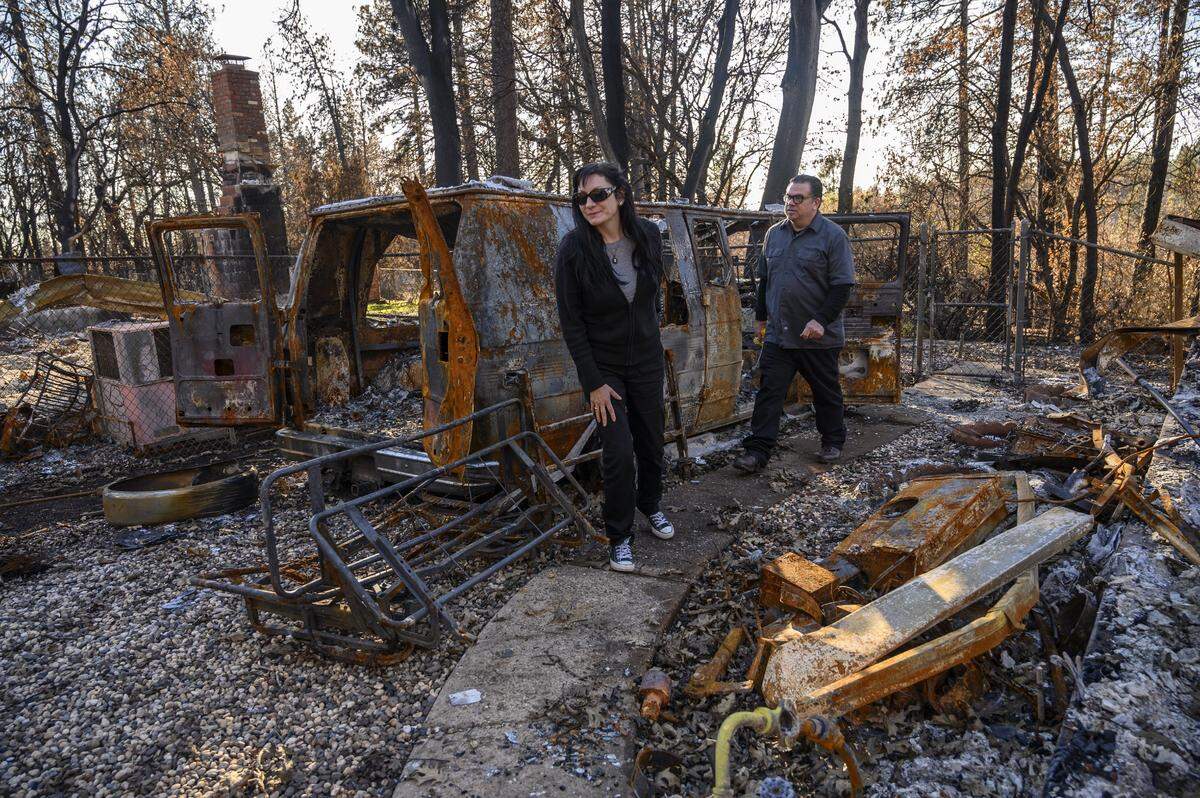
Viehmeyer, 56, is unemployed and is currently taking classes toward getting his heavy equipment operator license, with the goal of someday running a bulldozer for Cal Fire. Before the fire, he worked in IT and designed websites, he said.
Viehmeyer and his fiance, Butcher, were renting her mother’s property until the morning of Nov. 8, 2018, when the Camp Fire burned through the town. They stayed for months at a Red Cross shelter before eventually moving back to the property about a year ago in their RV.
Before moving to the lot, they got power restored and have running water along with their septic system.
They’ve acquired the land and have sought to rebuild, but Viehmeyer said it’s been a tedious process trying to get funds to put up a home.
“We’ve been going after grants, and then they say you don’t qualify, unless you make a certain amount of money, or it just goes on and on,” he said.
The couple hopes to have permits to begin building within the week, with the goal of getting into a new home within a couple of years, though that depends on how much — and when — they get their settlement, he said.
“We will rebuild,” he told the council Tuesday night. “Just not in two months.”
This story was originally published August 11, 2021 at 6:27 AM with the headline "Paradise wildfire victims still in RVs get eviction pause, as many await settlement cash."