
Stanislaus State awarded grant to prepare Latinos for science-savvy roles in agriculture
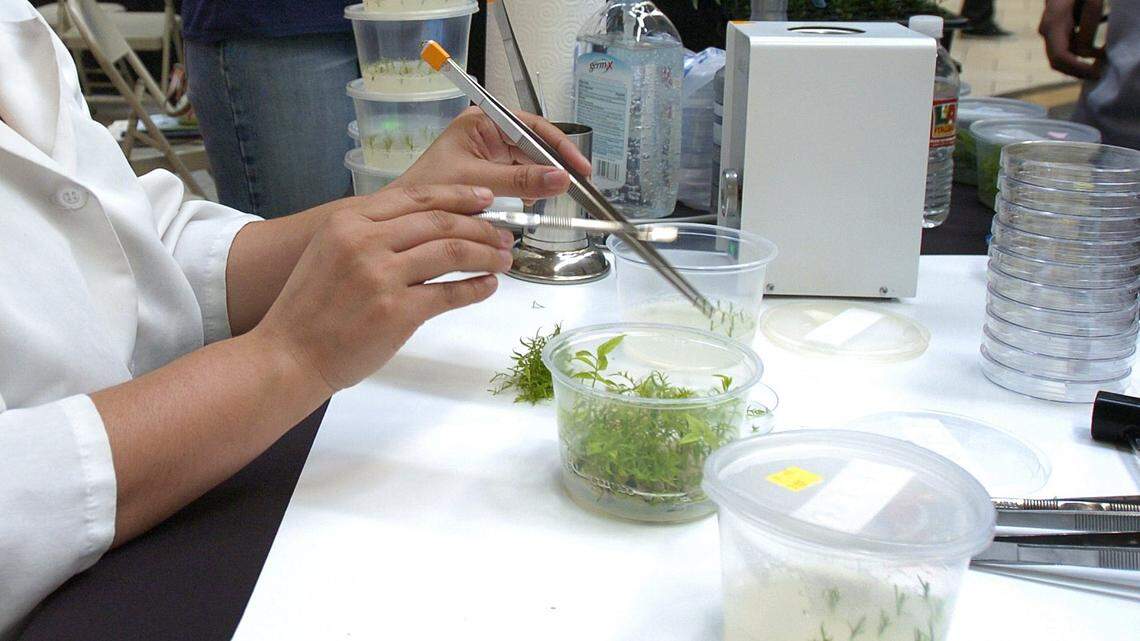
Latino students will get more opportunities to pursue tech-enriched, scientific careers in agriculture through the creation of a new concentration at Stanislaus State University.
Over $12 million will be invested across 25 Hispanic-serving colleges, including Stanislaus State. The Turlock school has been awarded $275,000 for its Career Ready-Ag Food and Safety (CRAFS) project, the U.S. Department of Agriculture (USDA) announced Friday.
The project’s overarching goal is to alter the stereotypical view of agriculture as the farmer on the tractor to a science-savvy agriculturalist who is comfortable both in the field and the lab.
To be called Hispanic-serving institutions, universities including Stanislaus State must have no less than a 25% Latino population and at least 50% low-income enrollees.
Funding is made possible through the National Institute of Food and Agriculture’s Hispanic-serving Institutions Education Grants Program, which advances student learning opportunities across the agricultural sector. The grant will be used to strengthen the institution’s ability to attract, retain and graduate underrepresented students pursuing careers in agriculture, natural resources and human sciences.
This comes in response to what the university has heard from industry leaders, said Emily Lawrence, director of the National Ag Science Center at Stanislaus State, in a news release. Critical to Stanislaus County, the agricultural industry contributes more than $7 billion locally, according to an annual county report.
But the industry faces increasingly scrutinized food processes, with the pandemic presenting additional challenges like labor shortages and traceability. Training is also lacking in the industry, but faculty over the past decade have engaged with critical segments of the industry to lay the foundation for the program, Lawrence said.
“This program will allow us to train students who will enter the workforce prepared for a career that plays a vital role in agriculture,” she said.
She added that normally, industry certifications are offered separately on Saturdays or in the evenings. However, certifications will be embedded into the curriculum so that students can finish college with the “whole package.”
The next workforce generation must be equipped to navigate the Food Safety Modernization Act, adapt to labor shortages and the effects of the pandemic on sourcing, production and shipping. The modernization act has significantly altered the way food safety is addressed.’
Stan State president Junn says program vital
A pathway for students to complete a bachelor of science with a concentration in food safety will be created and available through the CRAFS project for those majoring in biology, chemistry or agriculture. Tuition, books and other related expenses will also be covered for an undergraduate student through the education grant.
Organizers hope to attract students from underrepresented groups who may shy away from ag-based programs because of a lack of understanding about the breadth of career opportunities.
In a statement, Stanislaus State President Ellen Junn said this program will allow the university to increase its footprint in the agricultural industry.
“It will help us serve members of the next-generation workforce who may not have thought about food safety as a career,” she said. “We want to train them to move seamlessly from education into industry.”
An advisory committee made up of industry partners, faculty and administrators will be created to make sure that curriculum matches workforce needs and that industry partners are participating in career forums, mentoring and internship opportunities made available to students. No less than 50% of the advisory committee will consist of industry representatives.
The project will also be evaluated on its progress and effectiveness by three external evaluators selected by the committee.
Agriculture Secretary Tom Vilsack said in the news release that he and his organization recognized the value and contributions Hispanic-serving Institutions put forth. He added that the USDA is privileged to be partnering up with the institution, which ranked No. 55 in the nation for the number of bachelor’s degrees awarded to Hispanic students, according to the university.
“USDA has the great privilege of partnering with Hispanic-serving Institutions … to advance scientific research, develop future agricultural leaders and, we hope, cultivate the next generation of USDA employees,” Vilsack said.
This story was originally published October 14, 2021 at 5:00 AM with the headline "Stanislaus State awarded grant to prepare Latinos for science-savvy roles in agriculture."
