
Valley high schoolers given first-generation wisdom at Hispanic Education Conference
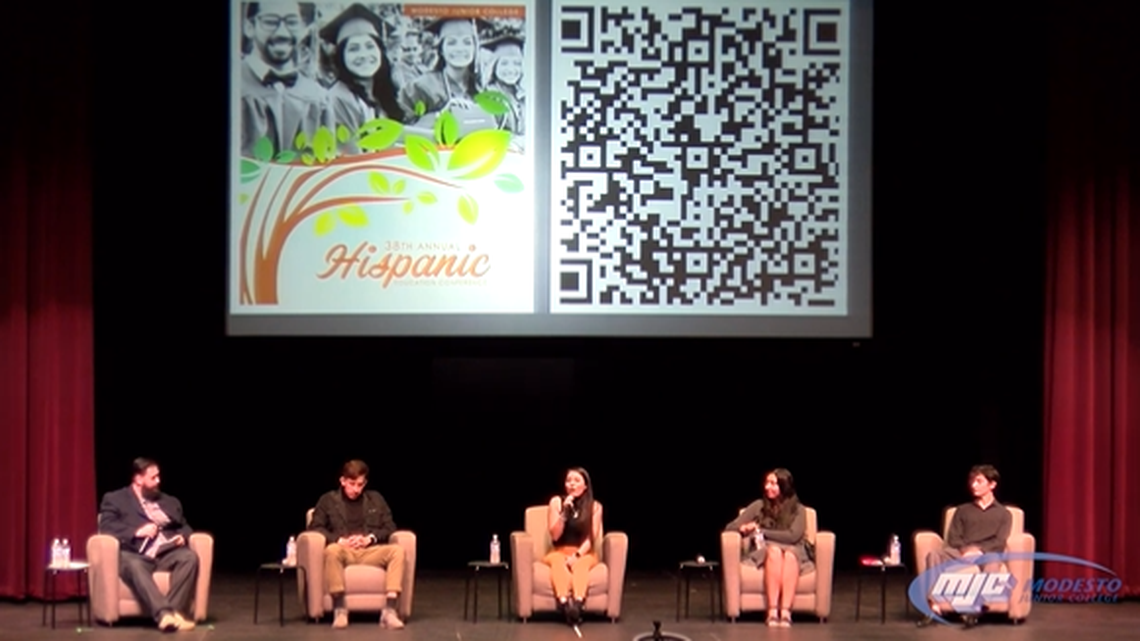
At Modesto Junior College’s 38th annual Hispanic Education Conference last week, one-time first-generation students spoke of learning to overcome obstacles in pursuit of higher education. Those challenges included being undocumented, having a learning disability, and parents who weren’t supportive or understanding.
The event — one of the longest-running education conferences in the state — was held in person and streamed online. It attracted high school students from across the region.
Juan Arroyo, an MJC alumnus and officer with the Turlock Police Department, shared his story to introduce the theme of the conference: “tus raices, tu voz, tu sueño,” Spanish for your roots, your voice, your dream.
Because his uncle was a California Highway Patrol officer, Arroyo said people often figured a law enforcement job was handed to him. They didn’t see his struggle to earn the uniform and badge
As a young boy, Arroyo dreamed of becoming a police officer. But in addition to learning English as a second language, he struggled with a learning disability his mother didn’t tell him about in hopes that the condition would not define him.
Immigrating from Michoacán, Mexico, as teens, his parents never attended college but pushed him to pursue higher education, Arroyo said. When the first-generation student stepped onto the MJC campus, he felt lost.
“I didn’t really know how to attend college,” said Arroyo, whose twin brother, Luis, is an officer with the Modesto Police Department.
When Arroyo sought guidance, he felt his counselor didn’t make time for him because of his previous low grades. He later found solace in the TRIO program, a federally funded service that provides guidance and financial literacy, which he says became his life line.
In 2013, he was sworn in as an officer with the Modesto Police Department and later graduated with his bachelor’s degree from California State University, Stanislaus. Though some agencies require officers to have only an associate’s or bachelor’s degree, Arroyo went on to earn a master’s from the University of San Diego.
Despite being badly injured when a drunk driver T-boned his patrol car during a pursuit in January 2018, when Arroyo still was with the Modesto police, he was able to get back to his dream career a year later. Today, he said he uses his voice to bridge communication and understanding between the Latino community and law enforcement.
“College isn’t going to be an easy thing to do, but it’s going to be worth it,” he said, urging attendees to think about how they will use their voices as they prepare to enter college.
MJC grads share lessons learned
Other MJC alumni also shared during the conference how they got through college as first-generation students.
Daniel Cornejo, a 2018 graduate, said that as an undocumented person, he thought he’d end up cutting grass as a gardener after completing high school. And after performing poorly for two semesters at MJC, he was embarrassed to say he had dreams of majoring in a STEM (science, technology, engineering, mathematics) field and going to a top college like UCLA.
He learned from instructors that college is what you make of it, so he adjusted his approach by challenging himself and stepping out of his comfort zone. Now he is a master’s student at UC San Francisco, majoring in chemistry.
“You’re the author of your story, so make sure to write a beautiful book,” he said.
When MJC alumna Cindy Barragan Lopez first started at at the college, she felt overwhelming anxiety and dealt with impostor syndrome. In addition to navigating college as a first-generation student, she contended with her mother not understanding her journey and why she couldn’t just get a real job.
Though she was stressed, she said it was a good kind of stress, where instead of worrying about bills, she worried about her studies. Getting through obstacles is what makes you grow, said the CSU East Bay psychology major.
“I’d rather stress about things that will help me grow and help me get myself out of this situation that I’m currently in,” she said. “Maybe I can inspire my nieces or nephews so they can say… ‘Why can’t I?’”
Money a barrier for Latino students
Ulises Ochoa, a student success specialist at MJC, told the audience there are students who lack the means to pay for college, as he did. He recalled sharing with his parents his desire to go to Sacramento State, and them responding that wouldn’t be possible because they couldn’t afford it.
“For a lot of us here, we wouldn’t have done it if it wasn’t for financial aid,” he said.
He added that those contemplating higher education should not fear the price tag because there’s always a way to pay.
Award presented to counselor
Also at the conference, the HEC Legacy Award was presented to MJC counselor Marcos Garcia.
Established in 2018, the award honors individuals and organizations whose commitment to the conference and students have made a lasting impact.
“Marcos is what makes our community so special,” MJC counselor Claudia Ramirez said during the event.
Garcia has worked as a counselor at the college for over 30 years, dedicating 20 of those years to organizing the HEC conferences. He said during his acceptance speech that the conference started as a dream after he saw the need to provide Hispanic students with opportunities to know more about college and various careers.
When the conference was first established in 1984, the Latino population at MJC was about 15%, Garcia said. Today, MJC is known as a Hispanic-serving institution with 54% of its students being Hispanic, according to the college.
“I’ll be leaving in a few years, so it’s time for other people to come here and continue this,” he said.
This story was originally published October 15, 2021 at 5:00 AM with the headline "Valley high schoolers given first-generation wisdom at Hispanic Education Conference."
