
Big expansion of train service to Central Valley, San Jose is delayed and already over budget
The start of new rail service connecting Sacramento with the Central Valley and San Jose is at least three years behind schedule and over budget, forcing officials to consider dropping some of the 16 new train stations that were part of the $1.3 billion-plus plan.
The vast project is part of a regional expansion of rail travel that would start in north Sacramento, head south and then split off in North Lathrop on separate lines toward Ceres or San Jose. It’s the largest buildout of rail service in California in more than two decades, part of an effort to get super-commuters and other travelers off the growing Central Valley’s congested freeways.
Four of the new stations scheduled to be built are in Sacramento, a fifth is in Elk Grove and a sixth in Lodi. The new midtown station will reintroduce passenger service to that section of Sacramento for the first time in more than 50 years. Other stations would pop up in Manteca, Ripon, Modesto and Merced.
“We may delay certain stations being constructed as we search for additional funds for the program,” said David Lipari, manager of marketing & outreach for the San Joaquin Joint Powers Authority and the San Joaquin Regional Rail Commission. The two groups are running the train expansion program.
The delays and cost overruns of the program will sound familiar to anyone following the plight of California’s high-speed rail project, which officials want to run between Merced and Bakersfield in its first phase. The new regional train expansion is designed to connect passengers with high-speed rail when, and if, it’s eventually built. Ultimately, the high speed is supposed to go between San Francisco and Los Angeles. Future lines after that could extend the system to Sacramento and San Diego.
Train passengers can already get from Sacramento to San Jose and the Central Valley via the Amtrak station downtown. But a second Sacramento-area line that does not connect with the existing downtown station will add more station choices and more trains.
The plan also includes the extension of ACE commuter train service to Sacramento for the first time. In addition, a new line for the ACE trains is scheduled to be built in the Central Valley. The line will go from North Lathrop to Ceres, and eventually to Merced.
It’s unclear which of the planned new Sacramento area stations or those in the Central Valley could be tossed out of the plan. But developers are moving forward with community meetings, including one last week in Sacramento, and designs for stations in Natomas north of Sacramento and midtown.
“We are not speculating on what stations will or will not be constructed,” Lipari said.
Back in 2018, the two transportation groups offered an optimistic projection that service would start from the new Sacramento stations by late 2021. The groups had just been approved for a $500.5 million state grant to build the Sacramento part of the project and stated the project would be fast-tracked. Construction was to start the next year.
Now, instead of 2021, the soonest service would start on the Sacramento part of the Valley Rail Plan is 2024.
Moving forward despite delays
Design reviews are beginning and construction is scheduled to start in 2023 on the new train station in midtown and the northern terminus of the rail line in North Natomas, said Alison MacLeod, a spokesman for the rail agencies running the project.
MacLeod didn’t offer timing on a start date in 2023 for the construction of the rail stations, but said building a station typically takes 12-18 months.
Lipari said the delay of the start of the new Sacramento train service is due to environmental reviews that took longer than expected as well as delays stemming from COVID-19.
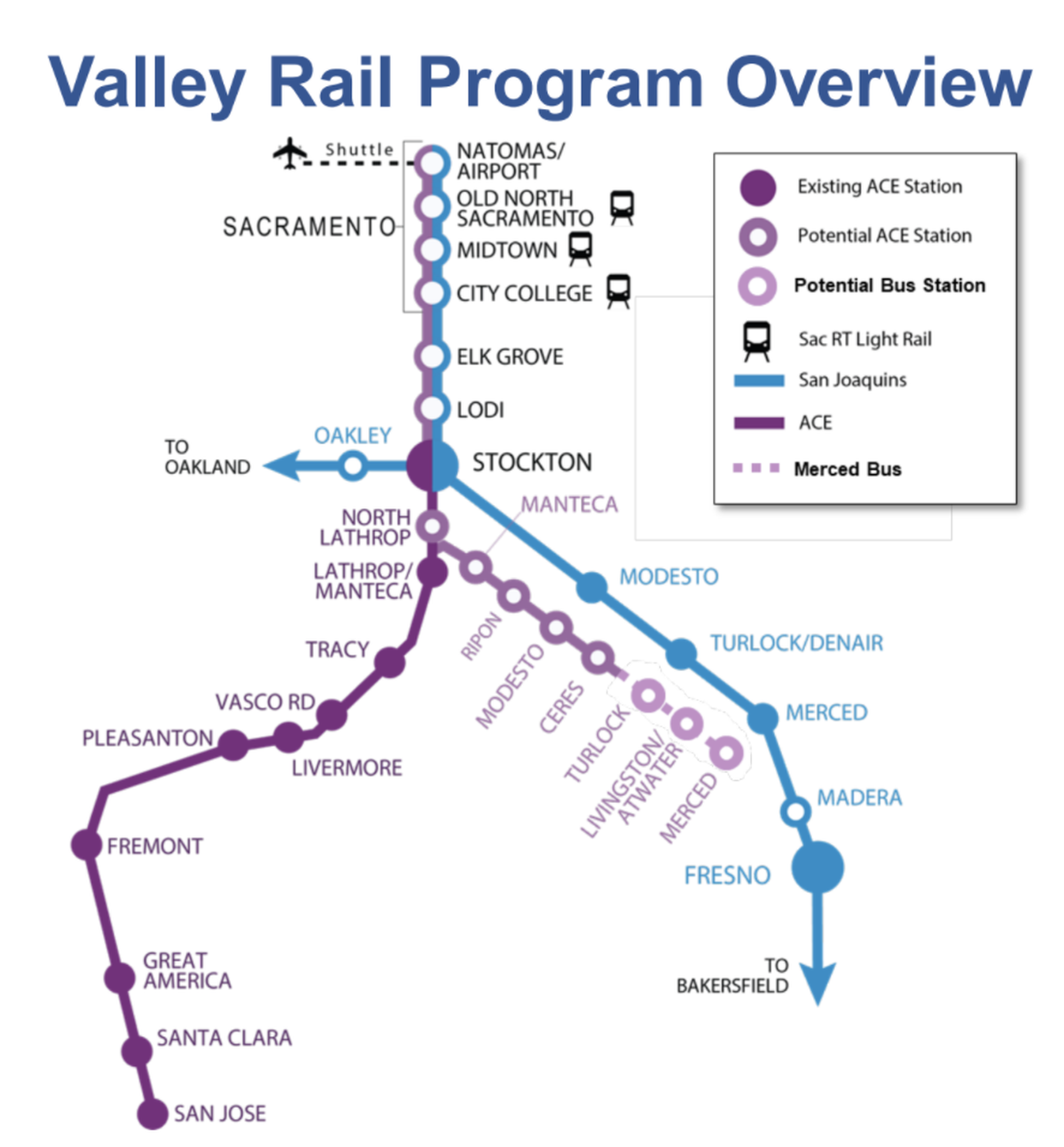
The southern end of the rail program appears to be progressing faster than the Sacramento terminus. MacLeod said trains are scheduled to be running from Ceres, a city of fewer than 50,000 residents in Stanislaus County, by late 2023.
The trains, however, won’t be able to go to Sacramento, without the capital area stations being open. MacLeod said initial service would be between Ceres and San Jose.
Staffing issues are also affecting the San Joaquin Regional Rail Commission, which will run most of the trains in the new rail program.
Documents from the commission’s Oct. 29 special meeting show that in June 2021, the Commission’s director of capital projects departed the agency for a job in the Bay Area. This left the agency without its top official to supervise more than 40 projects for the Valley Rail Program.
The agency then promoted the project’s senior planner to a new position of manager of capital projects who ended up leaving in September for another position in Sonoma County.
Regional Rail Commission officials say the train plan is moving forward despite the delays.
New stations throughout Sacramento region, Central Valley
The new stations are key to the project.
In addition to midtown and North Natomas, other stations are scheduled for construction in a neighborhood known as Old North Sacramento near Arden Way and Del Paso Boulevard, and at Sacramento City College. Trains will overnight at a planned maintenance yard at the North Natomas station
The site for the Elk Grove station is just north of Laguna Boulevard near Dwight Road. Originally, the Elk Grove station was scheduled to be located in South Sacramento, near Elk Grove. But environmental concerns from local residents about its closeness to the Sacramento Regional County Sanitation District helped change the location to a new site by a self-storage facility in Elk Grove proper.
MacLeod said the Elk Grove station is currently undergoing a mandated environmental review but didn’t comment when asked about the status of the stations in Old North Sacramento and by Sacramento City College.
Lipari said rising costs for construction material and supply chain problems stemming from COVID-19 are adding costs to the project, but he won’t specify by how much.
The two transit agencies had calculated the cost of the project in a report back in March 2020 but that report was based on 2017 estimates. An inflation factor was built into the calculations.
The estimates occurred before COVID-19 and the continuing supply chain shortages that have occurred since the pandemic began.
The report had calculated that it would cost more than $150 million to build the six new Sacramento stations.
Seven daily round-trip trains are scheduled to serve the new area stations when the rail plan goes into effect. A longer-term goal is to have trains as frequent as every half-hour.
Five of the initial trains would be commuter trains, part of Altamont Corridor Service, which do not currently serve Sacramento.
The northern end of the service would be in Natomas where passengers could board direct shuttle buses for an estimated 14-minute ride to Sacramento International Airport.
Passengers would also have the option to go to San Jose by ACE commuter train or a new line that would go from the new Sacramento stations to Ceres. Those trains are scheduled to eventually go to Merced.
A third option would be to travel on Amtrak San Joaquins trains. Two new San Joaquins trains will depart from the new Sacramento stations, one to Fresno, the other to the last stop in Bakersfield.
Union Pacific worried about freight operations
Originally, rail officials wanted to offer more trains from the Sacramento Valley Amtrak station at 4th and I street, where passengers can also board other Amtrak San Joaquins trains.
But Lipari said Union Pacific officials, who own the line, refused to allow more passenger trains because they were concerned that they would interfere with freight trains operations. He said UP officials agreed to let rail officials use the less-used Sacramento Subdivision to build the new stations and run trains.
Ultimately, part of the rail plan is aimed at a larger vision: provide the Sacramento passengers going south to Southern California with connections to high-speed rail in Merced.
But California High-Speed rail officials are billions of dollars short of completing an initial high-speed segment between Merced and Bakersfield. The legislature and the governor are also in conflict over funding — meaning it’s unclear if service will ever be finished.
Even if the high-speed service is built, a connection to Los Angeles is still years away. That means that train passengers would still end up taking a bus to Los Angeles from Bakersfield, the current practice when getting off the Amtrak trains.
The more immediate concern for rail officials is getting the new Sacramento service off the ground.
A state rail advocate said he’s not worried about the train service delay.
“They are moving at a steady pace,” said Steve Roberts, president of the Rail Passengers Association of California, noting that plans for key stations like midtown Sacramento and Natomas are moving forward.
He said it’s not unusual for construction projects to be behind schedule. Roberts said he was unaware the project had cost overruns.
“I thought they were fully funded,” he said.
Community appears to support new midtown station
Enthusiastic support was given by Sacramento residents for the new midtown train station at a virtual community meeting sponsored by the transit agencies on Oct. 27.
The midtown station will also bring rail trains back to the center of Sacramento for the first time since the early 1970s. The tracks through midtown once were a main passenger route through the state. The original California Zephyr train ran on the line for more than two decades until 1970.
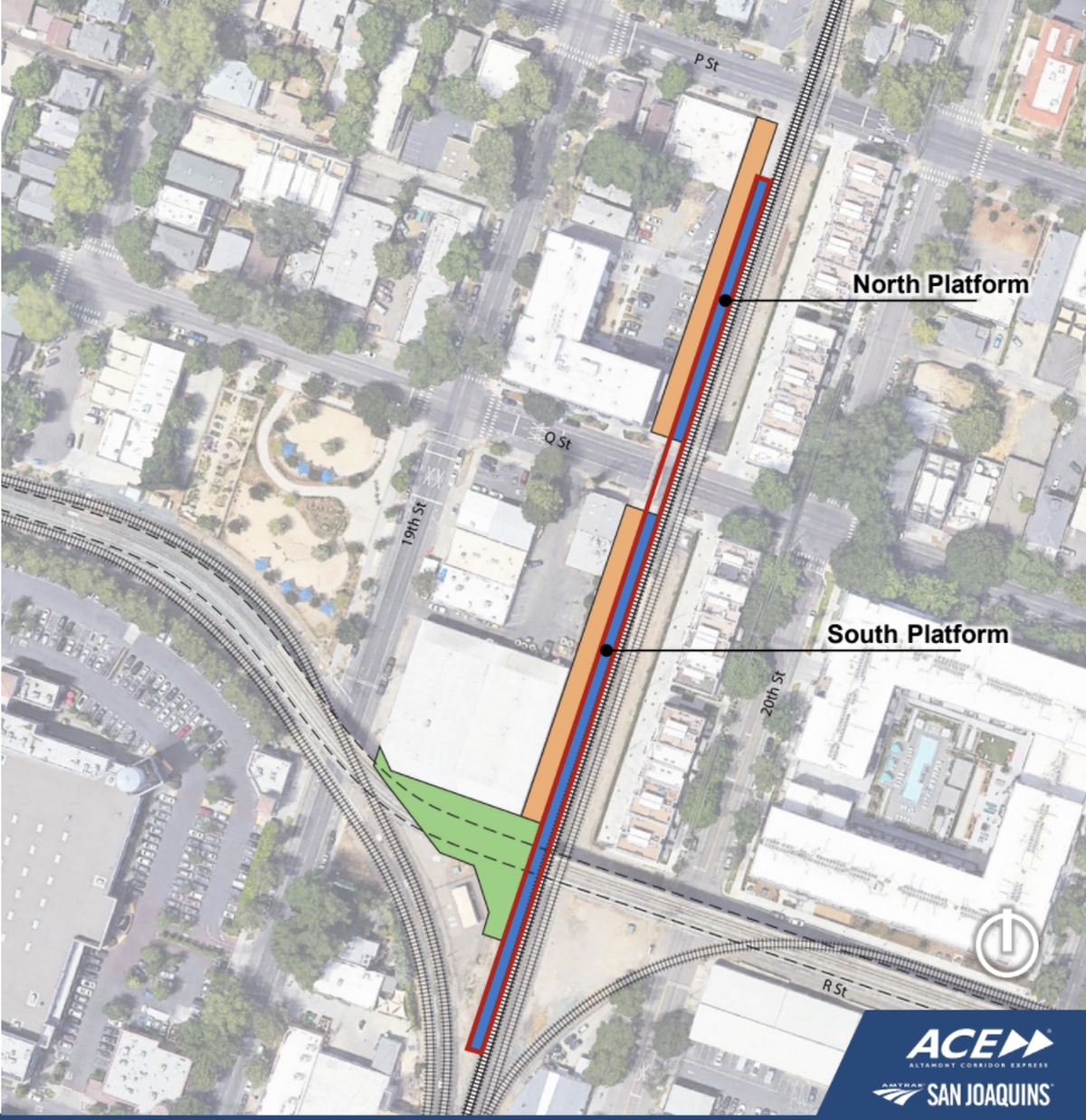
Rail officials have designed the new station on Q Street between 19th Street and 20th Street without a parking garage or lot. Instead, the emphasis will be on connection station bike trails and pedestrian access. Directional signs will point towards two light rail stations several blocks away. A pedestrian plaza will also be constructed and an area for food trucks.
The lack of parking spaces had been pushed by midtown community groups and city officials aiming to reduce traffic congestion and reduce pollution.
“This checks our boxes,” said Emily Baime Michaels, executive director of the Midtown Association.
Baime Michaels said the association has been advocating to reduce single-occupancy vehicle rides in the midtown area.
“This is an incredible opportunity to encourage people to go carless,” she said.
The city of Sacramento received $3 million in funding from the Joint Powers Authority for the new separated bikeways that will be built on 19 and 21 street, said Mary Lynne Vellinga, a spokesperson for the city.
“Having more train stations and more destinations will help Sacramento residents access jobs and economic opportunity, and it will help the city meet its greenhouse gas reduction targets by providing a viable alternative to cars,” she said.
This story was originally published November 2, 2021 at 5:00 AM with the headline "Big expansion of train service to Central Valley, San Jose is delayed and already over budget."