
Prison, probation, a missed warrant: Sacramento shooting suspects’ troubled route to K Street
Inside a rundown Phoenix motel room on the morning of July 18, 2016, Dandrae Martin twice used his hands to choke the mother of his child.
Because she refused to work as a prostitute, he also stepped on her neck, twice. He threatened to kill her before she ran from the room and a passerby called for help. During the assault, their 2-year-old son was asleep on the bed, and a 1-month-old tucked in a carrier.
After Phoenix police arrested him, Martin told investigators that he wanted to “forget about” the violence from that morning and move on, according to court records.
He also sketched a pattern depressingly familiar to anyone working in the criminal justice system: His father, he said, had a criminal record. The junior Martin had no positive role models in his life and, after dabbling with cocaine, marijuana, drinking and fighting as a teenager, he’d become affiliated with the Westside Crips gang in California. This wasn’t the first time he’d been charged in a domestic violence case — or the last.
“In regard to sentencing,” a probation officer wrote, “he believes unsupervised probation is appropriate and that jail will not help his situation because he has learned his lesson.”
A judge agreed. He was sentenced to four years’ probation for felony assault.
By that point, at age 21, Martin was well versed in the revolving door of an always overwhelmed criminal justice system. He had cycled in and out of jail in two states. Meanwhile, his older brother, Smiley Martin, had spent repeated stints in jail and prison, including in Sacramento and in Phoenix.
Now, the Martin brothers have been arrested in connection with the worst shooting incident in the region’s history. A hail of gunfire erupted in downtown Sacramento in the early morning hours of April 3, killing six and wounding 12.
Dandrae Martin, 26, has been booked into the Sacramento County Main Jail, a half mile from the shooting location, on charges of being a prohibited person with a firearm. Wounded in the shooting, Smiley Martin, 27, will be booked on charges of possession of a firearm by a prohibited person and possession of a machine gun, once he’s released from the hospital.
Police say the shooting was gang related and they believe at least five men fired guns, including the Martin brothers. On Tuesday they revealed the name of a third shooting suspect: Mtula Payton, 27, who was wanted on felony domestic violence and gun charges. His whereabouts were unknown late Tuesday.
What’s becoming increasingly clear is how the gun battle on K Street was made possible, at least in part, by a series of cracks in a fragmented justice system.
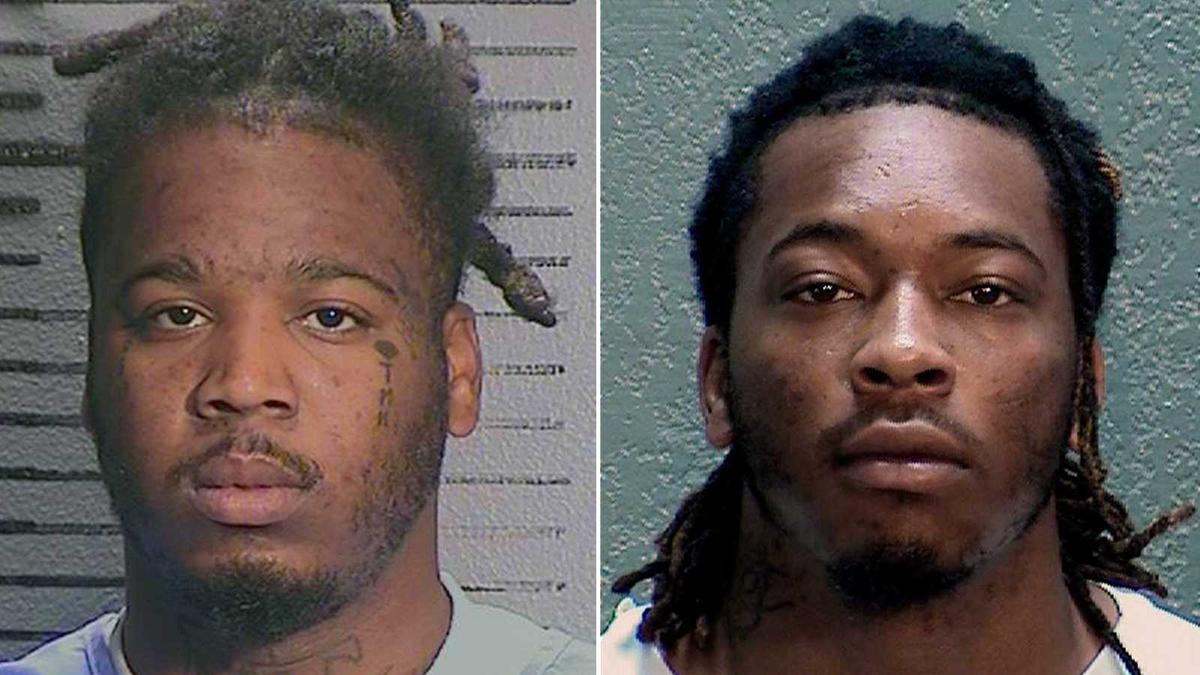
The Martin brothers stand as an example of how the local and state justice system struggles every day to address gun and gang violence. That effort is marred by a massive backlog in arrest warrants, meaning some wanted suspects evade law enforcement for years. And still, despite years of reforms and modest progress, a significant number of offenders leave California jails and prisons unrehabilitated and quickly relapse into a life of crime.
Smiley Martin in February was released from state prison in California after serving — including credit for time served in the county jail and for good behavior — a little more than five years of what was originally a 10-year sentence.
While Smiley Martin’s release from prison barely halfway through his sentence has become an early flashpoint among politicians since the downtown gunfight, that was merely the latest chapter in a nearly decade-long saga that took the Martin brothers from one jail cell to the next — as their lives bounced from Sacramento to Phoenix to a town on the Arizona-California border — before they landed on K Street in the fateful early-morning hours of April 3.
Sam Lewis wants the revolving door to stop.
The executive director of the Anti-Recidivism Coalition, a Los Angeles-based nonprofit that provides rehabilitative programs for incarcerated people, Lewis said the Sacramento melee and the suspects’ lengthy records show there’s a crying need for better rehabilitation programs inside prisons — and more intensive programs after they’re released.
Lewis, who was released from prison in 2012 after serving 24 years, didn’t excuse the suspects’ behavior. But he said policymakers have to figure out what failed while they were locked up and how to make sure it doesn’t happen again.
“If this person did multiple prison stints, where did we fail? Because it’s called the Department of Corrections, meaning to correct the behavior,” Lewis said. “But in order to do that, you also have to have robust programming in all of the institutions. We’re getting there. We’re not there yet. But we definitely need that.
“But my question becomes, where did we go wrong systemically?”
Trouble followed Martin to Phoenix
By the time he was arrested in Phoenix, Dandrae Martin was a wanted man in California.
Riverside County court records show that Martin served a 30-day jail term in late 2014 after being arrested in Blythe, a small desert city on the Arizona border, for beating the same woman he would assault two years later in Phoenix.
Originally charged with a felony, he pleaded guilty to a misdemeanor count of inflicting “corporal injury.”
A judge sentenced him to probation for three years and ordered him to surrender any firearms. During a court appearance, he said he had no weapons to give up anyway. Under the terms of his probation, he was required to perform 25 hours of community service and enroll in a year-long domestic violence prevention program.
He also was named in a criminal protective order, telling him to keep his distance from the 17-year-old woman. “Defendant must not harass, strike, threaten, assault (sexually or otherwise), follow, stalk, molest,” the order read.
A year later, he hadn’t done any community service or taken part in the domestic violence program. A Superior Court judge revoked his probation and issued a bench warrant for his arrest Oct 6, 2015. After he was arrested in Phoenix a year later, in the incident at the Travel Inn, a pre-sentence report didn’t make any mention of the Riverside case or bench warrant. Martin “does not have any known prior convictions,” the report said.
“Why those dots weren’t connected is a mystery to me,” said John McGinness, a former Sacramento County sheriff.
The Maricopa County probation department did not return a request for comment for this story.
That warrant was still outstanding when Martin was arrested April 4 for his alleged involvement in the Sacramento shooting, some six-and-a-half years later.
The warrant was likely fed into CLETS, the California Law Enforcement Telecommunications System. But it was for a misdemeanor — the offense to which Martin had pleaded guilty — and carried a bail amount of only $5,000. That would have been hardly enough to attract much attention among law enforcement agencies.
“They’re not going to be on the lookout,” McGinness said. “There are just hundreds of thousands of warrants.”
Even for serious cases, warrants tend to stack up. In California, about 40,000 felony cases are filed every three months, and roughly a third of those result in warrants being issued when a suspect fails to appear in court, according to data from the Judicial Branch of California.
The problem isn’t unique to California. The Columbus Dispatch and GateHouse Media in 2018 found more than 5.7 million cases in 27 states with open arrest warrants. The true tally could be double that when factoring in all 50 states, a staggering figure that highlights how common it is for warrants to go unserved for years.
Martin’s case — a warrant on a misdemeanor — would easily fall through the cracks.
McGinness said the warrant would have popped up if, say, Martin were pulled over for a traffic violation or some other encounter with law enforcement. Riverside County authorities would have been notified.
But given the nature of the original offense, it’s possible they wouldn’t have bothered retrieving Martin.
Sgt. Ed Soto, a spokesman for the Riverside County Sheriff’s Department, said the department probably would allow the suspect to be released on a “written promise to appear” in court in Riverside.
“It’s highly unlikely we would send a unit out … to go pick up that subject,” he said.
Criminal record began as a Sacramento teen
Smiley Allen Martin’s journey through the criminal justice system started early. Sacramento County Superior Court records say he was convicted of first degree burglary in July 2011, just a few days after his 17th birthday.
Martin would have still been considered a juvenile at 17, and the file is sealed and details of the case aren’t publicly available. In any event, he was in trouble again 18 months later, charged with firearm possession in violation of the probation terms from the earlier case, the first of a half-dozen more convictions he’d soon rack up.
According to a letter county prosecutors sent to state parole officials years later, the weapon was an assault rifle that he had concealed in his waistband, along with two fully-loaded 25-round magazines. Martin “admitted to transporting the assault weapon and large capacity magazines to potential buyers,” the letter said.
Court records show he was sentenced to 30 days in jail and placed back on probation.
Then, in May 2013, he was picked up by police in Arizona for marijuana possession. He pleaded guilty to the misdemeanor, according to court records, and was to be sent back to California. It’s unclear in the court records how much time he spent in custody.
His next arrest came in Sacramento, the Monday before Thanksgiving 2013, when he was charged with a felony count of second-degree robbery.
Sacramento County prosecutors said Martin and three other men stormed into the electronics department of a suburban Walmart, shoved aside a clerk and fled with some notebook computers. Days later, surveillance cameras revealed Martin stealing additional electronics gear from area Walmarts and Targets during the Black Friday weekend sales. He pleaded guilty and was sentenced to two years in prison.
Two more arrests followed — a stolen vehicle charge in early 2016 and a case 11 months later in which he gave a fake name and tried to run away after officers pulled him over in a vehicle. It wasn’t clear from court records what happened with the stolen car case. In the second case, he was sentenced to 60 days in jail.
As his record grew, Sacramento County prosecutors began to regard him as a career criminal. In a letter last spring to state parole officials, they said Martin “has no respect for others, for law enforcement or for the law.”
California voters liberalized prison terms
Jerry Brown had seen the light.
During his first stint as governor, in the 1970s, he signed legislation mandating lengthy sentences for many crimes.
But by the time he became governor again, in 2011, he was under almost immediate pressure to scale back California’s inmate rolls to reduce chronic overcrowding. Just a few months after his inauguration, the U.S. Supreme Court ruled 5-4 that California had to reduce its prison population by more than 30%, or around 30,000 inmates.
Conditions, the high court wrote, constituted cruel and unusual punishment.
“The violations have persisted for years,” Justice Anthony Kennedy, a Sacramento native, wrote for the majority. “They remain uncorrected.”
Brown was already onboard with the idea of reducing overcrowding. He had already signed into law “Public Safety Realignment” that diverted non-serious, nonviolent offenders from state prisons into county jails or released them on probation.
In 2014 voters approved Proposition 47, which downgraded certain theft and drug offenses to misdemeanors, and allowed those serving felony sentences for those crimes to petition the courts for lighter sentences.
Two years later, Brown came up with another idea to free up space in prisons. He proposed a ballot initiative that would amend the California Constitution and give prisoners expanded credits for good behavior and “approved rehabilitative or educational achievements.” The result would give inmates a shot at getting out sooner.
Brown acknowledged that he’d come 180 degrees on prison sentences.
“All of us learn. I’ve learned in 40 years. I think prisoners can learn,” he said in an interview with The Bee as the proposal, packaged as Proposition 57, was being placed on the ballot. The initiative “orients the prison toward rehabilitation, and I think that’s a good thing.”
Proposition 57 passed overwhelmingly, on Nov. 8, 2016.
A few months later, Smiley Martin was arrested again.
In and out of California prison, again
On May 3, 2017, according to county prosecutors, Smiley Martin forced his way into his girlfriend’s home.
“He located her hiding in her bedroom closet and hit her repeatedly with a closed fist on the face, head, and body, causing visible injuries,” they wrote. “He then dragged her out of the home by her hair to an awaiting car. After he put her in the car, he assaulted her with a belt.” Investigators discovered that — like his brother a year earlier in Phoenix — he was trying to turn her to prostitution.
Smiley Martin was charged with three felonies. He pleaded guilty to two counts and on Jan. 12, 2018, was sentenced to 10 years in prison — far and away the stiffest sentence either of the Martin brothers had ever received.
In the days before he was transferred from jail to prison, Smiley Martin said he was attacked by rival gang members inside the downtown Sacramento jail. In a federal civil rights lawsuit, Martin claimed that a Sheriff’s Office deputy violated protocol when he let the rival factions mix during breakfast time.
Members of the Bloods gang threw hot water on Martin, and he wound up with a busted lip and swollen eye from the scuffle. Jail employees never checked on his injuries, according to the lawsuit, and the deputy threatened him with further violence if he filed a grievance.
“I was threatened to not push it to the next level,” Martin wrote in the lawsuit.
The lawsuit slowly progressed for four years until last month when Martin’s attorneys struck a $7,500 settlement with Sacramento County.
“The county’s decision to settle was purely an economic decision,” Kim Nava, a Sacramento County spokeswoman, wrote in an email to The Bee. She said delays on the court calendar stood to drag the process out even longer. “A decision was made to put an end to the case as the costs going forward would multiply.”
Nava said the county had not yet mailed the check to Smiley’s attorney.
Meanwhile, back in Phoenix, Dandrae’s anger boiled over again in the summer of 2018, this time during an argument with his mom about cleaning their apartment and a Social Security card, according to court records. He pushed the woman repeatedly and threw her on the floor. When she managed to get him out of the apartment, he hurled rocks through the window, smashing a glass table and the television.
Officers soon found him with marijuana and in violation of his probation from the earlier assault. A judge was less lenient and on April 12, 2019 sentenced him to two and a half years in prison in Winslow, Arizona.
He got out in November 2020.
Before long, the brothers would reconnect on the streets of Sacramento.
Politics and confusion over prison release
In the spring of 2021, Smiley Martin had a shot at being released. As COVID-19 cut a sickening and deadly path through the still-crowded prison system, the state was preparing in the spring of 2021 to potentially speed up the release of as many as 76,000 incarcerated people.
Because voters approved an expanded system of credits for good behavior through Proposition 57, offenders could become eligible for release earlier.
Sacramento prosecutors urged prison officials to keep Smiley Martin in prison. “Inmate Martin’s criminal conduct is violent and lengthy,” Deputy District Attorney Danielle Abildgaard, who prosecuted the case that landed Martin behind bars, wrote in a two-page letter to the state Board of Parole Hearings on April 29, 2021.
“If he is released early, he will continue to break the law,” she added, cataloging Martin’s years in and out of the criminal justice system. The Bee obtained the letter through a Public Records Act request.
Abildgaard’s letter came as her boss, District Attorney Anne Marie Schubert, who is now running for California Attorney General, prepared to lead 43 other DAs in a lawsuit challenging the Department of Corrections and Rehabilitation’s handling of Proposition 57.
Their lawsuit, filed in Sacramento Superior Court a month later, accused the department of improperly rushing to implement the details of Proposition 57 “without an opportunity for the public, including victims and their families, to be heard.” The lawsuit warned that 76,000 inmates could have their prison terms shortened, including those sentenced for “violent and serious offenses.”
The lawsuit is still pending. Dana Simas, a spokeswoman for CDCR, said she had no data on how many of those inmates were released.
Martin was denied parole last May, according to Simas.
But in February of this year, he’d earned enough credits to be released and placed on probation in Sacramento County. He’d been sentenced to 10 years. But he got out after a little more than five years, including 508 days of credits earned while in the county jail while his case was pending.
In California and elsewhere, it’s common for offenders to serve only about half their term inside a prison, depending on how the state factors in things such as good-time credits.
California prison officials dispute the idea that he benefited from an “early release.” Rather, they say Martin completed his term as defined by the law — and say the expanded credit system creates incentives for good behavior.
“Increasing the amount of credits provides a compelling reason for individuals to positively program, as the credits may also be forfeited due to disciplinary action,” Simas said.
Vicky Waters, another spokeswoman for the corrections department, wouldn’t release any information on what Martin did in prison to earn his credits. “In general, incarcerated people who are not death-sentenced or sentenced to life-without-parole are eligible to receive credits for good behavior and program participation,” she said.
She also wouldn’t divulge where Martin served his term.
Nonetheless, conservatives have seized on Martin’s release in the days following the Sacramento shooting. Assembly Republicans sent Gov. Gavin Newsom a letter Wednesday urging a halt to the CDCR. “Accelerating the early release of inmates jeopardizes public safety,” wrote Assembly Republican Leader James Gallagher.
Some experts on gang violence and criminal justice fear that the K Street shooting will tilt the pendulum too far toward stiffer sentences.
“I hope this doesn’t become the sort of lightning rod that is used to paint too broad a brush,” said Pete Simi, a sociologist at Chapman University in Orange County who’s studied gangs, extremism and violence.
Even if some of the suspects in this case have lengthy rap sheets, Simi said the system should be careful not to “over-incarcerate people who are not violent offenders.”
While recidivism rates remain stubbornly high — roughly half of people released from prison get another conviction within three years — there have been modest improvements in recent years, researchers have found. Despite an increase in spending on in-custody programming, auditors have said the state should be doing much more.
Ping-ponging around different counties, with different justice systems, for an array of drug, domestic violence and other offenses is a textbook example of the criminal justice system’s “revolving door,” said Ernest Uwazie, professor and chair of the division of criminal justice at California State University, Sacramento.
That the suspects in Sunday’s shooting had long rap sheets in multiple courts is less a sign of a broken system, Uwazie said, and more a testament to a fragmented system working the way it was designed. He said that’s why the renewed focus should be on in-custody programming and offender rehabilitation.
“No matter what we do in California, for example, they will come out, most likely,” Uwazie said, referring to the majority of people in prison. “The question is, when they come out, are they going to be worse off.”
Trouble brews on streets of Sacramento
Smiley Martin was weeks removed from his latest stint in prison, hanging out on an Old North Sacramento street with his brother Dandrae and some other people.
It was hours before the shooting started on K Street, and the scene was boisterous if not downright ominous. In a video Smiley posted on Facebook, he was seen waving a gun in the direction of the camera — his lengthy rap sheet prohibited him from having a gun. The video has been deleted on Facebook but survives on YouTube.
There was talk about going to a nightclub, although Smiley said he couldn’t go inside because he didn’t have an ID card.
A police cruiser passed by about 9:45 p.m. An officer asked on his vehicle’s loudspeaker if anyone had seen two kids who’d been reported missing nearby. Several people shouted back, “No!”
“Alright, thank you,” the officer replied.
“You’re welcome,” one of the people behind Smiley Martin shouted back. “Have a good night.”
A few moments later, Martin pointed to the camera and introduced Dandrae.
“My little brother right here,” he said.
A police car drove by again.
“They can’t f--- with us,” Smiley said.
The officer drove away.
This story was originally published April 13, 2022 at 5:00 AM with the headline "Prison, probation, a missed warrant: Sacramento shooting suspects’ troubled route to K Street."
CORRECTION: Due to an editing error, John McGinness’ name was misspelled in a previous version of this story.