
Will my grocery store close? Here’s what a Kroger-Albertsons merger could mean for California
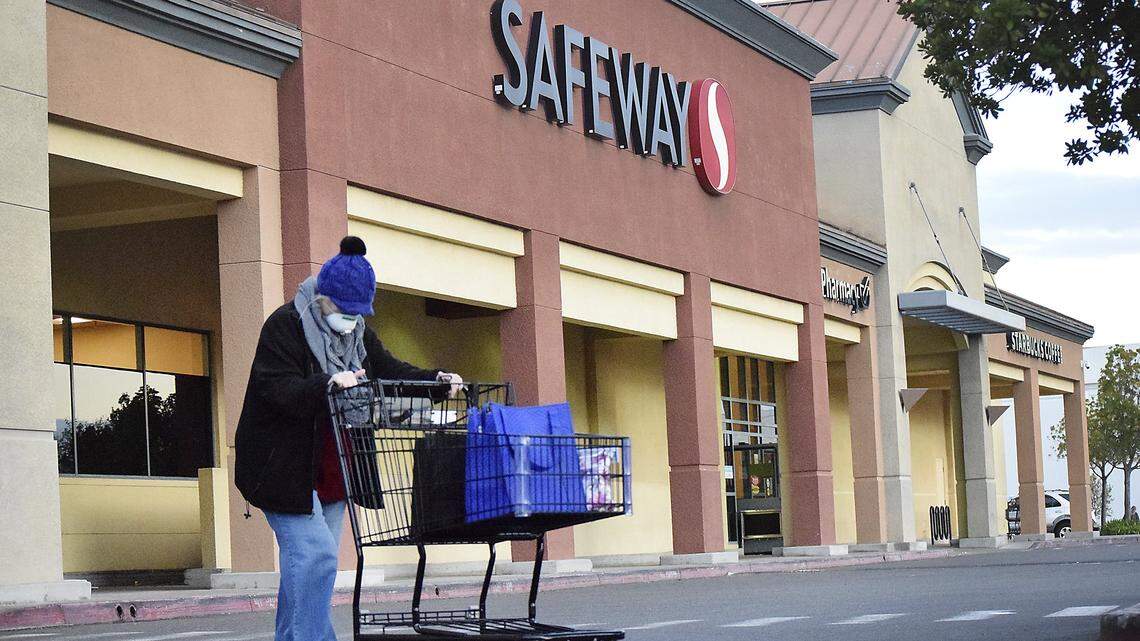
As food prices continue to soar, the last thing Californians want to think about is upheaval at their local grocery store.
But a proposed merger between Kroger and Albertsons signals big changes could be coming to California shoppers and grocery store workers.
Between them, the companies owns stores with household names in California. National chain Kroger owns California brands Ralphs, Food 4 Less and Foods Co. Albertsons, meanwhile, owns Safeway, Vons and Pavilions.
The $24.6 billion deal, announced on Friday, would be the second major merger between grocery chains in California in the last decade. The first, when Albertsons bought Safeway in 2015, ended in bankruptcy, layoffs and store closures.
The proposed merger “was absolutely devastating news for our members,” said Andrea Zinder, president of United Food and Commercial Workers Local 324 in Los Angeles and Orange counties. “They have very recent memories of mergers like this.”
The companies don’t expect the deal to close until 2024, hinting at a lengthy federal approval process.
The proposed Kroger-Albertsons coupling comes as big-box retailers like Walmart, Amazon and Costco have gobbled up large shares of the grocery market. Supermarket News lists those three as the top grocery retailers in 2022 by revenue, followed by Kroger in fourth place and Target in fifth. Albertsons is ranked seventh.
Some analysts, along with Kroger and Albertsons, say the merged company would be better equipped to compete with the likes of Walmart and offer lower prices to consumers. It could leverage better deals with suppliers, streamline production of store-brand products and force brand-name manufacturers to lower their prices as well.
“Lower prices are definitely an outcome,” said Burt Flickinger III, managing director of Strategic Resource Group, a retail consultant.
But union leaders and community advocates argue that a “megagrocer” would only make union bargaining more difficult and squash local independent grocers, who likely wouldn’t get those same deals from suppliers.
“Point to a merger that’s been good for workers and consumers,” said Jim Araby, director of strategic campaigns for UFCW Local 5, which represents workers in various Northern California cities.
Araby emphasized that the deal is a win for Albertsons shareholders – who will receive a $4 billion cash dividend on Nov. 7 – and for Kroger, since the company will neutralize its main supermarket rival.
“Who’s left holding the bag?” he said. “Workers and consumers.”
Will grocery stores close?
Store closures, and which ones get targeted, will largely depend on how federal antitrust regulators handle a process known as “divestiture”.
Kroger and Albertsons will have to sell off or close locations in regions where both companies have a large presence. Kroger owns only a handful of stores in Northern California, where Albertsons-owned Safeway has a large presence. The companies have more overlap in Southern California, which could lead to closures and sell-offs.
“Communities are going to suffer from this,” said Zinder, the union president.
Memories of the last major grocery merger, between Albertsons and Safeway in 2015, still haunt workers and union organizers.
The companies agreed to sell 168 supermarkets in western states to allow for competition. Of the divested stores, 146 went to Washington-based grocer Haggen Holdings, which is owned by a private equity firm in Florida. Eighty-three of those stores were in California, the Los Angeles Times reported.
By September 2015, Haggen had filed for bankruptcy, fired the executive in charge of the California expansion, and sold some of the newly opened stores back to Albertsons for a fraction of the cost.
Hundreds of employees lost their jobs as a result of the 2015 Haggen bankruptcy, Zinder estimates. Her members have been calling “nonstop” since the merger was announced, worried about what the deal could mean for their jobs.
Many Californians choose unionized grocery work as a lifelong career. The jobs pay well, have a low barrier to entry, and provide them with affordable health and retirement benefits. Members of UFCW Local 5 can make anywhere from $15.10 for entry-level courtesy clerks to over $27 for the top meat cutters. They also receive pensions.
Kroger and Albertsons said they plan to divest between 100 and 375 stores, which would be run by a new Albertsons subsidiary named SpinCo until a new buyer is found. Reuters reported the merged company could divest as many as 650 stores.
California food deserts
Lower-income areas, which tend to be more racially diverse, are at the greatest risk for divestiture and food deserts. The companies will likely choose their lower-performing stores to divest, said Araby of UFCW Local 5, and those stores more often than not are in poorer neighborhoods.
“There’s a history of that approach failing and people being left with no local grocery store,” said Stacy Mitchell, co-director of the Institute for Local Self-Reliance, a nonprofit group that advocates for community empowerment. “It increases the risk that communities will become food deserts.”
These communities often have fewer grocery options to begin with thanks to “supermarket redlining”, Mitchell said, where major chains avoid inner city neighborhoods in favor of wealthier suburbs.
“The reality is that no matter what angle you look at this from,” Mitchell said, “this is a bad deal, and it should be blocked by the FTC.”
This story was originally published October 21, 2022 at 6:00 AM with the headline "Will my grocery store close? Here’s what a Kroger-Albertsons merger could mean for California."