Election analysis: California may be a liberal state, but that doesn’t always show
So much for California as a liberal paradise.
Early election results Tuesday showed many voters were eager to clamp down on crime, were wary of a higher minimum wage and favored efforts to allow indentured servitude in state prisons.
Tuesday’s results show the state likes Democrats and is willing to go along with the party’s progressive views on climate change, abortion rights, civil rights and health care policy.
People voted overwhelmingly for Vice President Kamala Harris, who had previously won four times in California, for president. They elected Rep. Adam Schiff, a Los Angeles area Democrat, to the Senate.
But on issues that dealt with their personal security, voters had a very different message.
Proposition 36 won overwhelmingly. It’s a tough on crime effort that would increase penalties for theft and drug related crimes.
Proposition 6, which would end involuntary servitude in prisons, was failing.
There were, though, signs that Californians were willing to go the progressive way on certain issues. They easily approved a referendum on same-sex marriage.
“I don’t think Californians are turning to the right,” said John Pitney, professor of government at Claremont McKenna College. “Adam Schiff is winning by a huge margin. Kamala Harris will carry the state by a big margin. “But on certain issues, and especially crime, Californians have never been as true-blue as the national stereotype would suggest.”
No surprise on Prop. 36
The strong showing for Proposition 36 was no surprise. The Berkeley-IGS poll taken Oct. 22-28 showed it winning by a 3-to-1 margin, with strong support from every gender, racial and age group.
Democrats favored the ballot question by a 47% to 34% margin. Voters who called themselves somewhat liberal approved it by 48% to 33%.
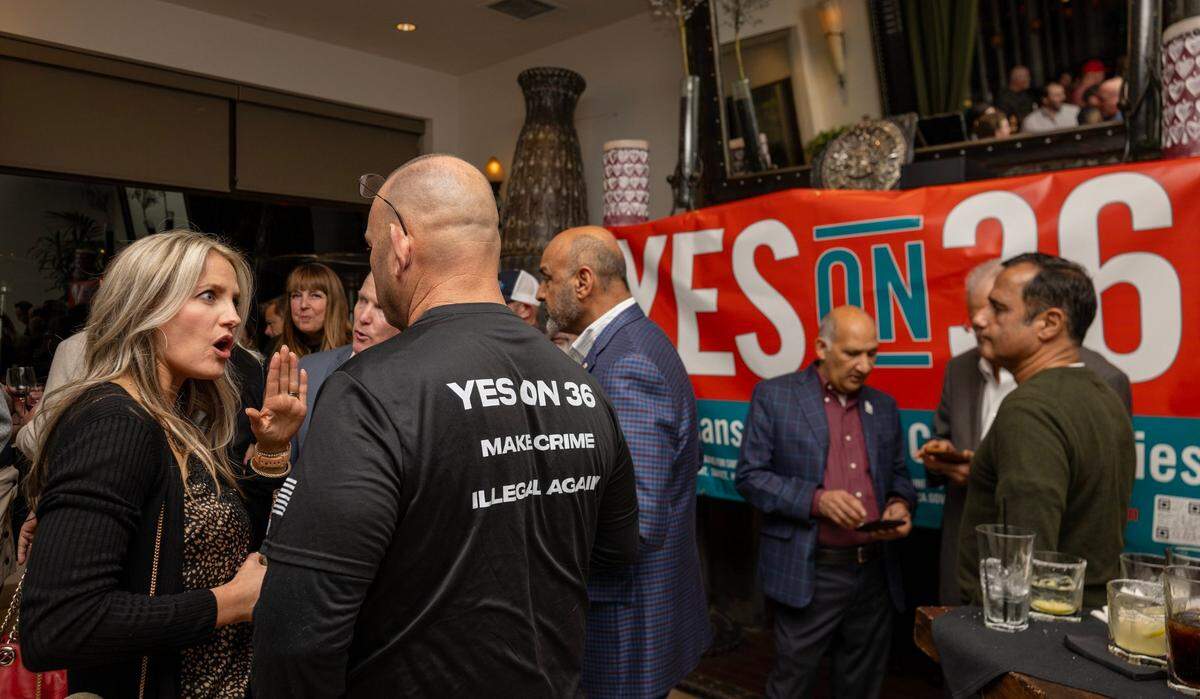
Early polling showed that many believe crime has worsened in the state in recent years, said Christian Grose, a professor of political science and public policy.
“I think in general we are seeing voters in this state taking relatively conservative positions on crime,” Grose said. “A lot of people who voted for this today or before election day, given the margins it’s passing by, some of these people voted to relax the law a decade ago.”
Proposition 32, which would raise the minimum wage, was behind Tuesday.
Experts said Californians were likely considering the economic uncertainty of the past five years, and other, somewhat recent increases to the state’s wage floor.
“I think there’s a concern about the overall business climate,” Pitney said.
Grose said the early results matched polling he helped conduct in September. At the time, he was surprised by the results.
“I thought, ‘Wow, this is something I thought would pass California really easily,’” he said.
Voters were acutely aware of inflation during this election cycle. Lower-income voters may have favored the measure as a means of dealing with higher living costs, Grose said, but higher-income voters were likely worried that raising wages would contribute to inflation.
A liberal state?
For all its reputation as a liberal laboratory of politics, California also consistently has been where conservative movements can thrive.
In 1966 Ronald Reagan, an actor who had never sought public office, was elected governor after vowing to pare the size of government and impose a strict conservative agenda.
In 1978, California voters approved by a nearly 2-to-1 margin Proposition 13, which put strict limits on property tax increases and set a standard for curbing taxes that was followed by other states.
In 1994, voters supported Proposition 187, which cracked down on illegal immigration, and in recent years have backed limits on how long a state legislator can serve.
A Republican state? No
None of this means California is suddenly going to become a Republican state. President George H. W. Bush in 1988 was the last GOP presidential candidate to win California, and none of the party’s nominees has won statewide since 2006, a trend likely to continue this year.
Roughly 46% of state voters register as Democrats. The number of Republicans is up slightly, but still only registers at about 25%.
“Californians have been switching parties for reasons that may range from opting to vote in a primary to taking advantage of the ease in updating their automatic voter registration details,” according to an analysis by Stephanie Barton, senior editor at the nonpartisan Public Policy Institute of California.
The party switches have been most prevalent among Black and Latino residents and younger voters, she said.
“I don’t think,” Pitney said, “that it’s an overall shift to the right in California.”
This story was originally published November 5, 2024 at 10:54 PM with the headline "Election analysis: California may be a liberal state, but that doesn’t always show."
.jpg)