Trial on National Guard deployment in LA ends. What lawyers for Newsom, Trump said
AI-generated summary reviewed by our newsroom.
- California claims Trump violated federal law by using troops for law enforcement.
- The case was argued over three days.
- The trial centered on whether the use of troops violated the Posse Comitatus Act.
President Donald Trump and his administration have illegally used soldiers in Los Angeles and must be reined in to prevent future abuses, an attorney representing Gov. Gavin Newsom, and the state of California, argued this week during a three-day trial.
“The federal government is not concerned with abiding by the law,” said Meghan Strong, a lawyer for the California Department of Justice. “They are concerned only with finding a loophole that allows them to dispatch the military to do their will.”
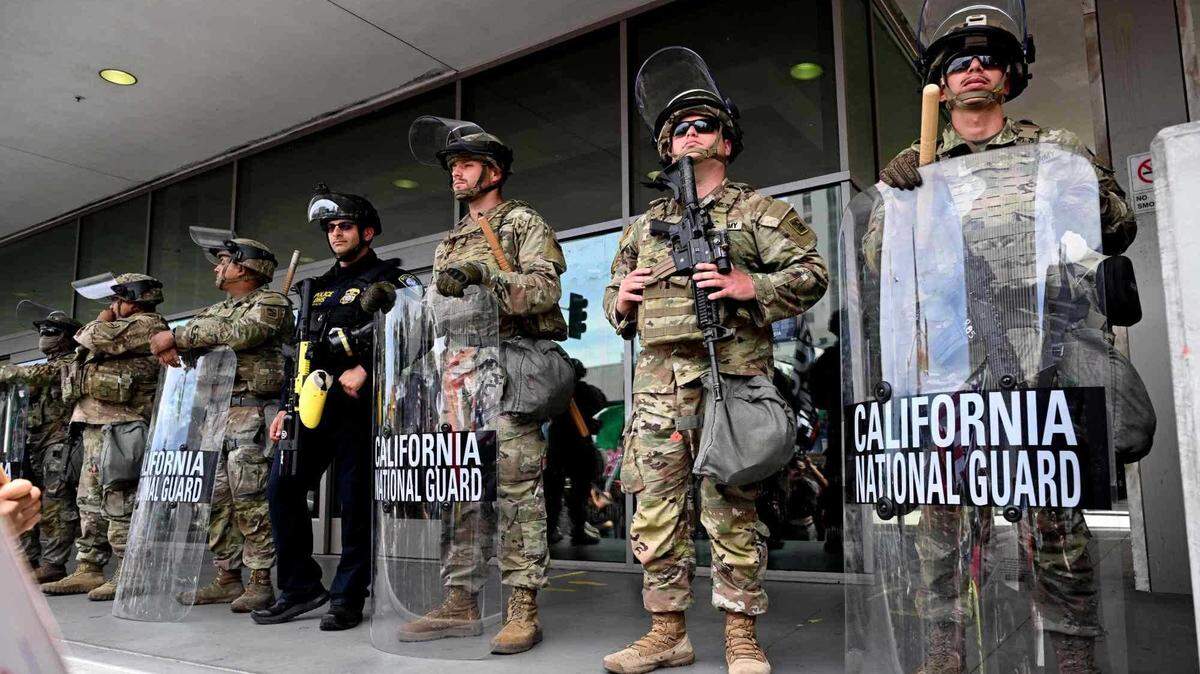
Newsom sued Trump and Defense Secretary Pete Hegseth in federal court for ordering roughly 4,000 California National Guard members, and about 700 Marines, to deploy to the Los Angeles area in June following protests against escalating immigration enforcement.
The trial, argued in San Francisco in front of U.S. District Court Judge Charles Breyer, centered on the Posse Comitatus Act, an 1878 federal law that generally prohibits the federal government from using the military as a civilian police force.
Strong argued soldiers in Southern California were used for security, to set perimeters and to apprehend people, which were all violations of the act.
“President Trump seems to see the military as his own personal army to use to further his agenda and enforce domestic law,” the attorney said.
Eric Hamilton, a lawyer for the U.S. Department of Justice, countered that soldiers were there to provide protection for federal officials and buildings, which he argued is allowed.
“The context matters. If the purpose is the protection of law enforcement officers, it isn’t law enforcement in the first place. It’s instead protection.”
Judge has questions of his own
Breyer at times openly wrestled with that argument, repeatedly interrupting Hamilton to ask pointed questions.
“So whenever federal personnel are used in connection with their official duties they then could be accompanied by a member of the military?” the judge said.
“Well, certainly in a situation here where the president federalized guardsmen and also deployed the Marines after multiple days of violent attacks on federal law enforcement officers and federal property,” Hamilton replied.
At another time, Breyer asked: “I’m looking at this case and trying to figure out: Is there any limitation to the use of federal forces?”
Protests in response to immigration enforcement in Southern California were largely peaceful, but some people threw rocks and other objects. Law enforcement officers were injured and vehicles and federal buildings were damaged.
Breyer’s skepticism was not unexpected. In June, the judge ordered the Trump administration to return control of California National Guard soldiers to Newsom, arguing that the president had exceeded his authority and violated the Tenth Amendment, which separates powers between the federal government and states.
An appeals court stopped Breyer’s decision, saying the governor did not have the authority to veto Trump’s order to deploy California National Guard troops.
In the first case, California’s attorneys argued the administration was likely to violate the Posse Comitatus Act. But Breyer did not rule on that argument. In this week’s trial, Strong argued such violations had occurred.
The attorney pointed to a handful of examples, including an operation where federal authorities marched through MacArthur Park in Los Angeles.
“The federal government wants a display of military force so great that any lawful opposition to their agenda is effectively silenced,” Strong said.
Overreach or lawful protection of federal officials?
Hamilton said the soldiers were there to protect federal officials. If people were intimated by their presence, he argued, that doesn’t make it a violation of the law.
“There isn’t anything in the Posse Comitatus Act that turns on the feelings of persons in the area on the work that federal service members are doing.”
In recent weeks, military officials have released most of the soldiers that were deployed. About 300 California National Guard soldiers remain.
Breyer seemed to express concern about the length of time troops have stayed in the area. There was violence in June, the judge said, but the threat has subsided.
“Why is the federalized National Guard, even though it’s been drawn down, still in place?” Breyer asked.
The use of federal troops is likely to continue to be the subject of federal court battles. On Monday, Trump announced he was mobilizing the District of Columbia’s National Guard to address violent crime in the city. During a press conference, he said Oakland, and other cities, also had crime problems.
Breyer did not issue a ruling before the trial finished Wednesday morning. No matter the outcome, his decision could be appealed again to a higher court.
This story was originally published August 13, 2025 at 1:34 PM with the headline "Trial on National Guard deployment in LA ends. What lawyers for Newsom, Trump said."