
She says her brother was murdered. In California, the crash was an ‘accident’
Andrew Pringle was in the air for a terrible moment, flung so hard by the crash that his feet lifted right out of his shoes. When he hit the asphalt, his arm, his pelvis and his skull were cracked.
The driver told police that she was traveling at the 40 mph speed limit when she barrelled into the crosswalk that sunny afternoon. An accident, she said.
The light had been red for 10 seconds.
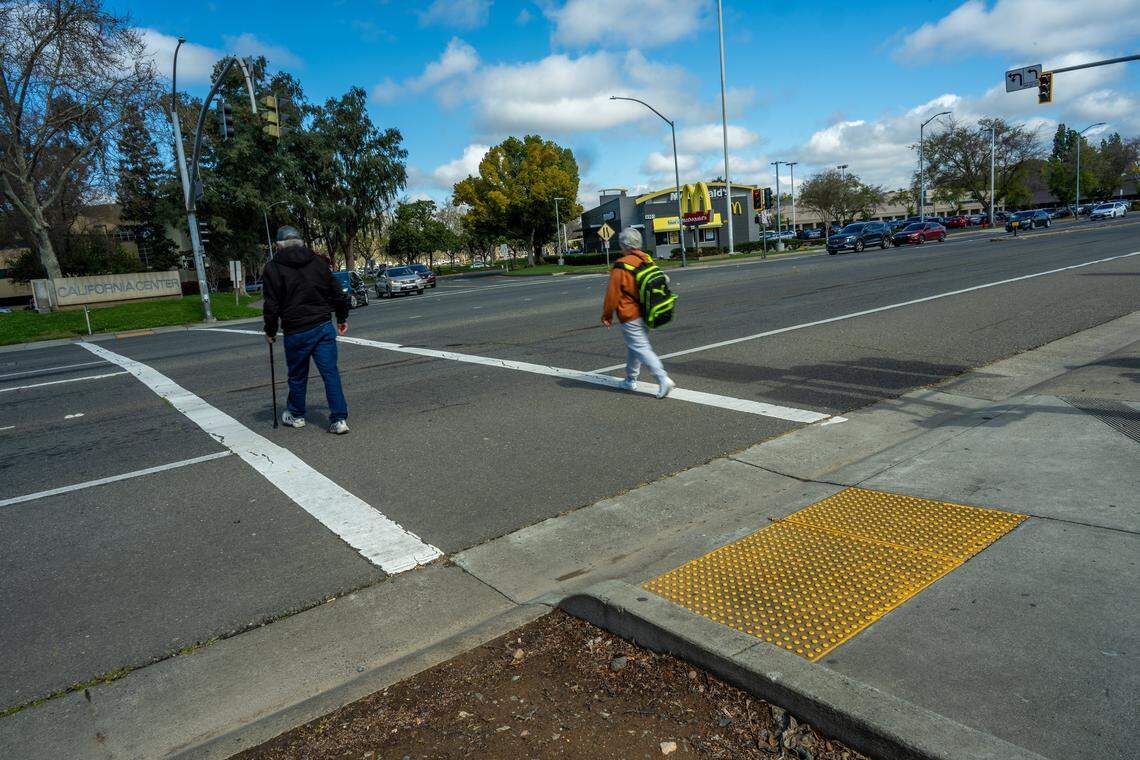
If Andrew had been ever so slightly slower or faster, maybe the driver would have plowed through empty space, and Andrew would have turned 22 a few days later. Instead, on April 23, 2023, he waited a few seconds after the pedestrian signal flashed to make sure he was in the clear. Security camera footage shows the lanky young man hopped on his skateboard at 1:17 p.m. and safely glided past the first lane. He was in the second lane when a woman slammed into him with a one-and-a-half-ton Volkswagen Jetta.
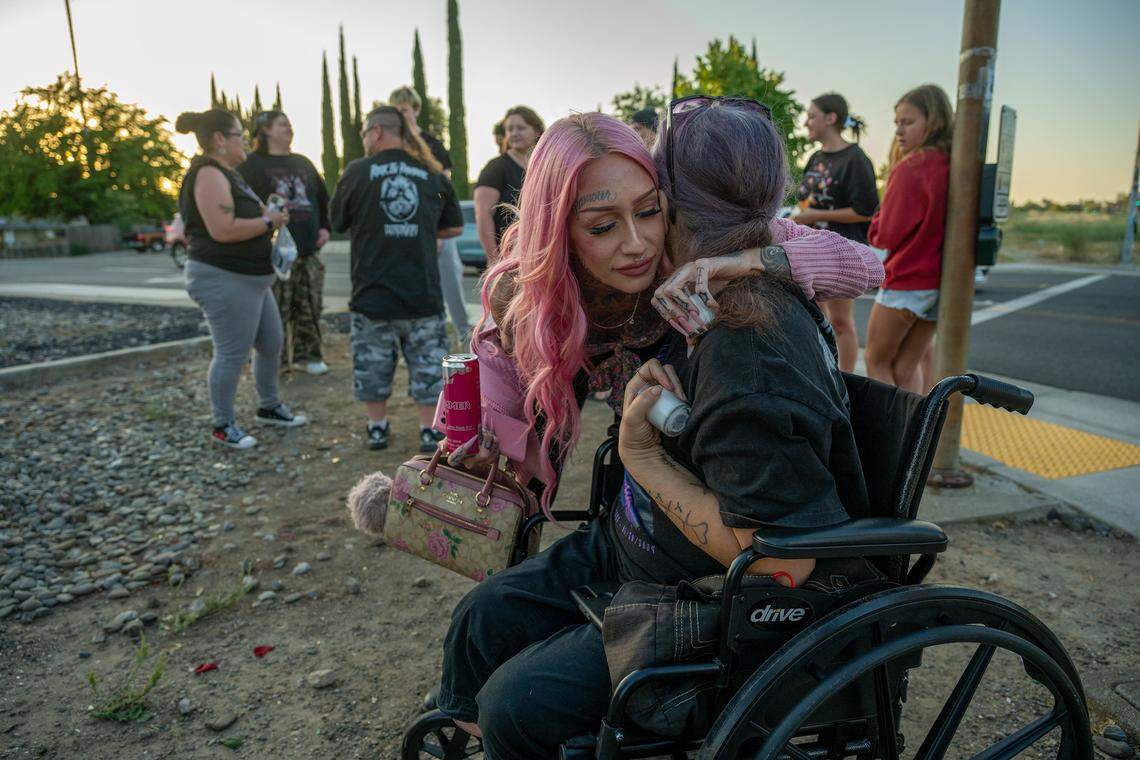
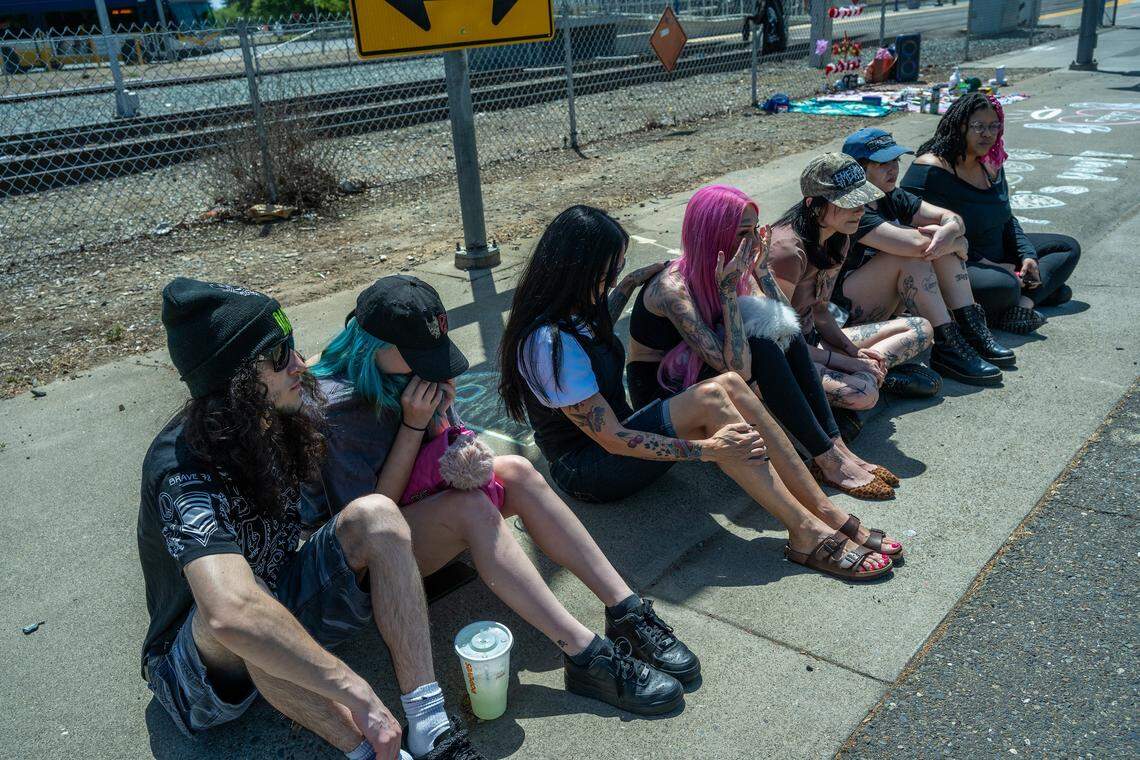
Two years after the crash — almost to the minute — an ambulance started to wail in Rosemont. Drew’s older sister, Erika Pringle, was sitting on the curb by the light rail station at Folsom Boulevard and Manlove Road, knees to her chest, looking at the spot where her brother fell to the ground. Wrapped in his favorite hoodie, Erika had been stoic on this anniversary, but as soon as she heard the siren, she began to cry. The sound made her picture her little brother lying on the street just after the crash, alone.
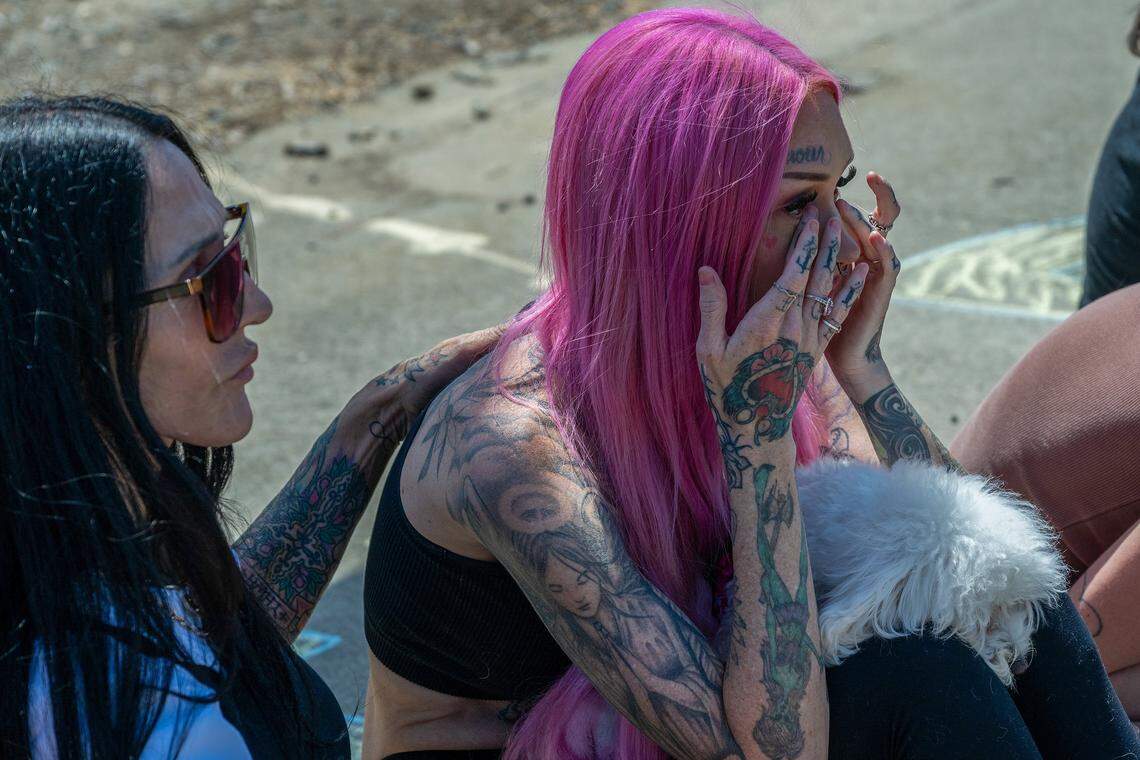
Everything — some stranger’s medical emergency but also the date and the hours and the minutes — brought her back to that day.
She can recite the whole sequence of events from memory. At 1:07 p.m., Drew leaves the house on his skateboard. He has a Sunday shift at a brewery in Folsom, where he’s a dishwasher; he heads down a quiet residential street toward the light rail station. At 1:16, Drew stands at the corner waiting to cross Folsom. He has decided to go to McDonald’s to eat something before work. Six lanes lie between him and a burger. At 1:17, Drew enters the crosswalk. While he is in the crosswalk, a driver speeds through the red light. 1:25: Emergency medical responders arrive to find Drew bleeding on the ground. He is unconscious. They whisk him away to the hospital. 9 p.m.: Erika is in the hospital room looking at Drew, but Drew is dead.
The grief was shattering. Erika has a child of her own, but because she was 14 years older than Drew, she tended to think of him as her son. She can picture him as the curly-haired baby she held in her arms, cooing, his club foot in a soft cast that seemed almost impossibly small. She can picture him as a teen with a goofy smile bringing home yet another stray dog.
“To me,” she said, “I lost a child.”
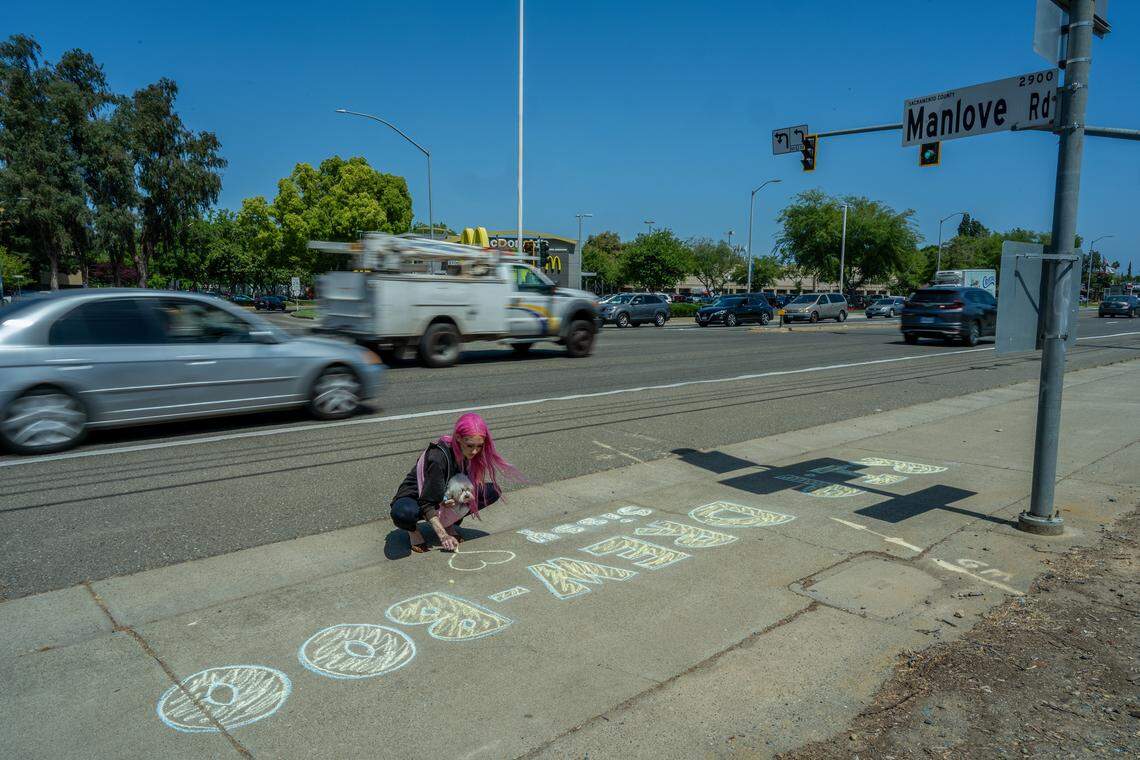
Outside of the Pringle family, however, Drew’s death had little consequence. Three things changed after the crash: Sacramento County removed four trees from outside the light rail station so that drivers could better see pedestrians about to cross Folsom Boulevard; workers put reflective yellow backing on the traffic signals; and the driver who killed Drew was slapped with a misdemeanor and sentenced to eight months in jail with an option for work release and a year of probation, keeping her license. The broader public had no reaction because news outlets didn’t report on the crash.
“You can’t even Google it,” Erika said. “There was no coverage.”
Compulsively gathering the facts of her brother’s final hours, Erika pored over the investigation records from the California Highway Patrol. “Every single detail of this whole thing,” she said, “is burned in my brain.” She repeatedly listened to the driver’s panicked 911 call, in which the woman describes Drew in the moments after she hit him.
“He has blood in his mouth,” the woman tells the dispatcher during the call. “He’s not awake.” In the recording, someone in the background yells that his eyes have rolled back.
That afternoon, Erika rushed to her little brother in the hospital. When she finally saw Drew, he had a bandage around his head from a futile brain surgery. His face was so bloody and bruised that it was black. The skin on his knuckles and toes had been shredded off. A bone was jutting out of his shoulder.
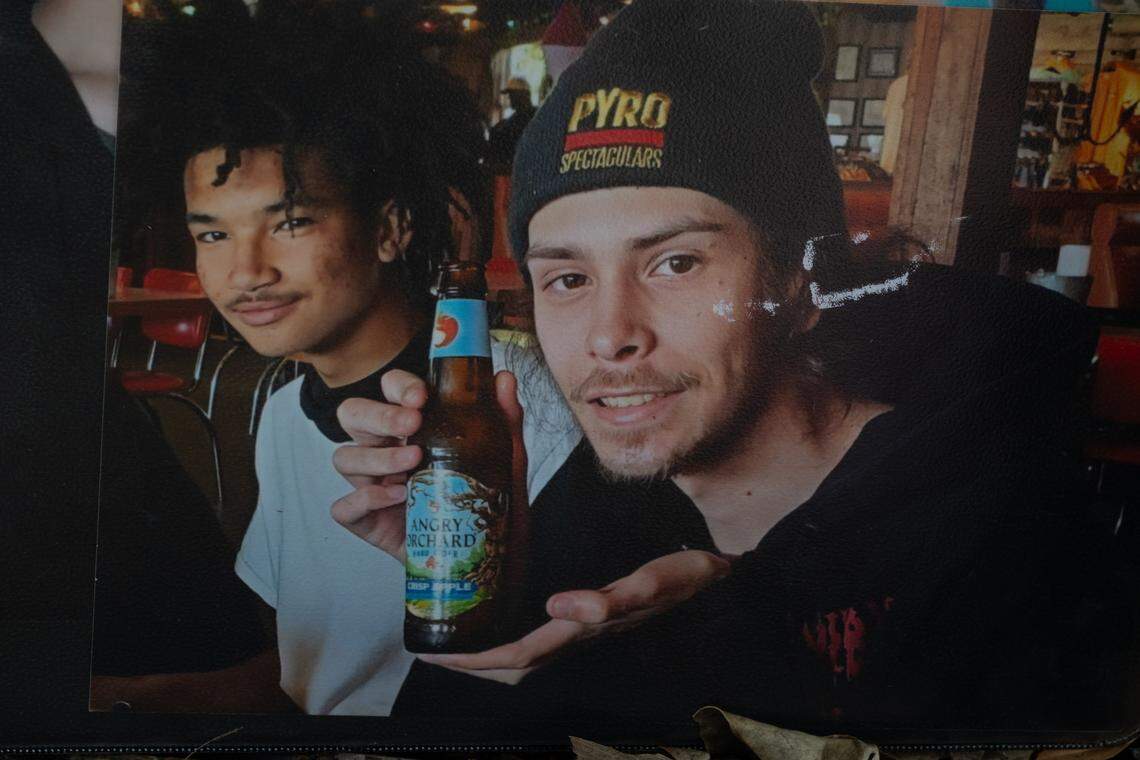
This is not how Erika wants to remember Drew, but she talks about it because she wants strangers to confront just how mangled his body was. She could hardly fathom the cruelty of this death. She read and reread the Sacramento County coroner’s autopsy report with its catalog of injuries — too many for one person to bear.
Almost too many for Erika to bear, too.
Together, the official records and Erika’s memories documented an incalculable loss, which made the institutional response all the more baffling to her. The boy she called Drew-Boo had been violently ripped away, and all that came of it was eight months in jail plus probation for the driver and a death sentence for four trees? How?
But her sense of dissonance reflected a broader pattern in California. On paper, policymakers make lofty commitments to public transportation and road safety, placing the utmost value on human life.
In practice, human life is not as important as the convenience of drivers — a policy choice that endangers every person in California.
1,000 California pedestrians deaths each year
The year that Drew died, the California Office of Traffic Safety said vehicle crashes in the state killed a total of 4,061 people.
Erika’s pain, multiplied by 4,061.
Even though drivers and their passengers died in the greatest numbers, people outside of cars were in far more danger. Almost one-third of the people killed in California crashes in 2023 were pedestrians or cyclists; the federal Bureau of Transportation Statistics shows that just 6% of California commutes involved walking, biking or transit that year.
The vast majority of traffic deaths are preventable with changes to infrastructure and policy. And yet California’s roads have become significantly more deadly over time. Data from the National Highway Traffic Safety Administration show that in 2013, a total of 3,107 people died in crashes in the state. By 2023, California’s population was only 2% larger, but the number of traffic deaths had shot up 31%.
Those numbers went down a little in 2024. The initial estimate was 3,807 — still 23% higher than the body count in 2013.
Multiple factors contributed to the growing death toll. The most pertinent was the size of cars and trucks: The average personal vehicle in the U.S. has become significantly larger in the last 30 years — and the larger the car, the more likely it is to kill someone in a crash. The Insurance Institute for Highway Safety says that cars today are generally 8 inches taller and 1,000 pounds heavier than they were in the early ’90s. Taller vehicles, especially those with a hood height over 40 inches, tend to be the worst for pedestrians.
Another major factor was time: People spend more time in cars now than they did in 2001, and housing costs have swelled, forcing many Californians into longer commutes. Drivers don’t just spend more time in danger; they also spend more time endangering those around them.
Then, a third factor: The widespread use of smartphones left drivers more distracted.
While increasingly distracted drivers in increasingly large cars spend increasing time on the road, they navigate a network of city streets largely optimized for driver “efficiency,” which often translates to “speed.” The AAA Foundation has found that when a driver hits a pedestrian at just 32 mph, the average risk that the pedestrian will die is already 25%.
All of this has left thousands of people maimed or dead — preventable tragedies repeated over and over. California lawmakers could have treated this as a solvable public health emergency, directing transportation agencies to spend money accordingly.
They didn’t. Instead, over the last six years, vast amounts of funding flowed toward infrastructure for cars.
Why were California cities built for cars?
To understand why cars take priority — to understand how Drew and more than 1,000 other pedestrians ended up dead that year — you have to start in the early 1900s.
When private automobiles were first introduced in the U.S., the idea that a pedestrian should stay on the sidewalk would have been unthinkable. Roads were a public space where people on foot could move at will. The vehicle traffic that existed at the time — often horse-drawn wagons or electric streetcars — moved at a slower, safer pace.
But as cars began to intrude in American cities, pedestrians began to die in stunning numbers. Many of the victims were children playing in the street.
These casualties weren’t met with the shrug that traffic deaths often receive now. As the historian Peter D. Norton wrote in “Fighting Traffic,” city-dwellers were both devastated and incensed. In the four years after World War I, Norton wrote, “more Americans were killed in automobile accidents than had died in battle in France.” Newspapers, including The Sacramento Bee, the Sacramento Union and the Sacramento Star, covered this domestic bloodshed critically. The Star called certain drivers “speed-mad murderers.”
Personal automobiles — often dismissed by reporters as frivolous “pleasure-cars” for the wealthy — developed a frightening reputation in cities. With that negative reputation and a 20% spike in the number of traffic deaths, the automotive industry suffered a huge sales slump in 1923. That same year, after 42,000 people signed a petition, the city of Cincinnati put a “speed governor” ordinance before voters, which would have mandated devices in vehicles that automatically shut off any car engine once it hit 25 mph. Panicked industry leaders rallied against the measure; in the end, it was crushed at the polls.
After the car sales slump and the Cincinnati crisis, as Norton chronicled, the auto industry organized as “motordom,” developing a sophisticated public relations apparatus and recruiting engineers and city planners to further their aims. Before the late 1920s, Norton wrote, pedestrians killed by drivers were usually perceived as innocent victims. But the auto industry pushed for pedestrians to be restricted to sidewalks and crosswalks, and by the 1930s, the image of the reckless “jaywalker” had been firmly planted in the national consciousness. Pedestrians’ deaths were largely viewed as pedestrians’ fault.
Motordom had other significant victories. Engineers in the 1910s and ’20s had advocated for prioritizing public transportation over personal cars because a train or streetcar efficiently moves more people with less space. But, led by a few key experts bankrolled by the automotive industry, traffic engineers largely dropped that line of reasoning. Selling an “automotive city” of the future, industry insiders persuaded transportation planners to widen streets and build separated highways. They expanded the available space to accommodate cars at an enormous cost to taxpayers.
As driving became more convenient and transit became less convenient, cars grew in popularity and clogged city streets. The automotive lobby began to portray transit — streetcars — as a cause of urban traffic. Sacramento became one of many American urban centers that, in the 1940s, tore out its train tracks. The trains would come back, but they would serve a transformed city.
Light rail returns and courts drivers
In the 1980s, the California capital’s light rail proponents resurrected streetcars. This time, however, they catered to drivers. Regional Transit’s first two light rail lines opened as “RT Metro” in 1987. Planners envisioned the train as something for suburban commuters: That was clear from officials’ explicit statements at meetings, from the routes and from the large parking lots at multiple stations.
One RT Metro line ran from the North Highlands stop at Watt Avenue and Interstate 80 to the terminus downtown. The other line ran along Folsom Boulevard toward the Capitol and included the stop where Drew would be killed.
In an advertisement published in the Sacramento Union, RT called the Folsom route “the New RT Highway 50 Branch.” The planners did picture pedestrians using the train, but they poured resources toward the free parking lots. They located the Folsom and Manlove station just east of Watt Avenue in an area that was relatively unpopulated at the time. In the nearly 40 years since the metro began service, car traffic on Folsom Boulevard has ballooned, and so have the dangers to pedestrians around the trains. Folsom and Watt are both wide thoroughfares where drivers are legally permitted to travel at lethal speeds.
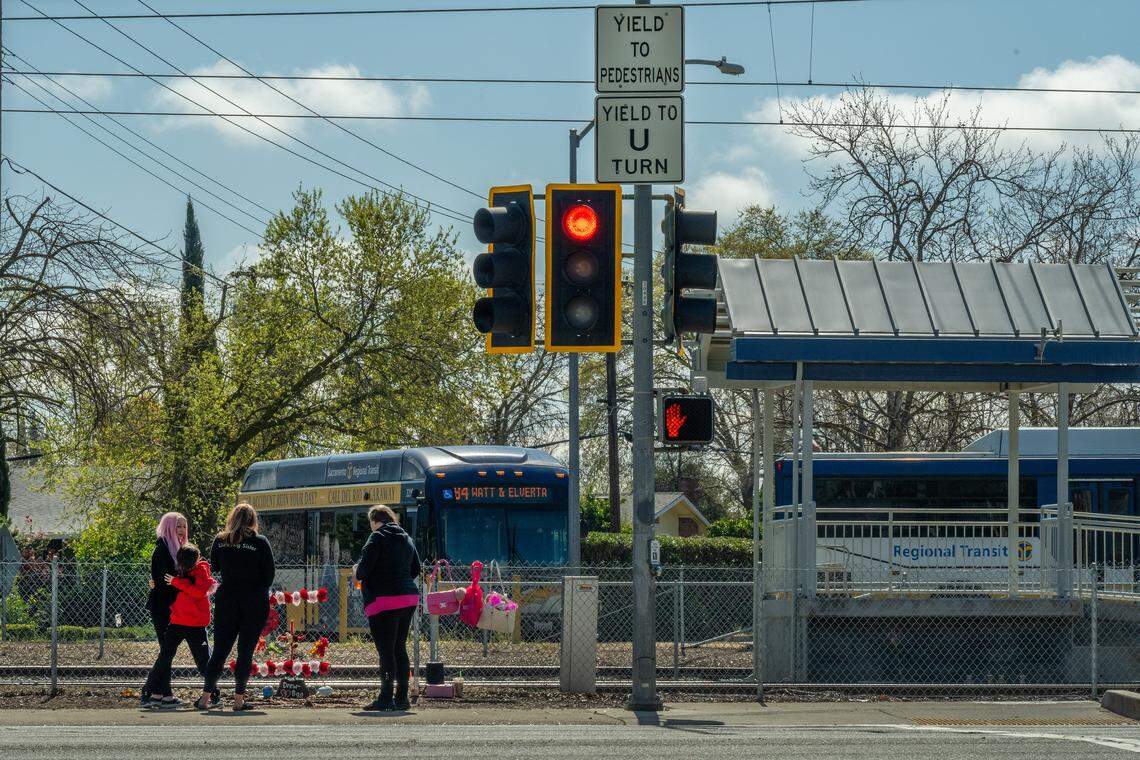
In line with the auto industry’s century-old campaign, the public transit system and its users on Folsom are secondary to drivers. And although the crash that killed Drew happened in 2023, he and the young woman who killed him both played their roles exactly as a 1920s auto tycoon might have scripted. Drew waited for the light to turn and carefully crossed in the crosswalk, ceding most of the public space to drivers. Meanwhile, the driver suggested after the crash that Drew had been the reckless one. According to a summary of the driver’s statement in the CHP’s report, she said that Drew “came into the road, headed northbound, skating super-fast. I did not see (him) until he was almost hitting my car.”
Drew’s sister and his mother both said that in the hospital later that day, a CHP officer speculated that maybe Drew had a breakdown and deliberately killed himself.
Just crossing the street made him seem insane.
Follow the money
If you compare California’s spending on car infrastructure to its spending on pedestrian safety, the officer’s assumption begins to make more sense: Officials treat walking like a niche activity.
Drew was one of millions of Californians who don’t drive. According to research from the Natural Resources Defense Council based on census data, 35% of Californians over 16 either do not have reliable access to a car for daily transportation or can’t drive due to a disability. In the two congressional districts that cover Sacramento County, around a quarter of residents over 16 have inconsistent access to a car, and 4% of the driving-age population — almost 56,000 individuals — live in households with no cars at all.
According to the U.S. Department of Transportation, the valuation of a statistical life — the dollar figure you might assign to a life saved — was $13.2 million the year that Drew was killed. By that metric, California wasted more than $13 billion just on pedestrian deaths in 2023.
These numbers are not reflected in the way California spends its money.
Caltrans’ total budget for the current fiscal year is $16.1 billion, a little more than half of the total $30.9 billion state transportation budget. The Active Transportation Program — the only state program exclusively dedicated to funding projects that make walking and biking easier and safer — received a budget about 1% the size of Caltrans’.
The Active Transportation Program has been slashed in the last two years. In 2024, Newsom proposed cutting $600 million, vastly decreasing the amount of grants that the California Transportation Commission can award to projects. The program was already so popular that it had to turn down applicants with high grant application scores due to a lack of funds before that cut. Eventually, the cut was negotiated down to $400 million. This year, Newsom — whose spokesperson declined to comment on the cuts — stuck with that.
As active transportation was sidelined, highways have continued to receive huge investments. In October, Newsom gave Caltrans the green light to spend $500 million on a single 10-mile stretch of highway that will vanish into the sea.
While the bulk of Caltrans funding goes toward car facilities, the agency does implement pedestrian and bike improvements in the course of much of its work. The agency plays a huge role in the state’s fight to slow climate change: Transportation contributes the largest share of dangerous greenhouse gas emissions, mostly through personal cars and freight. A large majority of California trips happen in cars, and the state has vowed to change that.
However, despite a 2021 Caltrans policy essentially mandating pedestrian, bike and transit elements in every project that’s not a freeway, those changes can be perfunctory or even nonexistent.
A Caltrans report published in January shows that between July 2018 and June 2023, the state added 551.5 miles of car lanes and 1.4 miles of transit-only lanes. In the same period, the agency added or reconstructed 76.7 miles of sidewalks and added 160.2 miles of new bike lanes — meaning Caltrans put in seven times as many miles of car infrastructure as pedestrian infrastructure, and almost three and a half times as many miles of car infrastructure as bike lanes. Additionally, 93 of the 160 bike lane miles that Caltrans counted were either shared shoulders or “sharrows,” the name given to bike routes where a sign is erected or the symbol of a cyclist is painted on the road, but no actual bike lanes exist.
Caltrans’ parent agency, CalSTA, discouraged highway widening projects in a 2021 plan and urged an emphasis on building infrastructure that reduces driving. Under CalSTA’s plan, robust transit paired with safe sidewalks and bike lanes would make it more appealing to get out of a car. In some cases, CalSTA suggests congestion-based tolls that would disincentivize car trips and account for the high cost that drivers impose on the rest of the tax base.
But Caltrans did not adopt the CalSTA policy for projects that were already underway. The California Transportation Commission, which doles out funding for many road projects, didn’t immediately adopt it either. Caltrans indicated that projects initiated after the climate plan’s publication would line up with the guidance, but added that the agency probably wouldn’t be in compliance until 2030.
Transportation planning and funding also happens at the local level, and funding is uneven there, too. Big and small projects typically rely on competitive grants. In Sacramento County, a “master plan” to redesign Folsom Boulevard proposed tree-studded medians and narrower lanes to slow down traffic on the road between Watt Avenue and Bradshaw Road, including the intersection where Drew was fatally struck.
That plan was finalized in 2016. By the time Drew was killed seven years later, one portion had been implemented: a 1-mile segment almost 1½ miles east of the crash, only on the eastbound lanes. The wide median, which would have significantly reduced the space for vehicles and discouraged high speeds, was left out.
The next phase of the project still wouldn’t reach all the way to the light rail station where Erika leaves flowers for her brother. Furthermore, it remains unfunded.
Little punishment for drivers who kill
The lack of funding for safe streets is possible, in part, because deaths like Drew’s barely register: There’s no public outcry and often no meaningful news coverage.
Still, before all this happened — before she watched her brother die — Erika had assumed that Californians could at least count on the criminal justice system to punish the perpetrator of a deadly crime.
That isn’t exactly true. Outside of hit-and-runs and egregious “gross negligence” cases, drivers who kill people seldom face charges, let alone serious ones. The young woman who killed Drew received a sentence of eight months in jail with an option for work release for misdemeanor manslaughter without gross negligence.
Drew’s mother, Cheryl Pringle, said that he “followed rules. And where does that get you?”
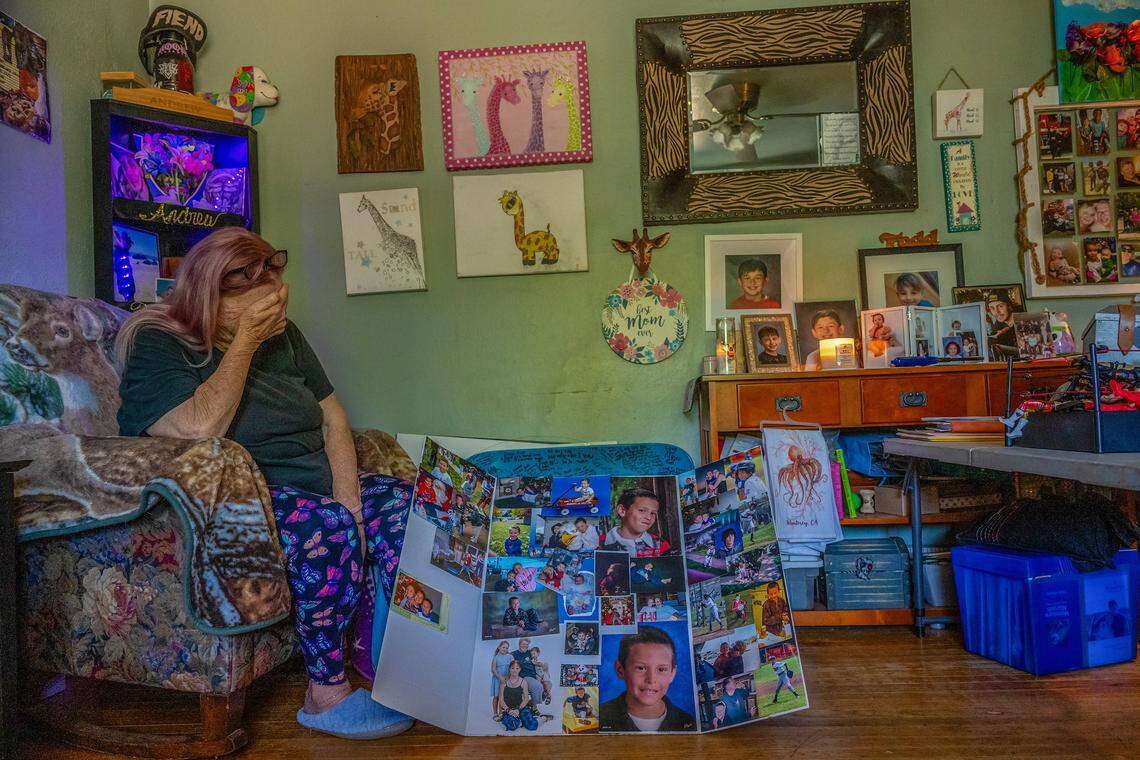
At the sentencing hearing in 2024, the driver spoke briefly. The court reporter captured just 53 words. “I,” she trailed off, then said, “Sorry. Um, after reflecting for the past year, I see his face every single night, I promise you. And I am really sorry that this happened. I’ll be more careful moving forward while driving. But I just imagine it being my own brother, and I can’t imagine the pain. I’m so sorry.”
Cheryl spoke for much longer. At the end of her statement, she told the young woman, “I hope you never have to go through what our family went through. A mother should never lose — have to say goodbye to her child. I miss Andrew so much. It breaks my heart every day without him. I just wanted to let you know that.”
Erika told the driver that she was furious. She wrote what she wanted to say on lined paper in her loopy script. “I have struggled to try to live life,” she said. “I’m mad that I had to watch my mom’s heart break when (they) told us that he wasn’t going to make it. I’m mad that I had to watch my siblings’ hearts break that night ... I am mad that I watched my brother struggle as he took his last breath.”
Because it was a misdemeanor case, the courtroom had a strange quality. Standing by her work station at a hair salon — which has a miniature shrine to Drew — Erika grimaced as she said that people who were in court to dispute routine traffic tickets had to listen to her give “my impact statement about how this girl murdered my brother.”
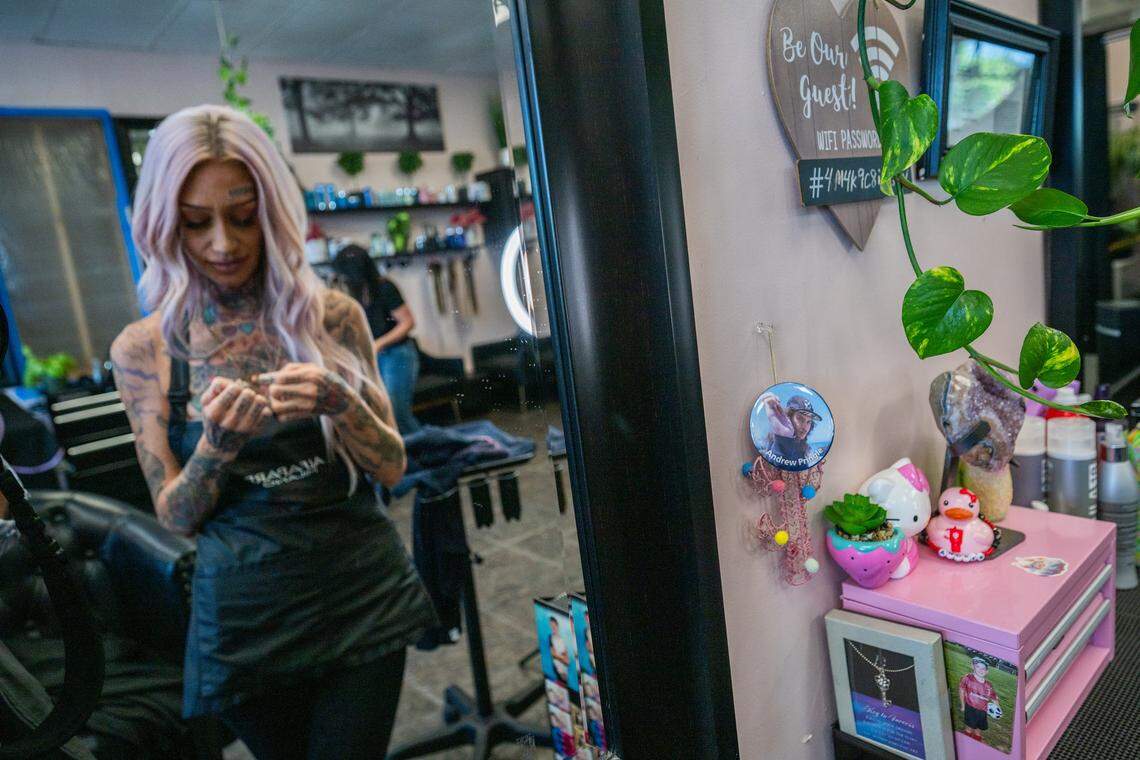
The driver’s sentence offended her.
“It shouldn’t be just a slap on the wrist,” Erika said. Severe injuries are life-changing and can be horrific, she said, even when the victim survives them. If the victim does not survive the crash, “You’re literally getting away with murder.”
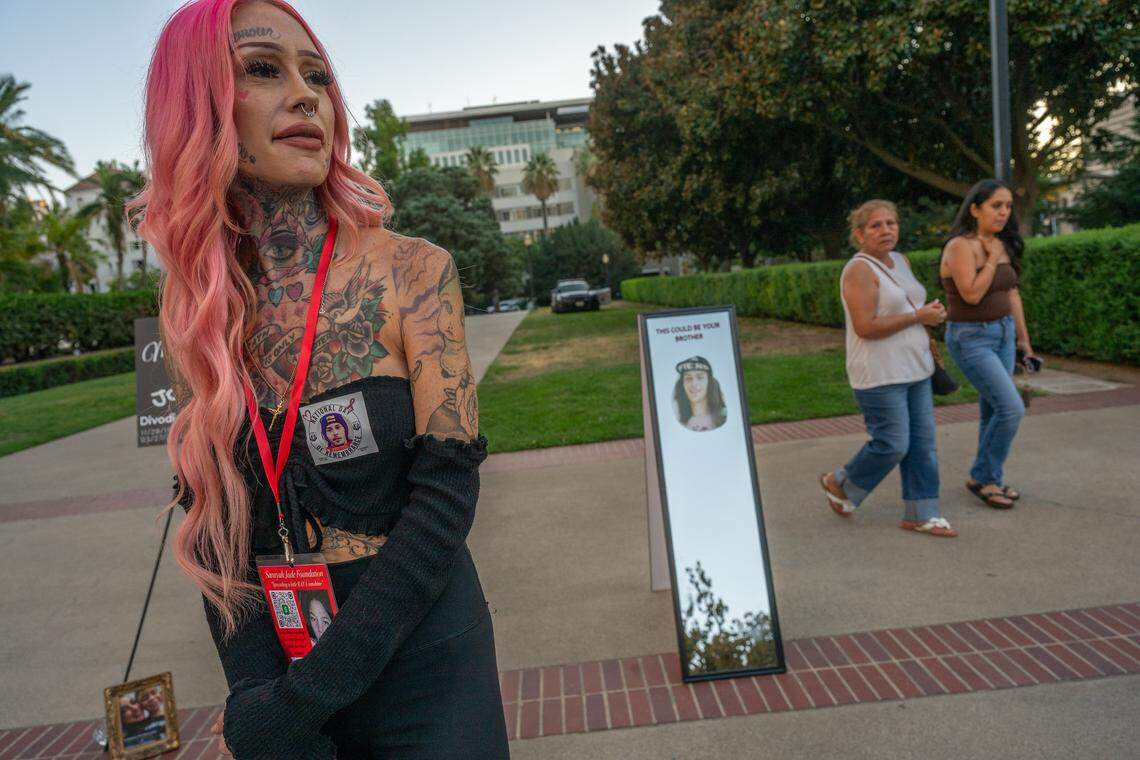
She’s tried to push that message into the public consciousness. She started volunteering with the Sacramento County organization Victim Advocate Angels, whose founder, Alexa Hansen, accompanied Erika to court dates and has shepherded many other families through the criminal justice system.
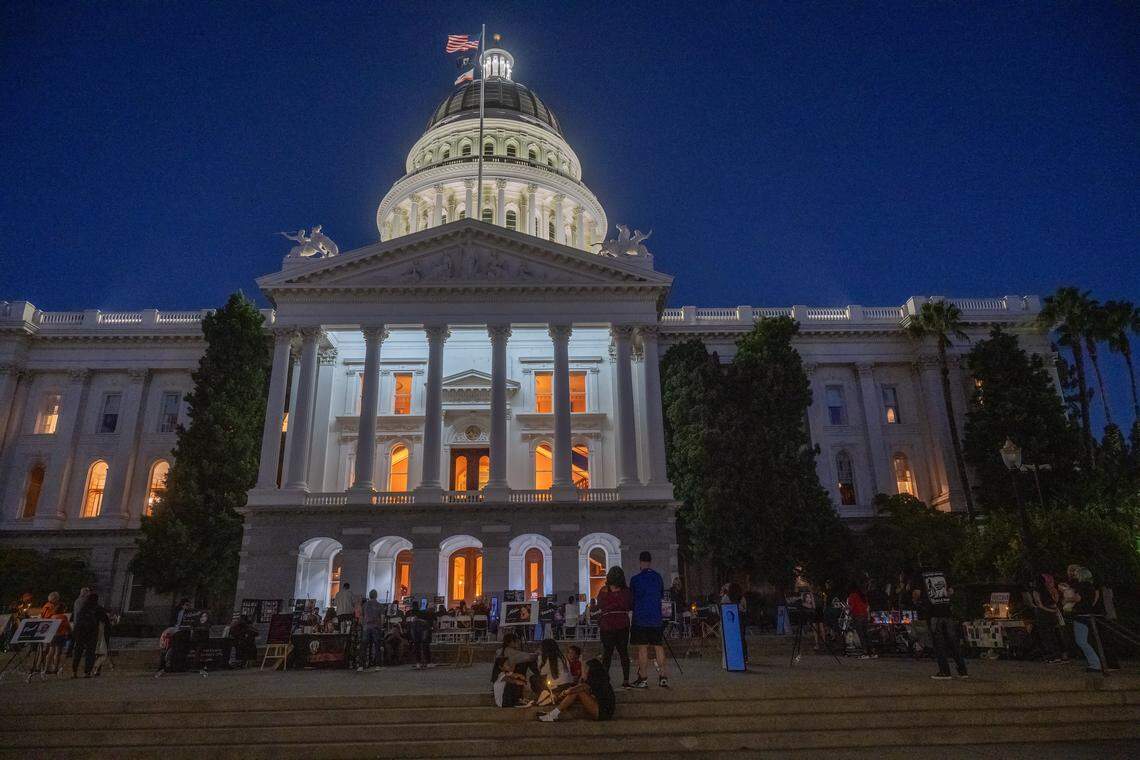
Erika used to be shy about public speaking, but on a windy night in September, she stood on the Capitol steps before a crowd of at least 100 people and spoke about Drew. In the long-term, she wants to change state law to make sentencing stronger in vehicular manslaughter cases. She believes that when driver error leads to a fatal crash, it should be charged as a felony.
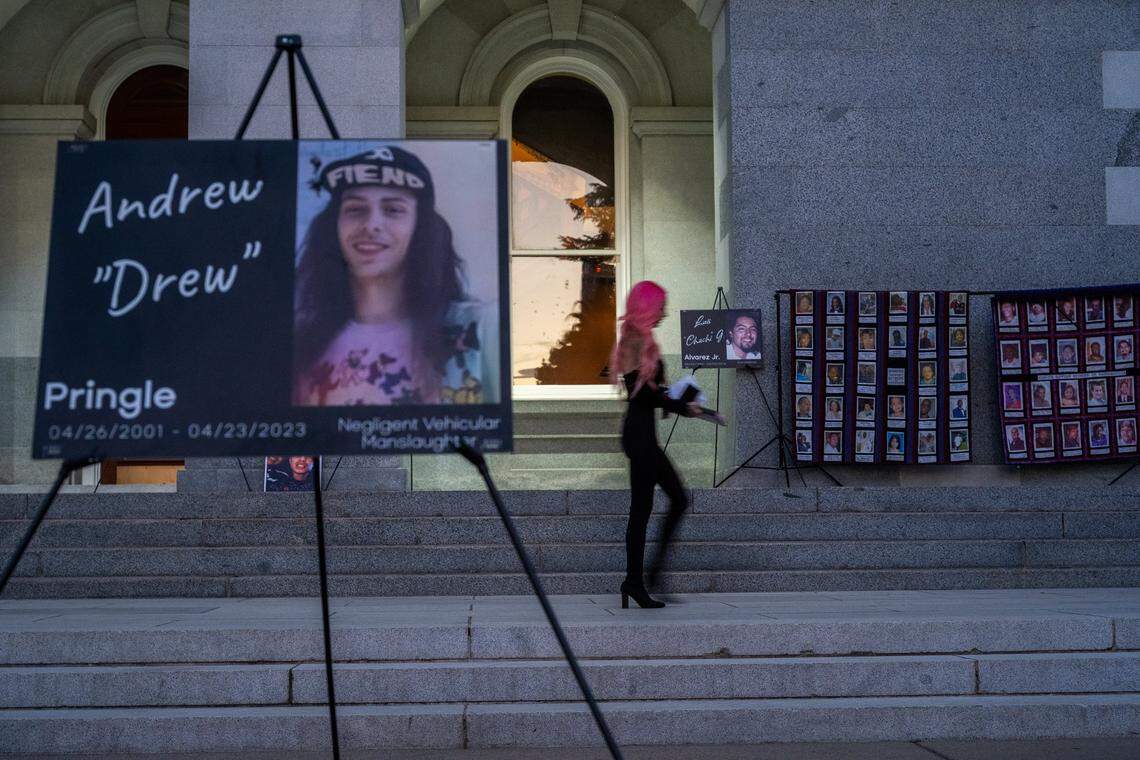
To Erika, when the woman who killed Drew received an eight-month jail sentence plus a year of probation and kept driving, it felt as though the system were saying her brother’s life didn’t matter.
The wide and dangerous road, the car-oriented train station, the silence of local media, the lukewarm prosecution of the driver who killed him. All of it said the same thing to her: Drew’s life was unimportant. That’s what auto industry strategists had wanted in the 1920s, when grief over traffic deaths had threatened car sales in cities. The strategists wanted to squash that sorrow. As Norton documented in “Fighting Traffic,” the president of the Chicago Motor Club declared in 1926 that “the day of the emotional sob sister campaign has passed.”
And the long-dead motor club president is still right most of the time. California’s dead pedestrians are usually ignored by reporters, by the public and by the criminal justice system.
But ultimately, those groups don’t decide whether a life mattered. Drew was just one twentysomething skater, and Erika is just one “sob sister.” But it’s hard to look at her and conclude that Drew meant nothing.
His loss has bled into every corner of her life.
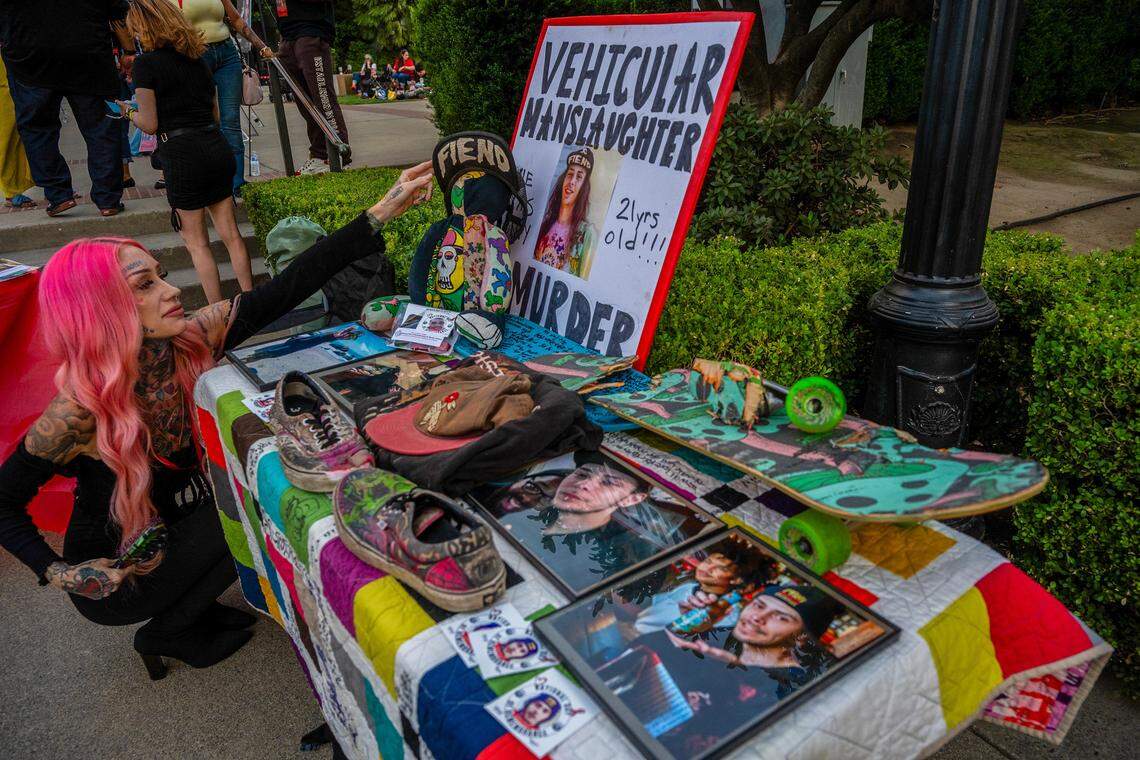
An unexpected baby
Drew was born April 26, 2001, a quiet boy in a tumultuous home. When he was just 2 months old, he was placed with an experienced pair of foster parents: Cheryl and her husband, James Pringle.
In July 2001, a social worker came to the house in Rosemont and handed Cheryl an infant with a tiny little club foot wrapped up in a cast. Cheryl’s youngest child — Michelle — was almost 5, and her oldest child — Todd — was about to turn 30. Cheryl was already 57: pretty old to start over. A baby wasn’t in the plan.
And yet, as soon as she saw him, Cheryl was certain that Drew was not just her responsibility, but her son. The Pringles quickly moved forward with an adoption, and the boy would be named Andrew James Mathew Pringle, or Drew-Boo, or just Drew. Erika was 14, and “stoked” for a baby brother. As Drew grew up, the pair grew closer.
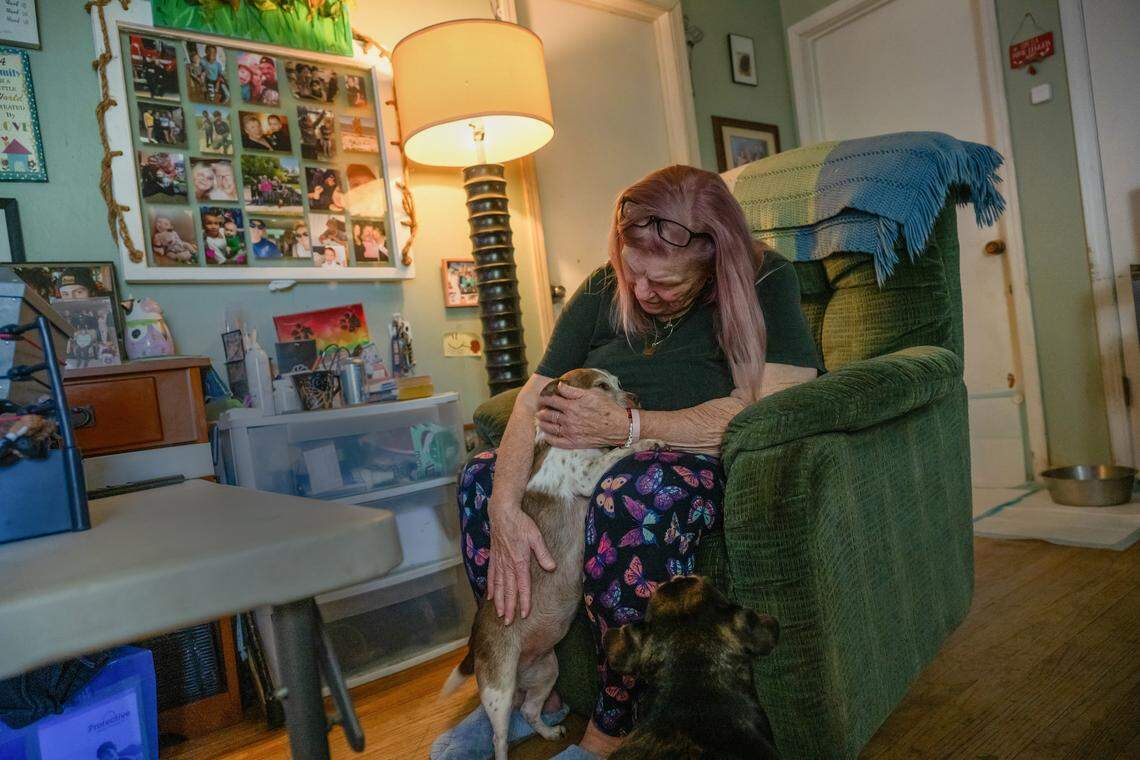
Erika was protective of him, and because she was already 14 when he arrived, she helped her older parents raise him. He was silly, and when he got a little older, he’d let Erika do his hair and paint his nails. He loved to sit right next to her on the couch and drape his limbs over her, even in his teens. He would trade secrets with his sister, Michelle. He never acquired that eye-rolling self-consciousness common in high schoolers — he always loved hugs from his family, and even though she kept declining, he repeatedly invited his mother to metal shows. As soon as he could form the words, he would tell Erika “I love you,” openly and earnestly.
“We were best friends,” Erika said, and added that he was also close with his oldest sister, Tiffany, and his youngest, Michelle. “He grew up in a household of girls, and you could tell. He was very sentimental, very caring.”
Erika had been a foster kid, too: She and her biological sister were the first two children placed with the Pringles, when Erika was just 18 months old. Her mother-in-law, Lucinda Witte, theorized that Erika clung to Drew so much because family was especially precious to her. She had learned as a toddler that she couldn’t take it for granted.
‘Never is mean’
Erika learned that lesson again when their adopted father died of respiratory failure in 2012. Drew had adored him, and Cheryl said that his first words were, to her astonishment, a full sentence: “Where’s my Daddy?” James died shortly before Drew turned 11, and the boy was quietly devastated, quitting baseball and soccer, drawing into himself.
But with the help of his sisters and mother, he pulled through the grief. He started up his humorous rambling again.
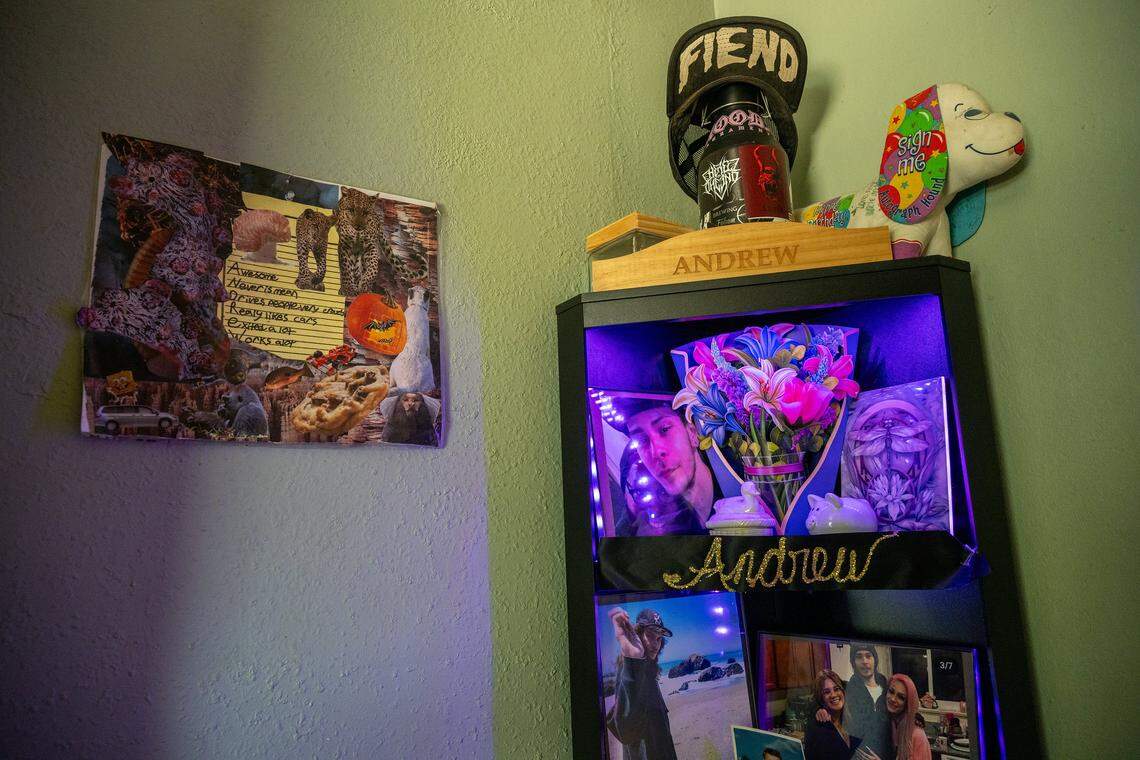
He had developed a stronger sense of self. In fourth grade, Drew was asked to make an acrostic of “Andrew” for school, defining who he was. Some of his choices were mundane or ridiculous: A was for “Awesome”; D was for “Drives people very crazy,” because he was such a chatterbox; R was for “Really likes cars.” But he wrote that the N in his name stood for “Never is mean.”
Erika saw that sweetness in him almost from the beginning. The boy had a soft spot for bugs, and they’d look for insects together. He refused to let anyone kill a spider in front of him. When he was older — around 17 — he jumped out of his mom’s moving car to scoop up a dog running into traffic on Folsom Boulevard, the very same dangerous road where he would later be killed. He adopted the little Chihuahua mix, and the weed smoker winkingly named her Mary Jane.
In his early teen years, Drew had begun to flail in school. The noise and bustle made him anxious, and he hated sitting at a desk. He bounced between a few campuses before landing at a charter school he liked with options for vocational classes. He took animal husbandry and brought home several chickens that he cared for in the backyard.
He never graduated from high school, but he had started talking about getting his GED and going to college. Everyone in the family expected he would live with his mother forever.
And why not? Cheryl was already the mother of two fully adult children by the time her sixth child came into her life; the version of Cheryl who raised Drew was different from the version of Cheryl who raised the other five. She was softer with Drew. You can’t really control the choices your children make, she had realized, and she wanted to be the person he turned to when things went wrong, not the person he hid from. She didn’t mind the weed smoking — it seemed to help his anxiety — and she didn’t mind driving him everywhere. She simply enjoyed his company.
By the time Drew was a teenager, only two things really mattered to Cheryl when it came to her relationship with her kids. “They have to know they’re loved,” she said, “and that they’re very safe.”
Erika felt the same way: All she wanted was for Drew to be safe. Before he died, she started tattooing again, and he wanted her to make his first piece. She refused.
“I was like, ‘I don’t want to hurt you,’” she said. “I was just so afraid to hurt him.”
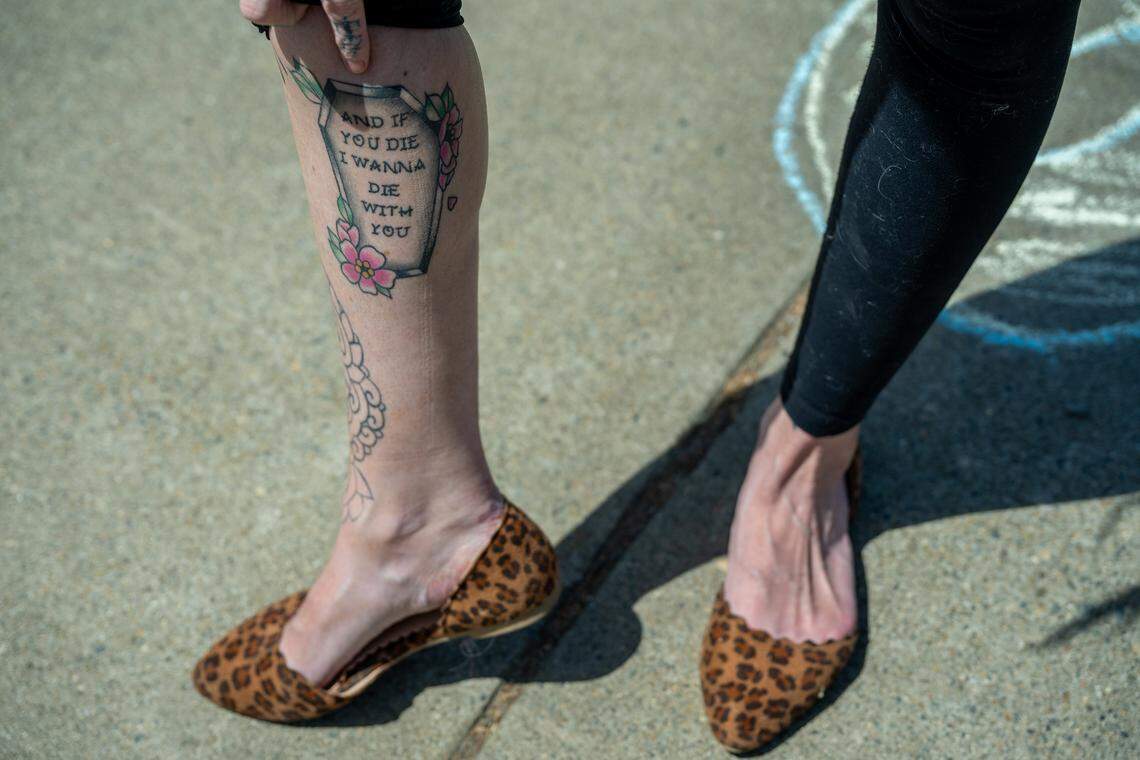
After his death, she and her sisters got tattoos of his fingerprint, with a trace of his ashes mixed into the ink. Erika did it so that she would never lose him.
After tragedy, joy comes with sorrow
Mourning has become a ritual for Erika.
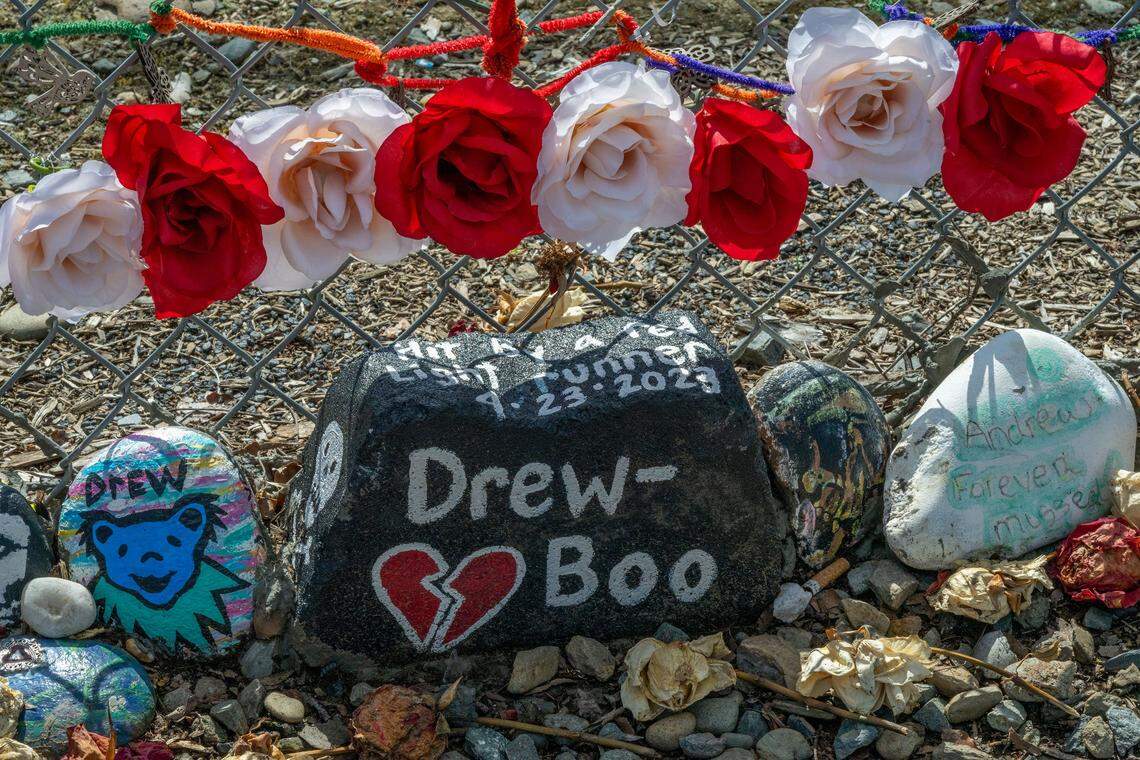
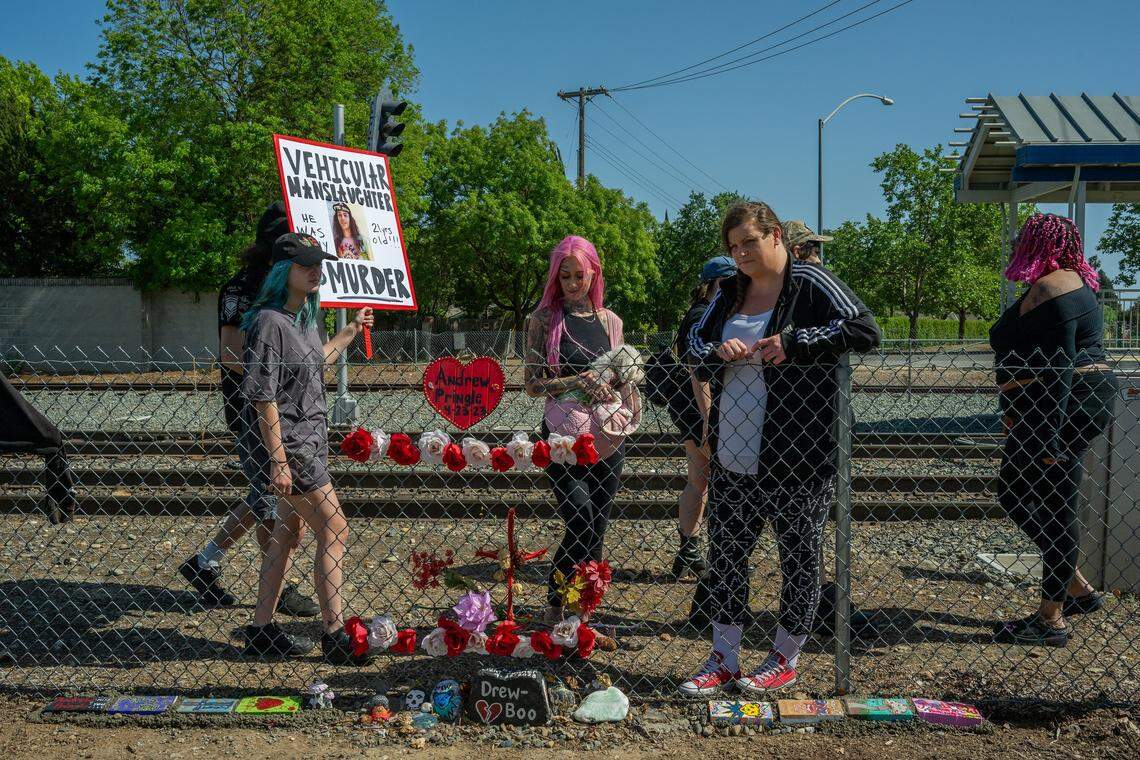
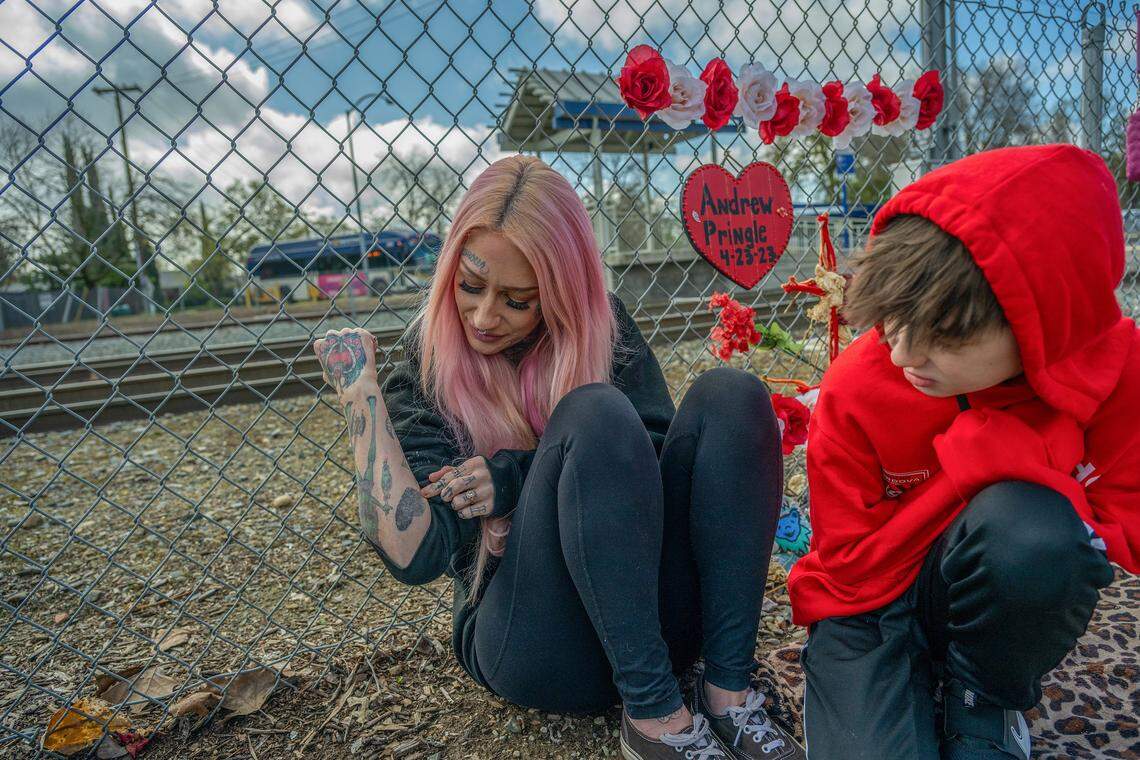
Twice a week, she sees her mother at the family home in Rosemont, and she also visits the nearby light rail station where she and his friends have set up a small memorial at the base of a chain link fence by the train tracks.
The intersection is an ugly expanse of asphalt, but she likes to see the last things that Drew saw; it feels to her as though he’s there. “For me, it’s relaxing,” she said. “It calms my noise in my head.”
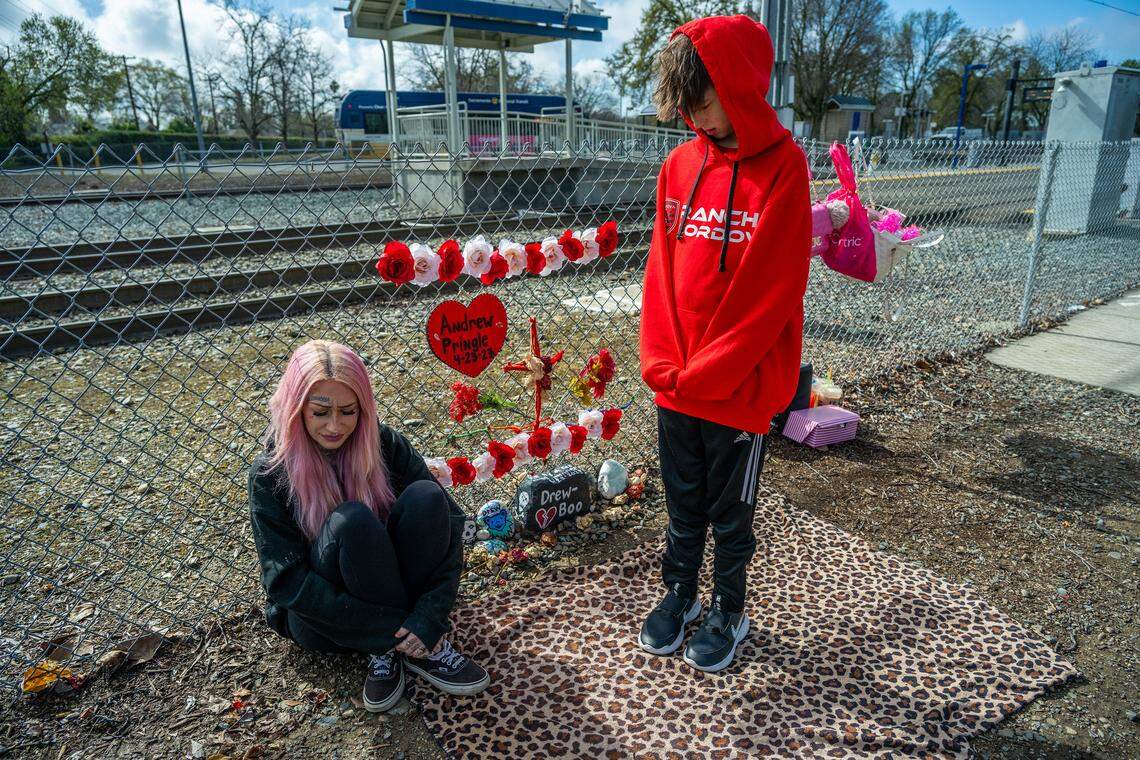
She brings something to sit on — often, a leopard-print blanket — and she sits with her back against the fence, looking at the street. The traffic roars past her in a near-constant rush. Sometimes she puts on headphones and listens to music Drew liked. Sometimes she pictures the crash and feels grateful that bystanders rushed to his side. Sometimes, she warns pedestrians to be careful crossing Folsom.
When strangers approach her outside the light rail station, she tells them why she’s there: her brother was killed, and now her whole life is infused with that grief. If they ask, she’ll tell them who he was. That he loved animals. That he was an organ donor, and his kidneys saved two lives. When she talks to people about Drew, she said, “It’s a very powerful feeling.”
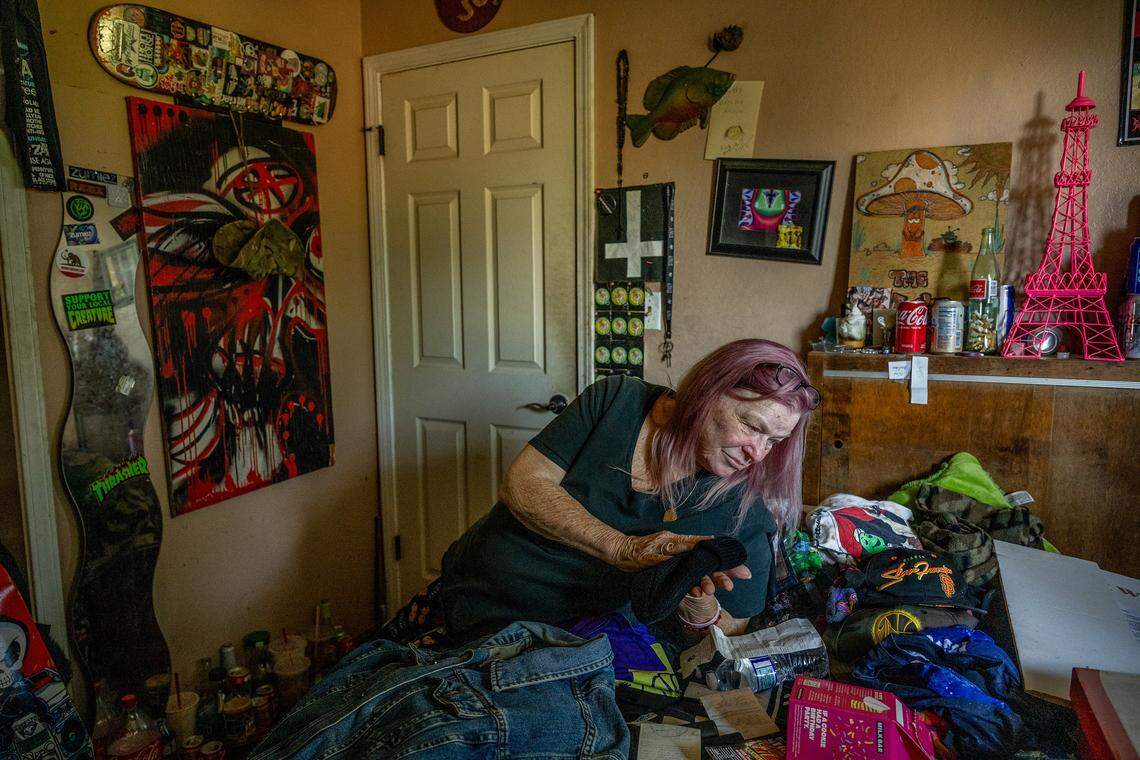
For two years, every time Erika went to her childhood home, she’d sit in Drew’s room on Drew’s bed. Cheryl had left the room almost untouched, with a lock on the door to make sure no grandchild snuck in unsupervised. The floor was lined with items that might have been classified as trash when he was alive: soda cups, beer cans, empty bottles. Because he was dead, every object had taken on a new meaning. It wasn’t a discarded Taco Bell cup; it was something Drew touched. Erika would sit on the bed and talk to him.
A year after Drew’s death, Erika hosted a metal show on his birthday. The crowd raged with the music; the mosh pit pulsed. They all sang “Happy Birthday” on the day he should have turned 23. The partygoers chanted his name.
She was surrounded by 200 of Drew’s friends, listening to the music he loved. To Erika, it felt like he was there.
On what would have been his 24th birthday, April 26, 2025, she gathered friends and family again, this time at a motorcycle clubhouse in Roseville. Cheryl — who jumped in the mosh pit briefly at the first party — hung out in the back, sitting on her walker and gently joshing Erika’s young son for wearing earplugs while a singer screamed into the microphone. The crowd was less boisterous than the one at the first memorial show, Erika said, but she liked seeing his friends. They moshed on the concrete floor. Everyone sang “Happy birthday” again.
But she’s decided that on April 26, 2026, she won’t host another metal show in his honor. Instead, that’s when she set her wedding date. She wanted to be “able to celebrate and do something every year,” she said, “and take him with me.”
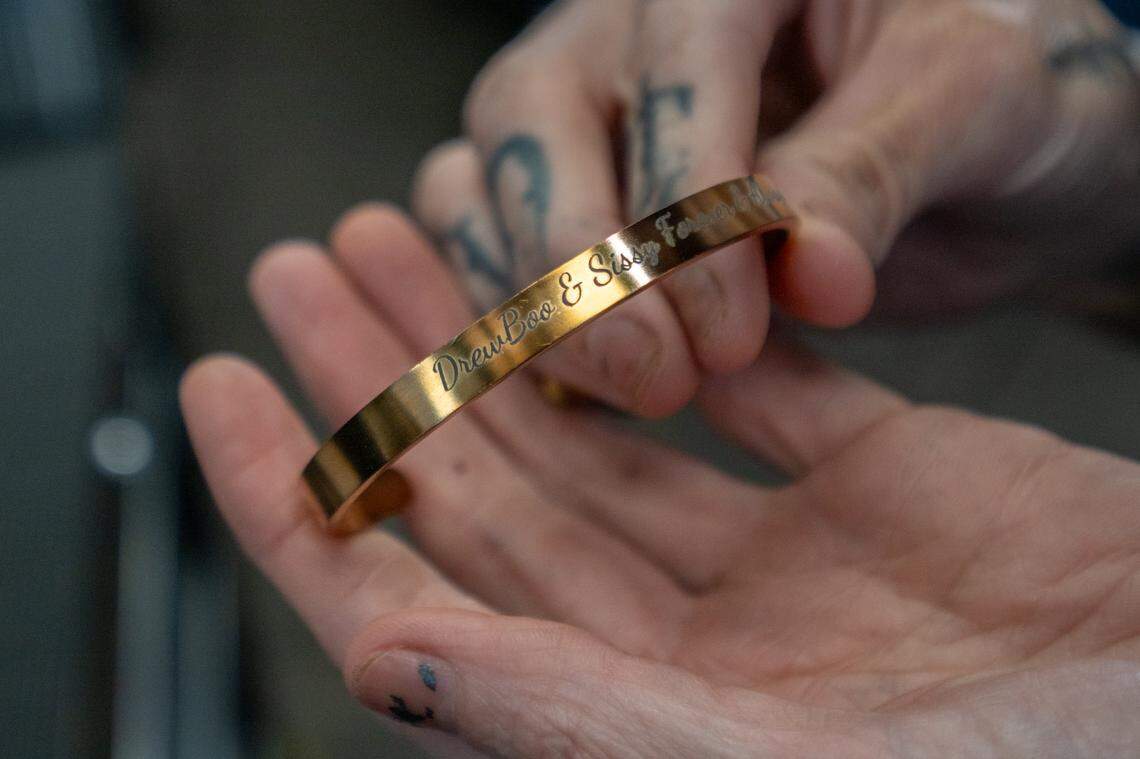
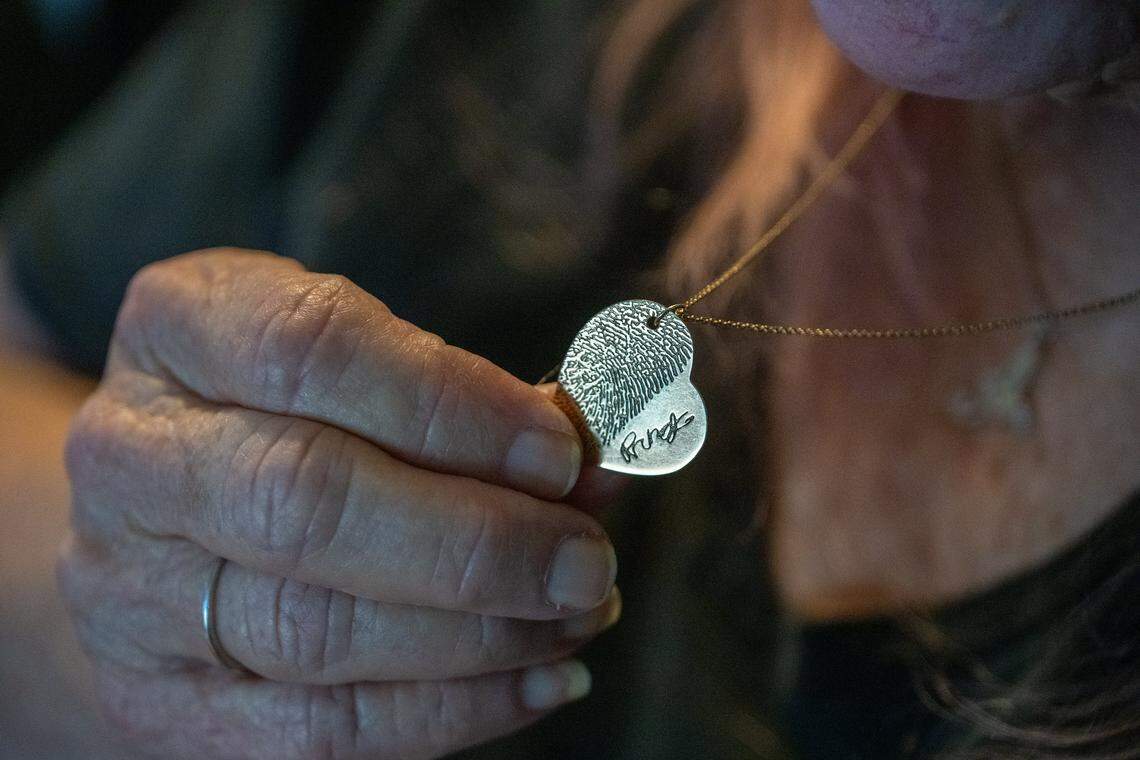
Drew will be at the wedding in so many ways. There’s his birthday, of course. But he’ll also be there in stories; he’ll be in the songs that remind everyone of him; he’ll be in his mother’s necklace, engraved with his signature; he’ll be in his sisters’ matching tattoos of his fingerprint.
And Erika will walk down the aisle wearing a black dress, in a veil of her brother’s absence.
The Bee’s Renée C. Byer contributed to this story.
This story was originally published November 13, 2025 at 5:00 AM with the headline "She says her brother was murdered. In California, the crash was an ‘accident’."
CORRECTION: An earlier version of this story misstated the driver’s sentence in connection with the death of Andrew Pringle. She received 240 days in jail with an option for work release, plus a year of probation. The story previously stated she was sentenced only to probation.
