
Drought Monitor map shows 0% of California is dry for first time in 25 years
For the first time in a quarter-century, no part of California was considered dry or in drought, according to the latest U.S. Drought Monitor assessment released Thursday.
The historic shift was first highlighted by Drew Tuma, a meteorologist for KGO-TV in San Francisco, after the latest weekly map showed 0% of the state’s geography was experiencing drought or abnormal dryness. Last week, areas around San Diego and the far northeast corner of the state were considered “abnormally dry.”
With the latest storms, every inch of the state was considered normal, which hasn’t happened since Dec. 26, 2000, according to the archive of assessments kept by the Drought Monitor’s researchers, who evaluate drought conditions across the country using rainfall, snowpack, soil moisture and water supply data.
Areas are classified from “abnormally dry” to “exceptional drought,” and the map is widely used by water managers, farmers and government agencies to assess current conditions.
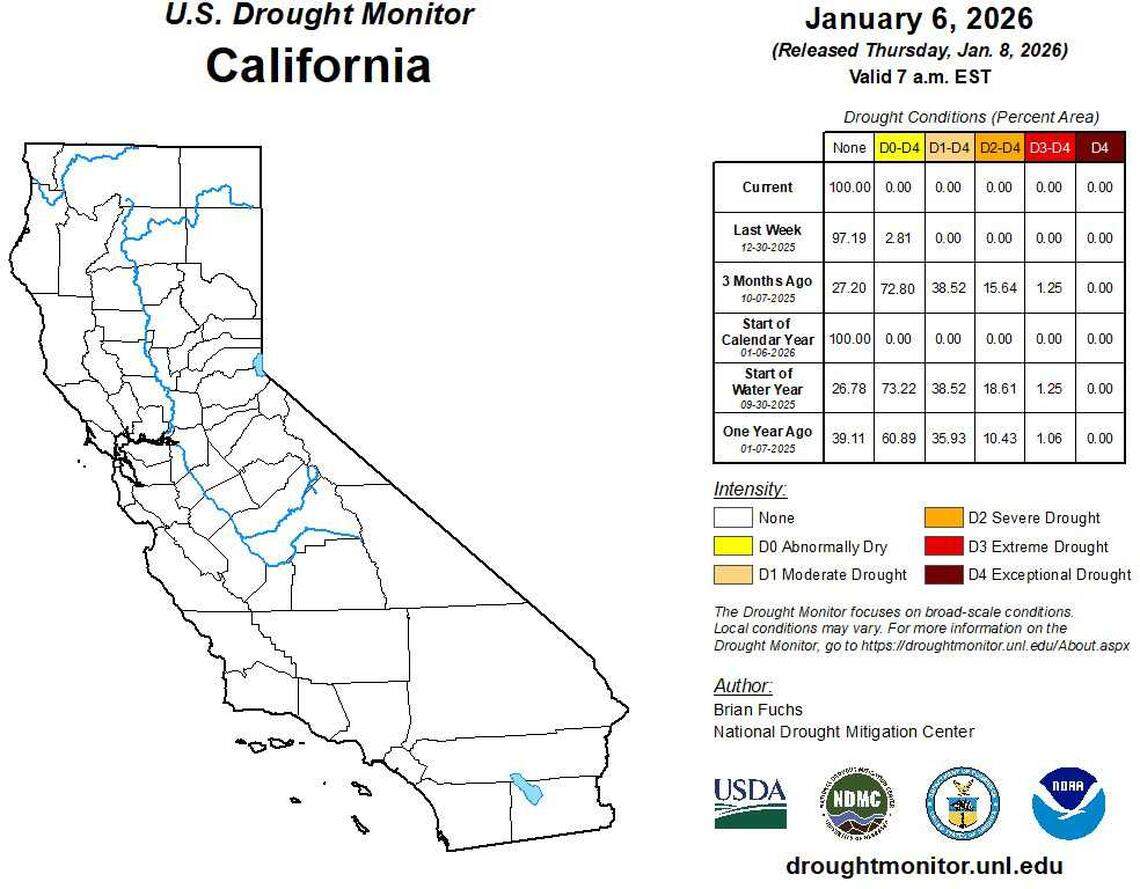
Michael Anderson, California’s state climatologist, credited the parade of storms that have moved over California since the fall, bringing steady precipitation across the region.
“Something that happened this year that did not happen last year — we had storms arrive right on time in October,” he said.
Many of the storms moved north from southern tropical climates or via the Pineapple Express that delivers atmospheric storms from Hawaii. Anderson said that shift, instead of the usual cold and dry weather patterns that move down from the Gulf of Alaska, helped Southern California especially see off-the-charts rain totals.
“Just to give you a sense of how big that was, looking at Ventura County for their November precip, they had over 7 inches of rain. Normally, they only get 1 inch in November.”
Los Angeles, for example, has seen 12.96 inches of rain since October, an 8,000% increase in its water-year totals from a year ago.
“Los Angeles has never seen a bigger year-to-year swing in precipitation from October 1 to January 1 since records began in 1878,” said Colin McCarthy, a UC Davis student studying the environment and climate change who tracks weather systems on social media under the handle @US_Stormwatch.
While the southern half of the state has benefitted from the warmer storms, the state’s overall snowpack outlook isn’t as rosy.
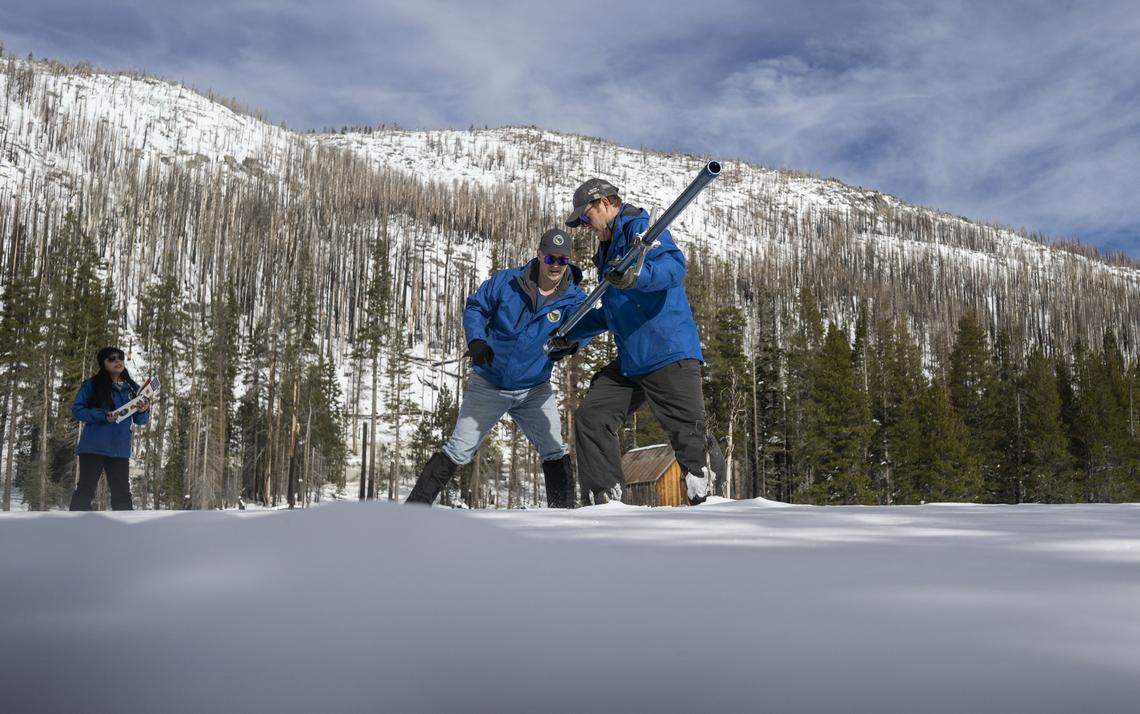
Early-season snowpack measurements have lagged behind last year despite the wet pattern. As of Thursday, California’s statewide snow-water equivalent stood at about 91% of normal for the date and a little over a third of the April 1 average, according to the Department of Water Resources.
Accumulation has been uneven across the Sierra Nevada. The Southern Sierra has tracked close to average for this point in the season, while the Northern Sierra — which supplies a large share of the state’s water — has remained below normal. That’s due in part to those warmer, southerly storms causing precipitation to fall as rain rather than snow.
As Anderson said, the storms’ tracks and the geography of the Southern Sierra’s higher mountains, home to Mount Whitney and more peaks over 12,000 feet, played a role.
“The number I like to use is 95% of the Sacramento basin is below 7,500 feet (elevation). Half the watersheds in the San Joaquin are above 7,500 feet. They have more watershed area to work with.”
Water managers have stressed that the snow season remains far from settled, noting that conditions can change as more storms arrive through March. Even a single cold storm could significantly boost snowpack totals.
What the map shows — and what it doesn’t
Statewide measurements as of Thursday reflect what climatologists described as an “exceptionally wet period” that replenished reservoirs and eased short-term water stress across California.
“If you’re younger than 25, you’ve always been living in a world where California is either entering or recovering from drought,” Tuma said in a segment broadcast Thursday. “It’s been a while.”
California in 2023 was declared drought-free for the first time in years after a winter barrage of storms and atmospheric rivers soaked the state. The state has seen three consecutive wet seasons since, which have helped soils hold on to moisture, reservoirs to refill and the critical snowpack of the Sierra Nevada to build.
Anderson said the clear map closely matched what residents experienced on the ground after repeated storms.
“Each map is kind of a snapshot in time,” Anderson said. “It agrees with what people experienced, and that’s a good thing.”
Brian Fuchs, a climatologist who works on the Drought Monitor at the University of Nebraska, said the milestone was notable because of California’s size and climate variability.
“It is significant to see such a large state be free of dryness, even though some areas are still seeing below normal snowpack for this time of year,” Fuchs said.
Climatologists like Fuchs cautioned that a blank drought map should not be mistaken for the idea that “everything is good and that conservation is not needed.”
“The next drought can start at any time,” he said.
Unlike a weather forecast, the Drought Monitor is a snapshot of recent conditions, not a prediction. Updated every Thursday, it reflects data through earlier in the week and shows where drought is occurring — not where it may develop next.
Anderson echoed that message, urging Californians to remain water-wise even during wet periods.
“We have this moment in time,” he said. “But we also know things change here in California.”
This story was originally published January 9, 2026 at 5:00 AM with the headline "Drought Monitor map shows 0% of California is dry for first time in 25 years."
