Dem CA governor candidates seek daylight during first debate
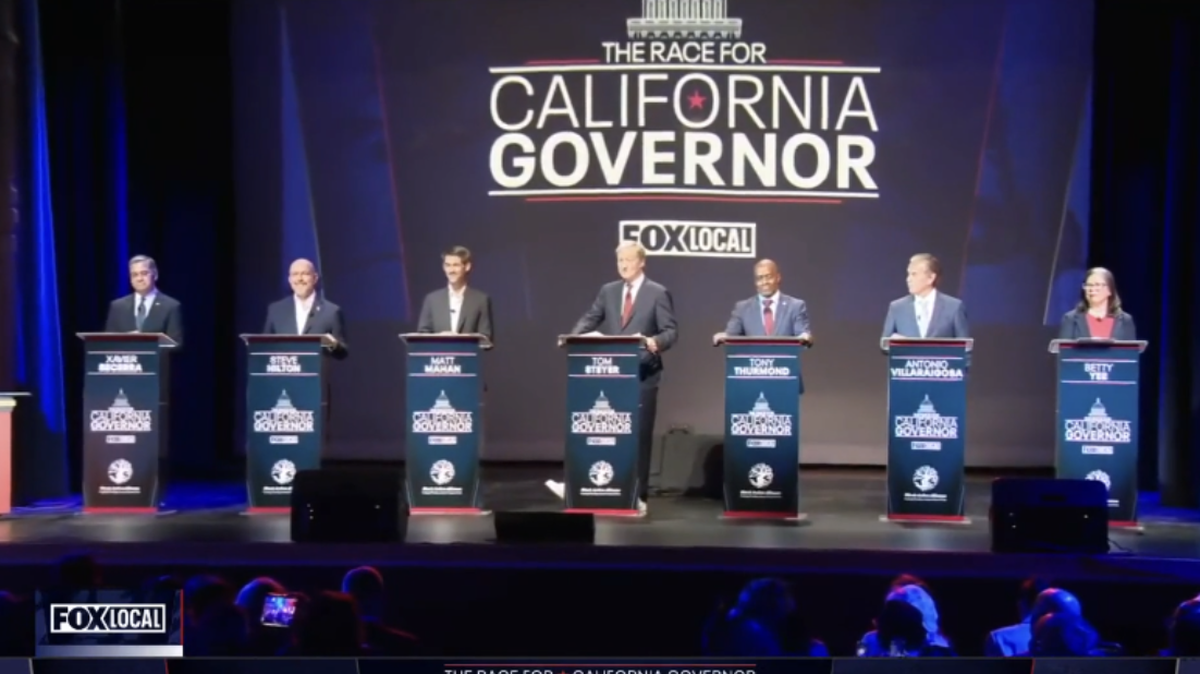
During a crowded Tuesday night debate in San Francisco where Democratic candidates endeavored to distinguish themselves, one interesting moment came when participants were asked if they supported a tax on billionaires.
A proposed ballot measure backed by the leaders of large California labor unions would impose a one time tax on the state’s billionaire residents. It has become a hot-button issue in California politics, including in a 2026 gubernatorial campaign that has otherwise lacked major fireworks.
For some of the candidates, the binary format of the question asked by debate moderator Marla Tellez — “a simple yes or no, would you support a billionaire’s tax?” — proved an undesirable one.
“No, if we’re talking about the initiative that’s maybe on the ballot,” former U.S. Health and Human Services Secretary and California Attorney General Xavier Becerra said.
“We should close loopholes billionaires use to not pay taxes,” San Jose Mayor Matt Mahan said. He opposes the wealth tax proposal.
“I believe that billionaires have to pay their fair share,” San Francisco investor Tom Steyer, himself a billionaire, said. He has expressed doubt about the design of the ballot measure as proposed but said he’d vote to increase taxes on billionaires.
Some candidates had an easier time.
“No,” Republican candidate Steve Hilton, a former Fox News host, said.
“Yes,” said California State Superintendent of Public Instruction Tony Thurmond, who carved out a distinctly progressive lane at Tuesday’s debate.
Former Los Angeles Mayor and California Assembly Speaker Antonio Villaraigosa joined Hilton in a simple “no,” while former California State Controller Betty Yee echoed Thurmond’s one-word “yes,” answer.
The question came at the tail end of a roughly two-hour debate hosted by KTVU Fox 2 San Francisco that saw largely civil sparring between six Democratic candidates and some audience booing directed at the lone Republican candidate, Hilton. Democratic candidates at times distinguished themselves from each other on housing, tax and climate policy, though they largely agreed with each other on the substance, if not on every detail, of proposed solutions to California’s biggest issues.
It remains to be seen if the debate moved the needle for any of the Democratic candidates in a race that lacks a clear frontrunner entering the event.
The two highest polling Democratic candidates, U.S. Rep. Eric Swalwell and former Rep. Katie Porter, did not participate. Swalwell told organizers he had to remain in Washington D.C. as the U.S. Congress navigated a possible government shutdown, according to Fox panelists. Porter had yet to offer a clear explanation for missing the debate, those panelists said.
“Did it hurt them? Probably, probably because voters got to hear from a stage full of candidates and they were not in the mix,” Los Angeles-based political strategist Jasmyne Cannick said, speaking on a panel after the debate.
Menlo College political science professor Melissa Michelson disagreed. Swalwell and Porter have established bases and are leading in the polls, Mickelson said, and didn’t need the opportunity to distinguish themselves as much as Mahan, a newcomer to the race, or other Democrats who have struggled to gain traction.
Hilton, meanwhile, used his introduction to attack his Republican rival in the primary, Riverside County Sheriff Chad Bianco. Hilton labeled Bianco a “Republican In Name Only” and called for the sheriff to drop out of the race so conservative voters could unite behind a single candidate.
Each Democratic candidate generally found a policy area or two in which to stand out, even if the distinctions were in some cases narrow.
Becerra proposed a program to provide home-buying capital to California’s minority residents. He also leaned on his record as state attorney general during the first Trump administration to say he would continue California’s current struggles with the White House if elected governor. Thurmond repeatedly raised the prospect of a state income tax credit paid for by a tax hike on billionaires. Yee joined Thurmond in that proposal, and said her experience as state controller to say she could clean up the state’s wobbling budget in a way that would protect its most marginalized residents.
Villaraigosa cited his fiscal experience, saying he’d led lawmakers to balance the budget as assembly speaker, a role he held from 1998 to 2000. He was one of several Democratic candidates to pursue a more moderate position on energy and climate issues, saying the state needs to ease regulations on oil refineries to lower the price drivers pay for gasoline.
Going into the debate, some political observers were looking for clashes between Mahan and Steyer, as the billionaire has been quick to challenge the mayor over who his campaign funding backers may be.
Steyer has cast himself as a candidate whose independent wealth would allow him to enact more sweeping change than someone who must raise a campaign war chest. He has vastly outspent his opponents on ads to date.
That clash stayed civil, and did not come until the closing remarks.
“Right now the big tech CEOs are terrified about the idea of paying their fair share,” Steyer said in his closing remarks Tuesday. “Right now they’re supporting Matt, that’s where they are… I’m the billionaire who is going to take on the billionaires for working families.”
Steyer also touted recent labor union endorsements he’s secured in the last two weeks, from the California Nursing Association and California School Employees Association.
Mahan was quick to respond. “I’ve got about three billion reasons not to trust your answer on that,” he told Steyer. Most media estimates put Steyer’s wealth at between $2 billion and $4 billion.
Mahan has sought to cast himself as a municipal government leader who put solutions over politics. On Tuesday, he repeatedly sought a middle path.
Politics, he said, “has become this bloodsport between populists on both sides.”
This story was originally published February 3, 2026 at 10:50 PM with the headline "Dem CA governor candidates seek daylight during first debate."