Historic Berkeley home with ties to ‘60s Black Panther movement is up for sale
AI-generated summary reviewed by our newsroom.
- 1920s Berkeley home at 1049 Keith Avenue is listed for $2.2 million.
- The house was designed and built by Paul Beygrau and his wife, Marie Beygrau.
- A visible “Free Huey” carving on the adjacent sidewalk links the house to 1960s Black Panther events.
A circa-1920s home in Northern California is on the market as equal parts residence, artwork and time capsule.
The hand-built showpiece at 1049 Keith Avenue in Berkeley, California, makes available masterful, French-inspired design and an unexpected connection to the Bay Area’s political upheaval of the 1960s.
The 3,425-square-foot, four-bedroom, four-bathroom property is listed for $2.2 million. Alex Michas of Compass is the listing agent.
The home was designed and built by artist-architect Paul Beygrau and his wife, master woodcarver Marie Rosalie Schaff, according to Compass, the brokerage that holds the listing. Their backgrounds read like a prelude to the house itself: Beygrau was London-born, trained in fine arts and architecture, and had earned recognition designing interiors for royal commissions in England and grand public buildings in Winnipeg, according to the home’s listing materials. Schaff, a woodcarver from Alsace, France, brought the kind of hands-on craft that still defines the property’s interiors.
In the early 1920s, the couple focused their talents on a personal project in Berkeley — creating a pair of neighboring homes at 1049 and 1051 Keith Avenue that would embody their shared artistic vision, according to the official listing. The work drew enough attention to land on the front page of the San Francisco Chronicle in 1928, described then as “the most remarkable expression of domestic art and architecture in the Bay Region.”
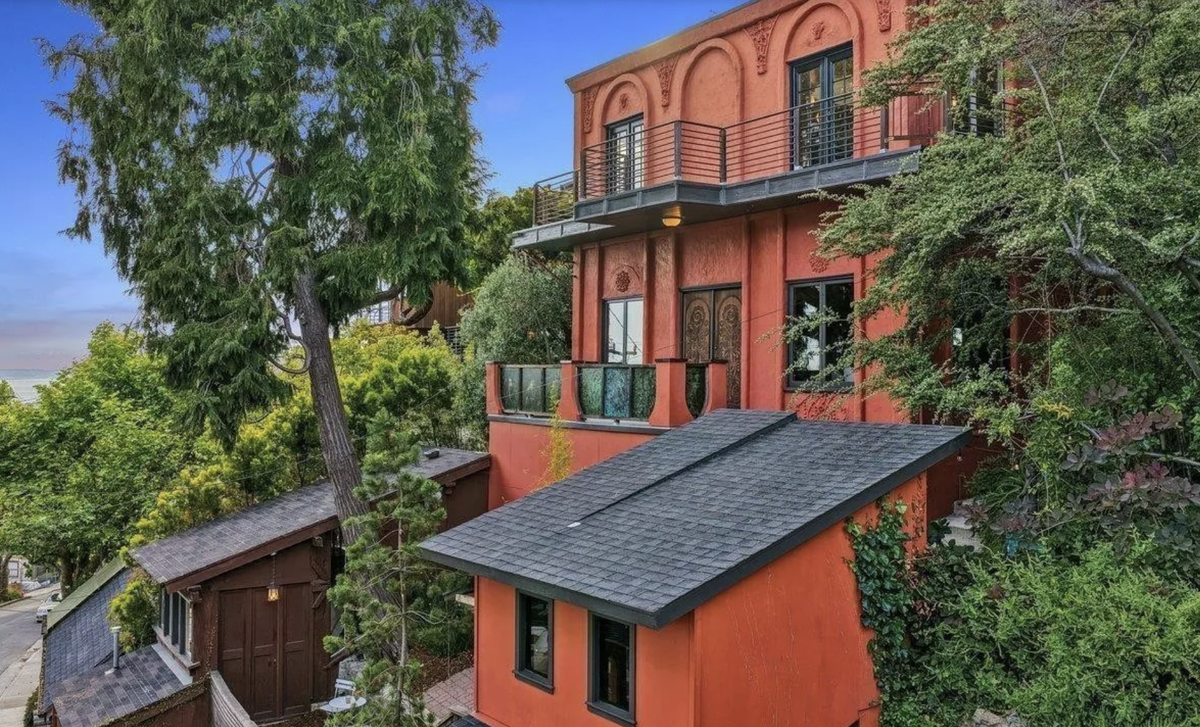
Nearly a century later, the line still fits: this isn’t a house where art is only hung on the walls — it’s embedded in the walls, doors and ceilings.
Compass ties the home to French Mannerism, also known as the Henry II style, a decorative European tradition associated with Fontainebleau-era interiors. The listing describes the result as a richly detailed blend of sculpture, plasterwork and woodcraft — an “immersive” environment that feels closer to a living artwork than a typical residence.
“Art, history, architecture and fantastic views all come together in the Berkeley Hills … this home has been the center of visual arts, gardening, music and political movers and shakers for over a hundred years,” Compass agent Alex Michas said in a statement via email.
The official property description reads like a guided tour through a private gallery. It highlights “massive, hand-carved wooden doors — reportedly shaped by Marie Beygrau herself,” intricate inlaid hardwood floors, and rooms with solid, hewn redwood wainscoting. Overhead, ceilings reflect Beygrau’s European fresco influences through sculptural plaster and painted finishes, giving the main living and dining spaces a sense of theatrical scale. Compass also points to a dramatic rotunda and a “Temple of Flowers”-inspired upper-level atrium.
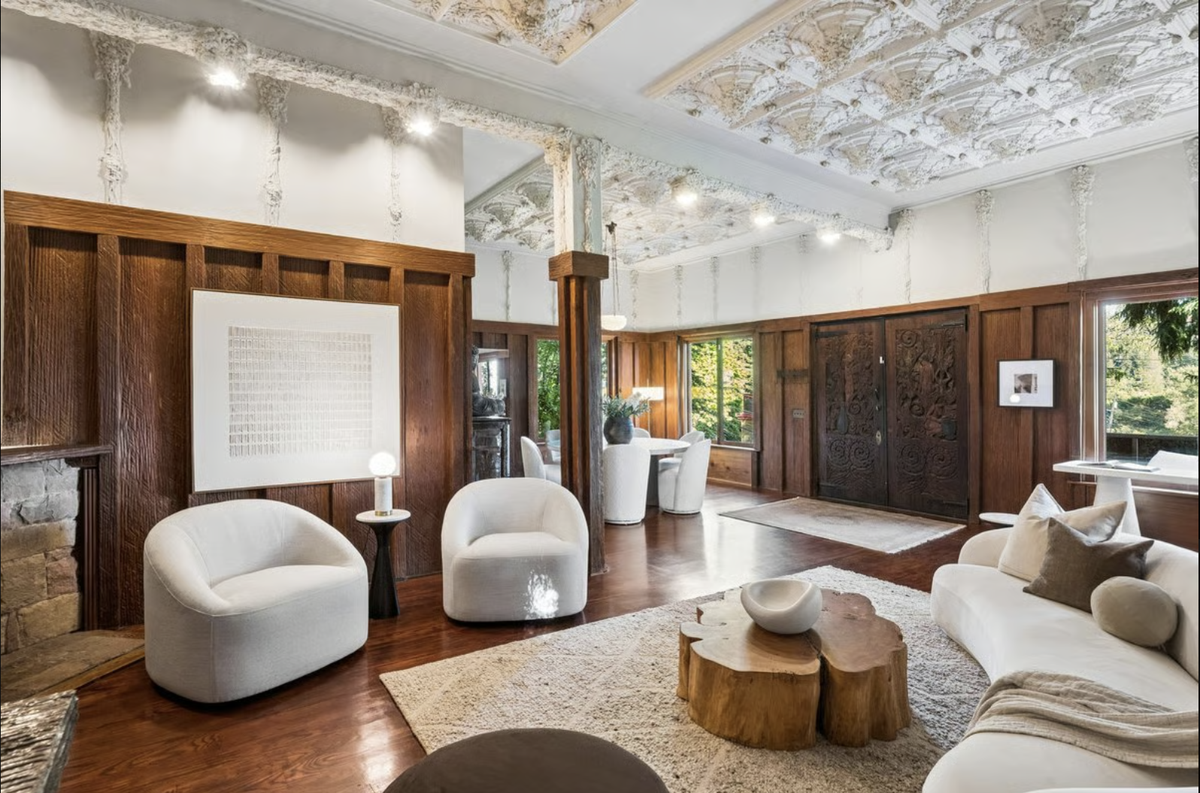
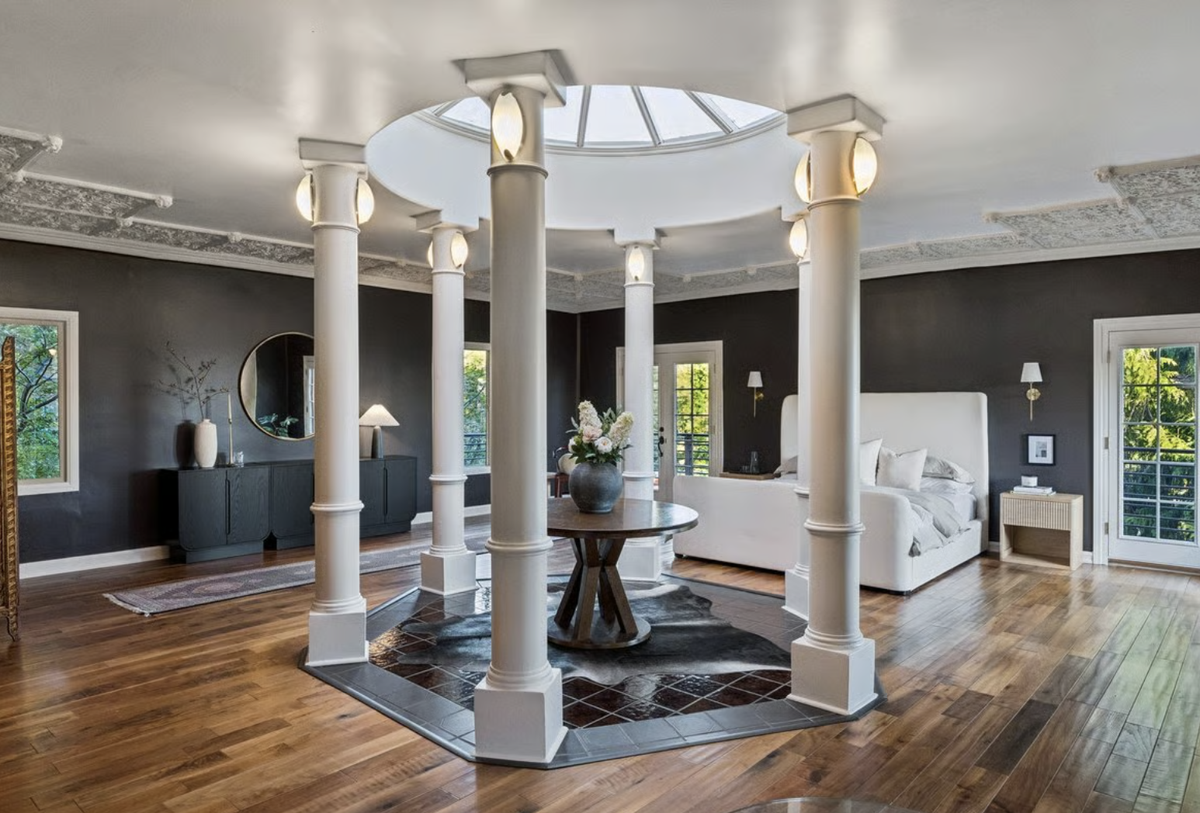
Upstairs, the listing describes an 800-square-foot primary suite “crowned by a columned atrium ceiling” and opening through French doors to a view deck. Two additional bedrooms provide contrasting moods — one wrapped in warm wood wainscoting, another a larger room with a fireplace, French doors to the garden and an ornamented ceiling. A detached apartment with a lofted sleeping area and its own terrace adds flexibility for guests or creative work.
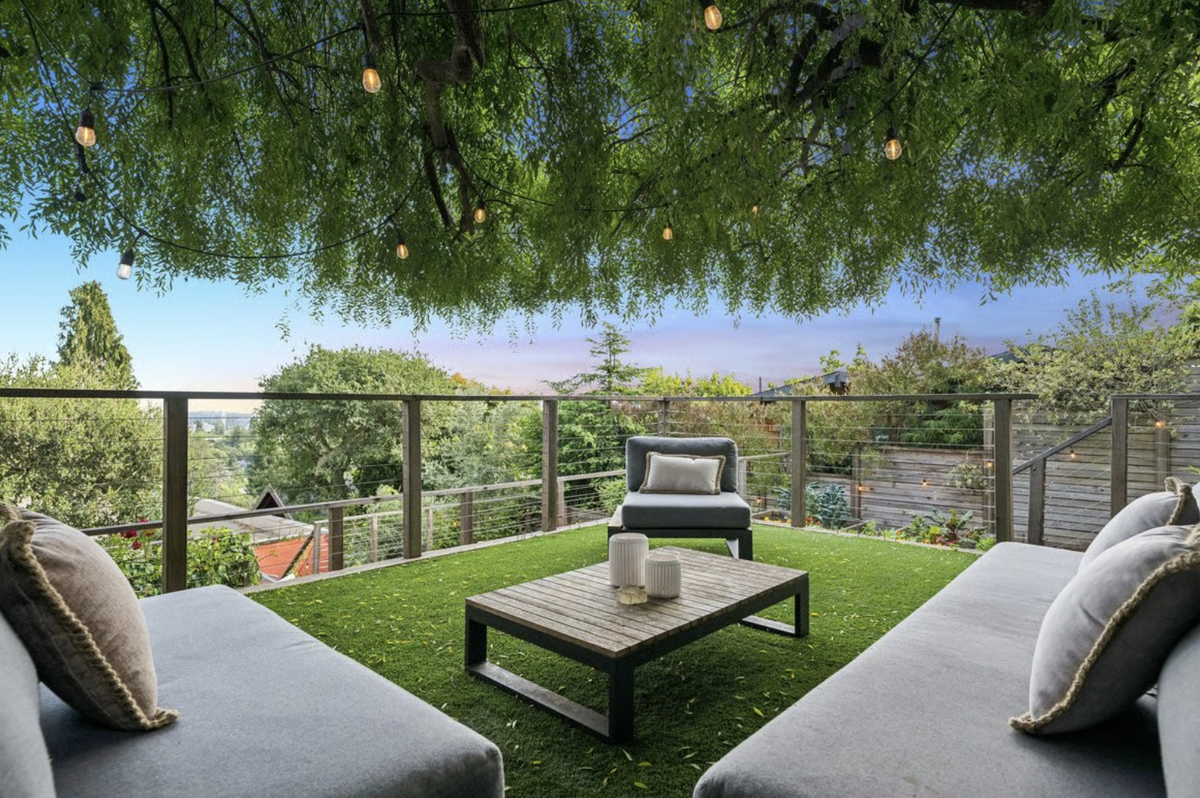
Outside, the property continues down the hillside in terraces meant for gathering, play and gardening, with landscaped areas and raised planting beds below.
What pushes the house beyond rare design, however, is the history attached to its walls — and even its sidewalk.
Compass says the property, later nicknamed the “Plaster Palace,” served as a gathering place for artists, activists and thinkers. Eldridge Cleaver visited and signed an accord here during the 1960s, and a press conference related to Huey Newton’s arrest was held at the home, according to Compass. A still-visible “Free Huey” carving remains on the adjacent sidewalk, the seller, Christopher Sobky, said.
In a note included with the listing, Sobky frames the home as something his family lived with rather than simply lived in.
“This is a property that has been in my family for nearly half a century. And it has never been just a house for us - it has always been part of the longer story.”
Sobky traces the home’s shifting identities over time:
“Originally known as ‘Villa Vine,’ then ‘The Castle’, and then in the 60s as ‘The Meeting House’ and finally the ‘Plaster Palace’” — a nickname he attributes to Cleaver.
“Extra historical fact, and as I mentioned the Black Panthers, the sidewalk outside adjacent to the wall still has a ‘Free Huey’ carved in it,” Sobky said. “I learned that the house was where the press conference for his arrest was held.”
For Sobky, the draw wasn’t only the grandeur but the atmosphere — “quiet, mysterious, and full of possibility,” he wrote — and later, the everyday livability.
“While the home was originally built by an artist in residence and reflects that creative spirit, what we came to appreciate most is how well it supports everyday life,” he said, describing years of family life, time outdoors and spaces that evolved with their children.
Michas said the home’s long arc — artistry, views and cultural history — is exactly the point.
“In the 1920’s, famed architect, Paul Beygrau known for designing for Royalty in Europe and amazing public buildings in Canada built his own palace in the Berkeley Hills. He said great art can be present on any scale and he and his wife created their artistic masterpiece.”
This story was originally published May 13, 2026 at 12:56 PM with the headline "Historic Berkeley home with ties to ‘60s Black Panther movement is up for sale."