
Officials gather in Fresno for high-speed rail groundbreaking
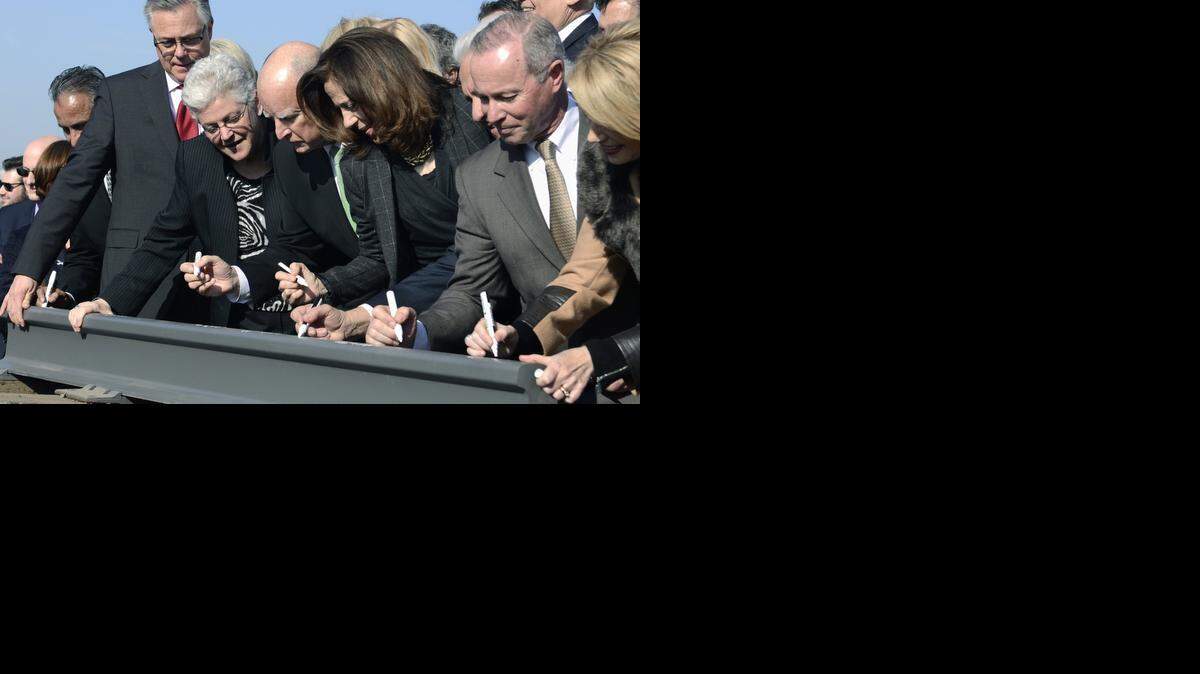
With California Gov. Jerry Brown leading the way, a ceremony Tuesday in downtown Fresno marked the start of construction on the high-speed rail project, more than six years after voters approved a $9.9 billion bond act that will help fund the system.
Brown and other dignitaries signed pieces of ceremonial rails, signifying that the project is underway.
The California High-Speed Rail Authority expects that millions of the traveling public will want to ride its sleek, 220-mph bullet trains between the Bay Area and Los Angeles when the system starts running in the early 2020s. But Tuesday’s ceremonial groundbreaking in Fresno for the controversial rail project – considered one of the largest public works efforts in California history – was an invitation-only affair for about 1,200 dignitaries and guests.
The event came two years after the original date for construction to start. California voters approved Proposition 1A, the $9.9 billion high-speed rail bond act, in November 2008. In 2010, when the Federal Railroad Administration announced that the Obama administration was pledging more than $3 billion in federal stimulus and transportation money to California’s high-speed train project (to be matched with money from Proposition 1A), officials touted a schedule that called for construction to commence in September 2012.
Fall 2012 came and went while the rail authority was seeking bids from companies to design and build the first construction segment of the statewide system, a 29-mile stretch from the northeast edge of Madera to the southern fringe of Fresno.
The High-Speed Rail Authority and the state have been targeted by a smattering of lawsuits challenging various aspects of the project, from the adequacy of environmental analyses for the Madera-Fresno and Fresno-Bakersfield segments to whether Proposition 1A bonds could be sold to finance construction, and from challenges of a 2011 draft financing plan to whether the rail system in its current proposed incarnation will be able to fulfill Proposition 1A requirements for a trip from San Francisco to Los Angeles in 2 hours 40 minutes or be able to operate only on its self-sustaining income without any public subsidy.
It has also taken longer than expected for the rail authority to acquire the property it needs and to string together enough parcels to accommodate major construction. Engineers with Tutor Perini/Zachry/Parsons began work on designing the route soon after their contract was signed in mid-2013. But it wasn’t until last July that subcontractors were able to begin clearing parcels and demolishing buildings along the route.
As of mid-December, the rail authority owned 101 of the 525 pieces of property needed for the Madera-Fresno segment. It also needs 539 parcels for its second construction segment, about 65 miles from the southern edge of Fresno to the Tulare-Kern county line.
What hasn’t changed since the federal grants began flowing four years ago is a Sept. 30, 2017, deadline for substantial completion of the rail sections in the San Joaquin Valley. That’s the date by which the state rail authority must spend its federal money.
Despite the downtown Fresno setting for Tuesday’s ceremony, the first major construction on the Madera-Fresno segment is anticipated to be at the eastern edge of Madera, where an elevated bridge will be built to span the Fresno River, Highway 145 and Raymond Road just west of the BNSF Railway freight tracks. Downtown Fresno is expected to be the site of some other early work, including relocation of utilities to make way for construction.
The rail authority has about $6 billion – a combination of the federal funds and matching Proposition 1A money – available to build the backbone of its system from Merced to Bakersfield. That’s a little under 20 percent of the $31 billion that it’s expected to cost to build the first operational segment between Merced and Burbank by the early 2020s. It’s also less than 10 percent of the anticipated $68 billion cost to build the 520-mile phase 1 system from San Francisco to Los Angeles by the late 2020s.
This story was originally published January 6, 2015 at 6:25 PM with the headline "Officials gather in Fresno for high-speed rail groundbreaking."