
Biden vowed to cut wildfire risk in California’s forests. Here’s how much he plans to spend
Three months ago, as smoke filled the air from a wildfire 75 miles away, the U.S. agriculture secretary stood alongside Gov. Gavin Newsom and promised to increase spending on forest-thinning and other fuels-reduction projects in California’s overgrown and increasingly flammable forests.
“Over the generations, over the decades, we have tried to do this job on the cheap,” said Agriculture Secretary Tom Vilsack, who oversees the U.S. Forest Service.
On Thursday President Joe Biden released a legislative package that would spend more than $15 billion over the next decade to help make forests less combustible in California and other states.
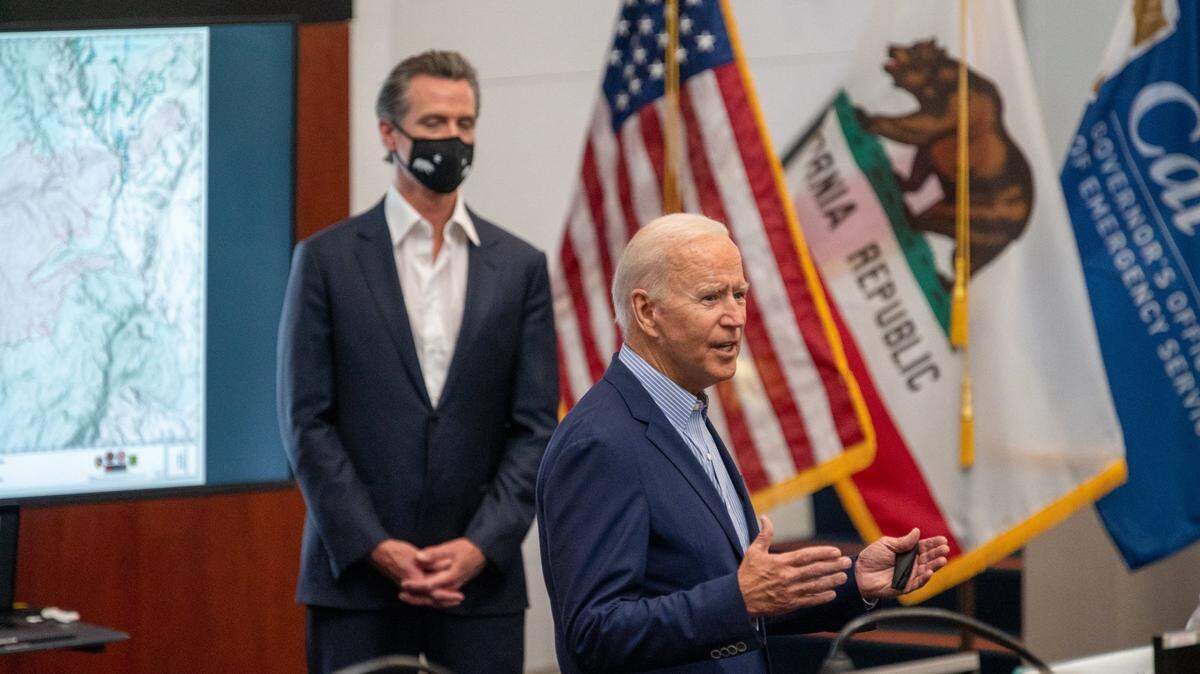
The proposal is part of a compromise $1.75 trillion “Build Back Better” spending plan that Biden unveiled in a nationally televised address, following weeks of negotiations with congressional leaders and holdouts within the Democratic Party. Biden campaigned for more spending for the Forest Service when he came to Sacramento a month ago and toured damage wrought by the Caldor Fire in El Dorado County.
Although his overall spending plan is about half the size of his original $3.5 trillion proposal, it does appear to represent a substantial increase in the federal government’s commitment to the state’s troubled forests.
“This is an absolute game-changer,” said Wade Crowfoot, secretary of California’s Natural Resources Agency. “If this holds, this would be a quantum leap.”
The bill language doesn’t spell out how much money would be spent in California. But Crowfoot said he assumes California would get a major chunk of the funding, based on “our share of hazardous wildfire threats.”
Last year Newsom and Forest Service leaders signed a nonbinding memorandum in which each pledged to thin and treat 500,000 acres of land annually. More than 6.5 million acres of land have burned in California the past two years, and Newsom and others have complained that the Forest Service needs to do more to prevent as well as fight wildfires. The agency controls 20 million acres in California, about one-fifth of the state’s total landmass.
In the past, the state has spent millions on fuels-reduction projects on Forest Service land, Crowfoot said.
“We’ve been subsidizing work on federal lands,” he said. “This underscored the need for the federal government (to increase spending).”
Bill Stewart, a forestry expert at UC Berkeley, said it’s been obvious the Forest Service needs the additional resources.
“The Forest Service right now is extremely expensive and not too effective,” he said.
Vilsack’s trip to California in August underscored the Forest Service’s troubles. Newsom had just publicly complained to Biden that the agency wasn’t moving aggressively enough to put out new fires. Other critics said the agency wasn’t spending enough on forest-thinning programs to tamp down the dangers of big fires.
During a visit to the Mendocino National Forest — site of last year’s August Complex Fire, the largest in the state’s history — the agriculture secretary acknowledged that the agency had a “rob Peter to pay Paul” mentality that took money from thinning projects and spent on fighting fires that had already broken out.
“We have tried to get by — a little bit here, a little bit there,” he said as smoke drifted into the area from the McFarland Fire in Trinity County.
“We are prepared to do a better job if we have the resources to be able to do this,” he added, referring to the budget negotiations getting under way in Congress.
Most mainstream fire and forestry scientists advocate some form of forest thinning as a means of reducing wildfire risk. Firefighters said extensive forestry projects around the Lake Tahoe basin in recent years were a major reason why the South Lake Tahoe area was spared major damage from the Caldor Fire this year.
This story was originally published October 28, 2021 at 2:11 PM with the headline "Biden vowed to cut wildfire risk in California’s forests. Here’s how much he plans to spend."