
‘Fuel for the next fire.’ Why California can’t unload the trees that worsen its wildfires
Niel Fischer’s company sits on an enormous stack of kindling — a staggering backlog of dead and dying trees that could catch fire again.
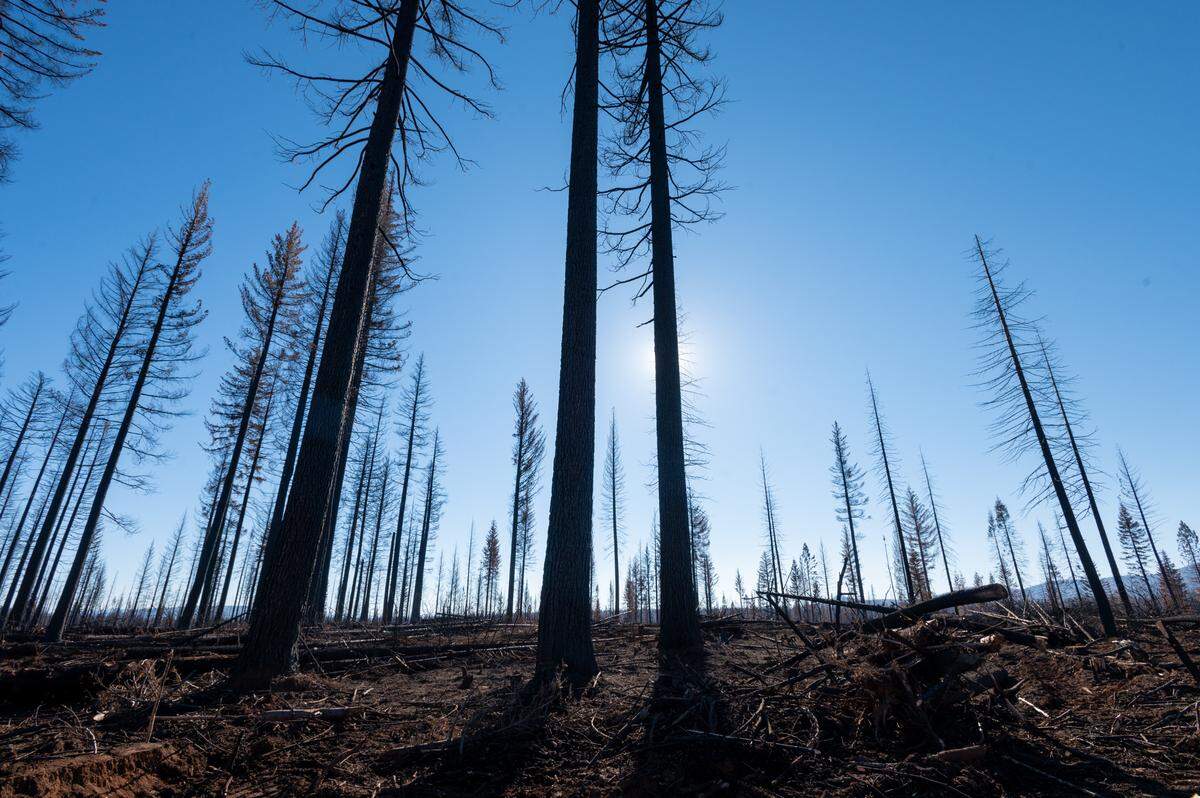
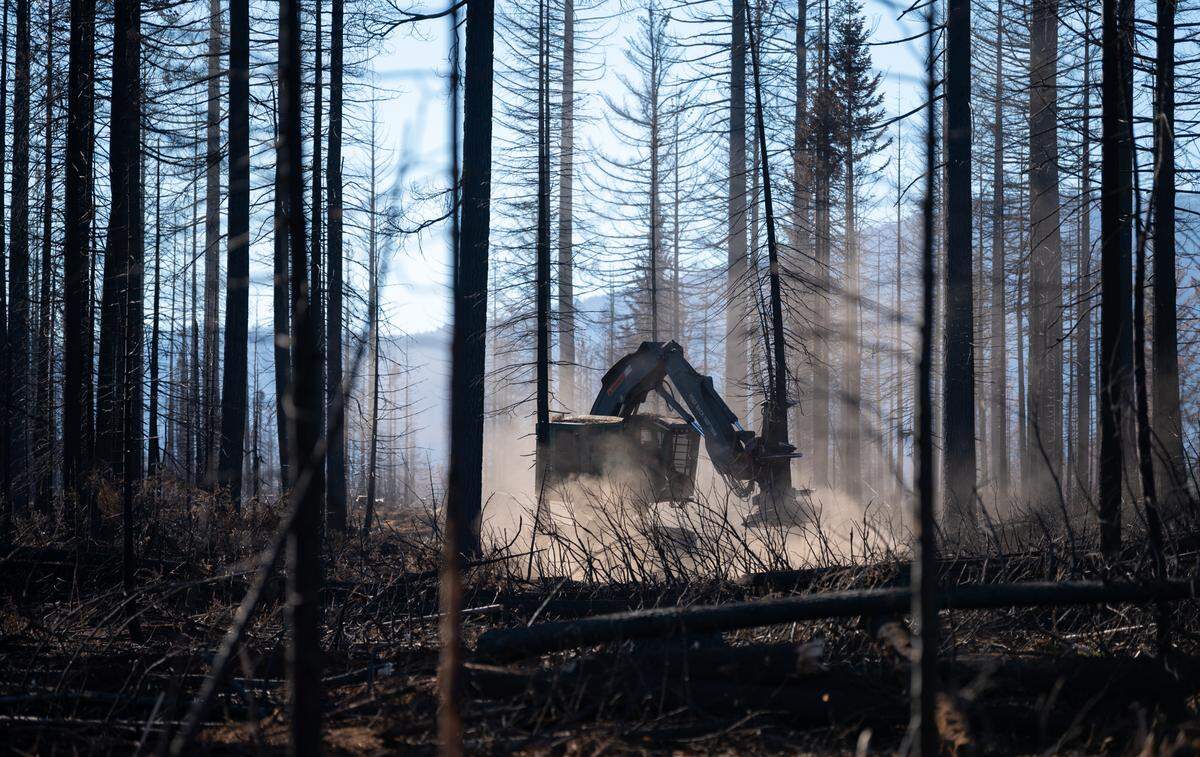
Collins Pine Co. was left with 30,000 acres of blackened pines and firs after the Dixie Fire ripped through the company’s private forest in Plumas County this past summer. There’s no way Collins’ lumber mill can process the trees quickly, and the same goes for neighboring lumber companies struggling with their own stock of burned, dried-out and combustible timber.
“Dead on the stump — I mean dead — we’re estimating 10 to 15 years of supply,” said Fischer, the resource manager at Collins. “They are at a high risk of burning again ... at a higher intensity level than would a green forest.”
California’s wildfire crisis is being fed by a host of problems, notably climate change and drought. The dilemma at Collins illustrates another contributing factor: a shortage of places for the state to process wood.
State and federal officials, as well as forestry experts, say California doesn’t have nearly enough lumber mills to process the trees — dead or alive — that need to come out of the state’s 33 million acres of forestland to reduce the risk of megafires. California suffers from a similar shortage of biomass plants, which make electricity out of trees and brush hauled out of the woods.
So the timber stays in the forests.
“It’s fuel for the next fire,” said Tim Robards, a staff chief at Cal Fire who oversees forest health and wood products issues.
Robards said the problem has worsened in the past two years, during which 6.7 million acres burned. The surge of dead and dying trees is clogging the state’s meager fleet of mills and biomass plants, he said.
The problem is intensifying at the very moment state and federal agencies are trying to reduce the density of California’s forests. The U.S. Forest Service, which manages 20 million acres of California land, says the shortage of mills and plants makes it hard to even plan the fuels-reduction projects it wants to undertake.
“We lack sufficient infrastructure to make as much progress as everyone would like us to do,” said Larry Swan, a wood utilization and biomass specialist with the Forest Service.
There’s no obvious quick fix for “this deficit of capacity,” as Robards called it. The facilities have been in decline for decades — lumber mills have been disappearing since the early 1990s, largely because of environmental restrictions, and the biomass industry has been battered by competition from cheaper energy sources.
“We had this robust infrastructure,” said Mike De Lasaux, a retired forester with UC Cooperative Extension. “Now we see these humongous piles of treetops and small trees that have no place to go.”
How to manage wildfires, forests?
Not everyone believes the remedy to California’s wildfire troubles consists of thinning forests or building more sawmills and biomass plants.
Some environmentalists fight the Forest Service in court over fuels-reduction projects, saying these programs are really an excuse to clear-cut forests of old-growth trees — which are more resilient to fire anyway. They say thinning out forests actually makes them more vulnerable to wildfire by removing shade and leaving the remaining vegetation to dry out in the sun.
When it comes to logging from a burned forest, some environmentalists say the trees should be left alone to provide nesting habitat for woodpeckers, owls and other birds. The Forest Service, in a 2019 study, acknowledges that post-fire salvage logging is “injurious to certain species,” although the impact can be minimized with the right equipment.
Crystal Kolden, a fire scientist at UC Merced, said the fire hazard posed by blackened trees isn’t as severe as timber industry officials argue it is. Even though dry trees are more dangerous, they’re fairly resistant to fire as long as they’re upright, Kolden said. Brush and small trees also often sprout where trees are removed, she said.
Nonetheless, a broad consensus has emerged about forestry and fire. Most wildfire scientists, Kolden included, agree that some form of thinning improves wildfire safety and forest health. It won’t erase the risk, but it can reduce the likelihood of a fire turning catastrophic. Some mainstream environmental groups, such as the Nature Conservancy, have embraced this strategy as well.
Government officials agree. Gov. Gavin Newsom signed a nonbinding agreement with the Forest Service last year that calls for the state and federal governments to eventually treat a combined 1 million acres of woods per year — roughly doubling the current volume of fuels-reduction work.
President Joe Biden’s Build Back Better legislation, pending in Congress, would appropriate billions for more aggressive forestry management projects. In September, Newsom signed legislation appropriating $1.5 billion to make the forests more resilient.
Layers of government are starting to throw money at the infrastructure problem, too. Biden’s proposal includes $1 billion to support facilities making wood products. The state’s “climate catalyst fund” has $47 million to promote biomass facilities, and the budget includes $50 million to develop a biomass pilot project.
But in the meantime, trees continue to accumulate in the forests, especially the highly combustible smaller ones.
“The estimated number of small-diameter trees that need to be removed exceeds the capacity of the existing mills and processing plants,” Kolden said. “It’s a bottleneck.”
Timber industry shrank
For decades, loggers harvested valuable old-growth forests with little interference from government. About 140 mills operated in California as recently as the 1980s.
The industry was already shrinking, though. Annual timber harvests dropped from 6 billion board-feet in the mid-1950s to less than 5 billion in the late 1980s, partly because of “inventory declines” of Douglas firs, according to a Forest Service analysis.
Then the hammer came down. The U.S. Fish and Wildlife Service placed the northern spotted owl under the protection of the Endangered Species Act in June 1990, and a federal judge ordered a halt to logging in the few remaining old-growth forests in California, Oregon and Washington. The Clinton administration allowed logging to resume in 1994 but with strict limits, and annual harvests in California have fallen to 2 billion board-feet or less.
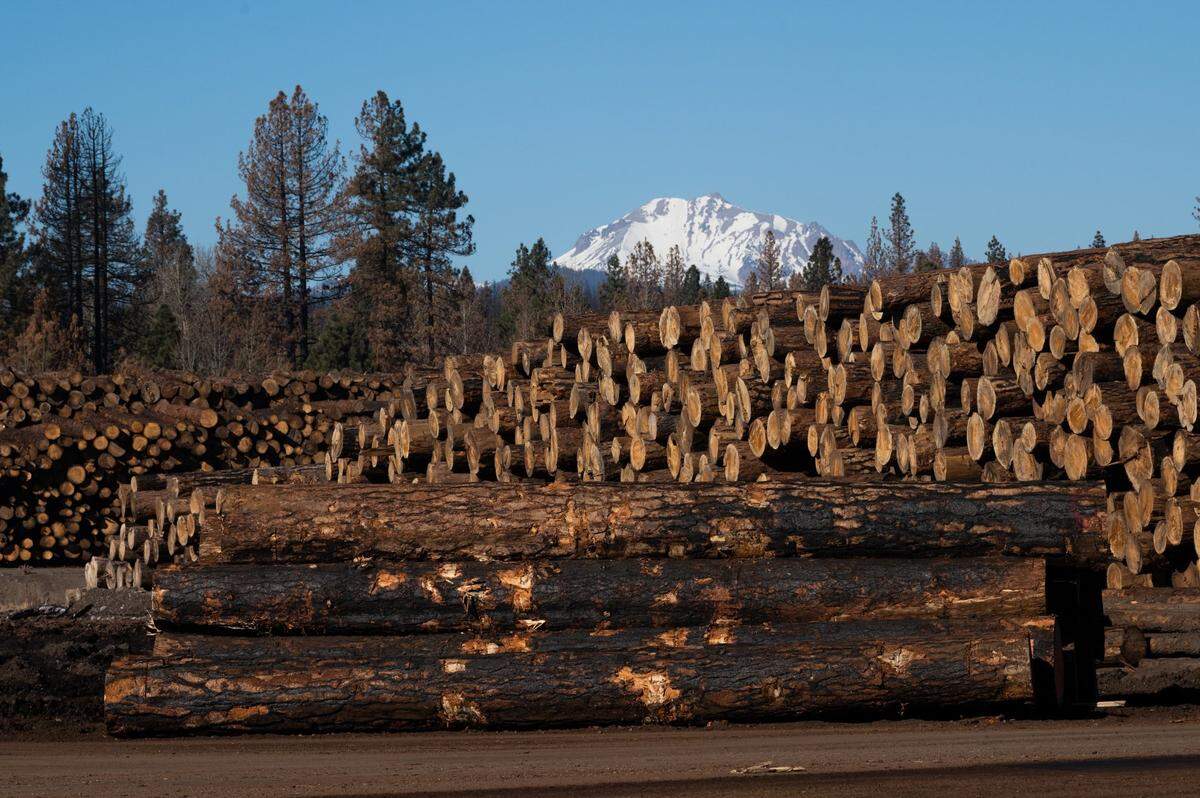
The state has fewer than 30 mills left — not nearly enough to process the cascade of trees that have burned the past two years. The Dixie Fire alone burned more timber on private land — 1.6 billion board-feet — than the state’s mills process in a typical year, according to the California Forestry Association, the industry’s main lobbyist in the state.
Dead or dying trees can be salvaged for lumber, but after a few years, they rot — if they don’t burn first.
“It’s truly a crisis,” said Matt Dias, president of the forestry association. “The industry at this point is completely overwhelmed with black wood, black logs.”
Rebuilding the industry is coming in small pieces. In the Auberry area of Fresno County, where the 2020 Creek Fire ravaged the Sierra National Forest, retired school-district plumber Kirk Ringgold has recently reopened a sawmill that closed almost 30 years ago.
Ringgold isn’t likely to become a lumber baron; this is more like a labor of love. He’s operating on a $250,000 Forest Service grant and his personal savings.
“This isn’t about a business plan,” Ringgold said. “It’s just something I’ve got to do.”
He has ample raw material: The Creek Fire burned 379,895 acres. Ringgold is trying to save what’s left.
“This is about a forest that’s going to burn down and we’re not going to have anything anymore.”
Biomass struggles
When Californians think of the timber industry, they probably conjure up images of logs being sawed into slabs of lumber for construction purposes. But when it comes to consuming wood, biomass is bigger.
Biomass, which feeds off brush and smaller-diameter trees that don’t have much value for lumber, takes in about 43% of the wood coming out of California forests, according to a 2016 study by the Forest Service. Just 32% is turned into lumber.
During a brief golden age of the 1980s and 1990s, when state and federal governments began requiring utilities to buy renewable energy, more than 60 biomass plants operated in California, said Tad Mason, an industry consultant in Rancho Cordova.
Then energy economics changed. Solar and wind prices plunged to less than half the cost of biomass. Turning wood into electricity became noncompetitive. Today, California has just 22 biomass plants, Mason said.
“The wind blows for free and the sun shines for free,” said Julee Malinowski-Ball, executive director of the California Biomass Energy Alliance. “Biomass energy ... needs to be trucked, chipped, moved to a facility. That takes a lot of manpower, it takes a lot of equipment, and it costs.”
PG&E Corp. buys more biomass energy than anyone in California — 260 megawatts’ worth, enough to power nearly 200,000 homes. But that’s a fraction of PG&E’s solar and wind usage.
“We are always looking for the best value for our electric customers,” said PG&E spokesman Paul Moreno.
Biomass has its critics. Some environmentalists cite the emissions from the plants. But the industry says the alternative is more megafires.
“It’s a tragedy,” said Brett Storey, the recently retired biomass manager for Placer County. “All of that material would be utilized instead of going up in smoke every summer.”
Storey spent years trying to get a biomass plant built near Lake Tahoe. A proposed site near Kings Beach faltered when residents and local officials objected to an industrial facility opening in the Tahoe basin. County officials then chose a spot near Truckee, but that fell apart four years ago when they couldn’t make a deal with the area’s electric company, Liberty Utilities, to buy the plant’s energy.
Now the county is trying again. After the Caldor Fire nearly burned down South Lake Tahoe this summer, county officials are taking a fresh look at the biomass project.
“There’s just a great sense of urgency,” said Kerri Timmer, the county’s regional forest health coordinator.
The state has tried to revive the industry, with some success. An auction-based program called BioRAM, which requires utilities to purchase biomass power, has enabled some plants to garner higher prices for their electricity than they can negotiate on their own. The program has saved at least one plant that was about to shut down, Burney Forest Power in Shasta County.
But not everyone’s eligible.
In the Sierra County town of Loyalton, the American Renewable Power biomass plant was consuming 100,000 tons of wood annually until it closed last year. One reason was price: Because of issues around its connection to the power grid, the Loyalton plant wasn’t eligible for the BioRAM program and couldn’t negotiate a decent rate for its energy.
Jeff Holland, who runs a logging company near Placerville, purchased the Loyalton site for $825,000 and is trying to resume operations. But startup costs are higher than expected, and he isn’t sure when it will reopen. He thinks the state must do more to support biomass.
“Logical thinking people who are tired of breathing smoke and tired of losing our national treasures believe biomass should be in the picture,” Holland said.
Burning wood in the open air
Biomass plants are so limited in number, it often doesn’t pay to haul the wood out of forests that have been thinned. Instead, it gets stacked up and burned in the open, polluting the air.
“For a lot of that biomass that’s being produced, particularly in the forested areas, there isn’t a market for it,” said Steve Eubanks, a retired Forest Service official who’s trying to build a biomass plant near Grass Valley. “They’re either leaving it on the ground or piling it or burning it.”
Often, the piles sit a long while. The regional air district has to issue a burn permit. The weather has to cooperate — if it’s too windy, the fire could blow out of control, as when the Caples Fire burned part of the Eldorado National Forest in 2019.
“It’s a struggle to burn our piles, and, yes, we have a backlog,” said Swan of the Forest Service.
It pains Steve Wilensky to watch the wood pile up.
A former Calaveras County supervisor, Wilensky runs a nonprofit called CHIPS that has conducted fuels projects on thousands of acres in the area. He’s also spent years trying to build a biomass plant in Wilseyville, at the site of a shuttered lumber mill.
The idea is to generate income to fund more work in the forests. He’s raised investment dollars and struck an attractive deal to sell power to PG&E.
But the project has run into an obstacle — a labor-backed group called Citizens for Responsible Industry.
The group tried to scuttle the project at a meeting of the county Planning Commission last month. Kevin Carmichael, a lawyer for the group, told commissioners the plant would emit “toxic air contaminants.”
Although the commission OK’d the project anyway, Wilensky said the labor group is appealing to the Board of Supervisors.
Carmichael didn’t respond to requests for comment. Wilensky, though, said the group is trying to “greenmail” the county into forcing him to use union labor at the plant.
Wilensky is a former organizer with the Service Employees International Union. But he wants to hire area residents for this project and thinks what Citizens for Responsible Industry is doing is deplorable.
“All they’ve got is the leverage to kill projects like ours,” he said. “We’ll win this thing, but it won’t be easy.”
‘A catastrophic loss’
The Dixie Fire was 3 weeks old, on its way to becoming the largest fire of 2021 and the second-largest in state history, when it turned its fury on Collins Pine in early August.
Winds of 30 mph drove the fire north toward Collins’ complex in Chester, near the Lassen National Forest. The Collins mill was saved, but portions of the town burned. About 30,000 acres of fir and pine trees belonging to Collins perished, representing about one-third of its forest.
“A catastrophic loss,” Fischer said.
Collins, which is headquartered in Oregon, has a reputation for sustainability; its practices have been certified by the Forest Stewardship Council, an environmental organization from Germany. Fischer said Collins preserves many old-growth trees, and “we never cut more than we grow.”
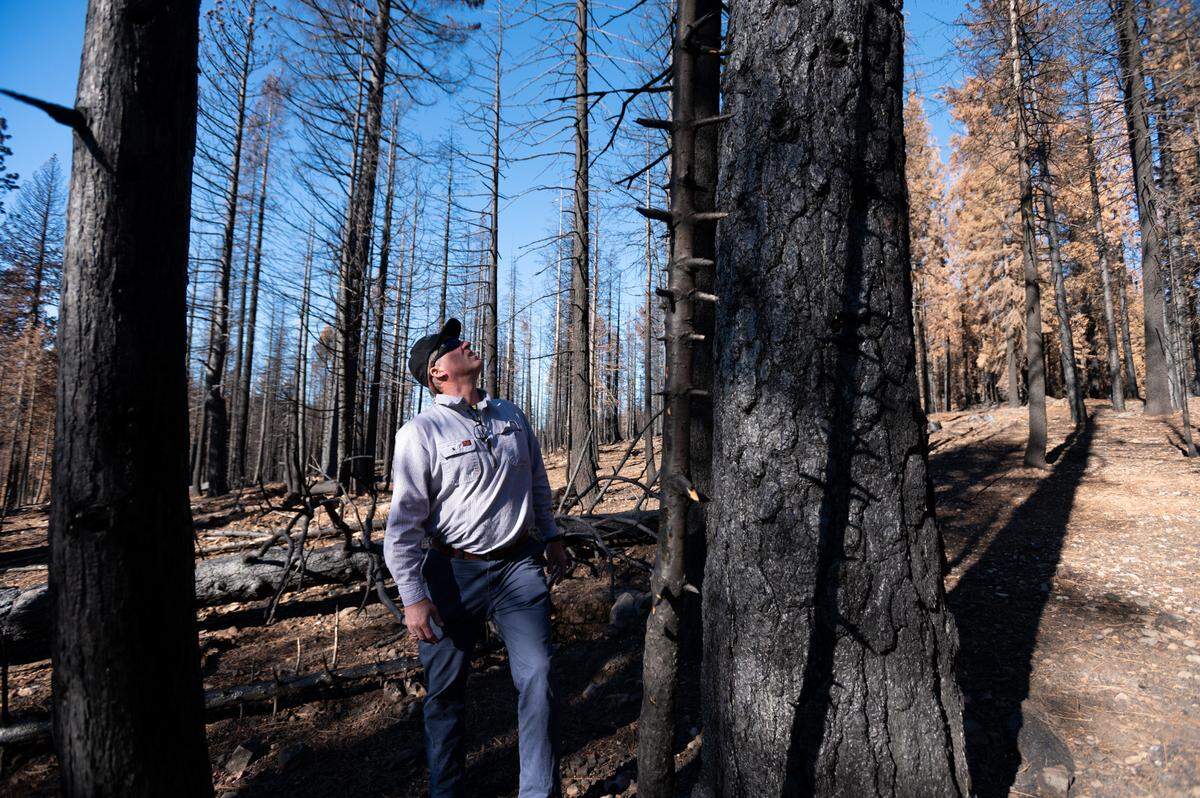
But now it’s racing to pull damaged trees out of its Plumas County woods as quickly as it can — big and small, young and old.
“Dry fuel constitutes a higher threat,” Fischer said. The problem worsens in future years as brush starts to grow back: “You end up with a very ripe acre for fire.”
Fischer said many of the trees will surely rot before they can be harvested. “We’re doing triage,” he said.
About 30 miles south, in the town of Crescent Mills, Jonathan Kusel is on a mission.
A sociologist who runs the nonprofit Sierra Institute for Community and Environment, he has secured grants to open a small mill near the Dixie Fire burn area.
It’s a modest operation: three machines in a parking lot where a Louisiana Pacific mill closed decades ago.
“If we had $1 million, this would look different,” Kusel said.
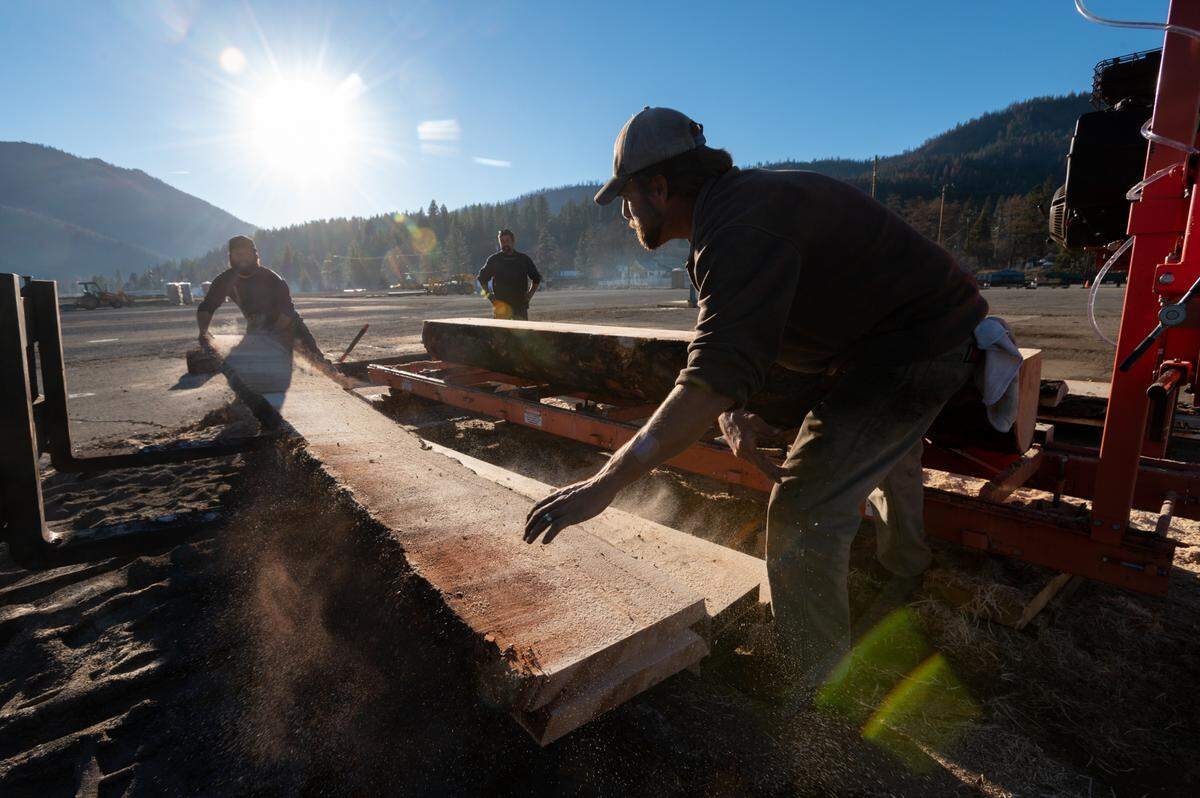
But his ambition is enormous. Partnering with J&C Enterprises, a local timber company, Kusel’s group has begun carving lumber out of trees burned in the Dixie Fire. He wants to hire people, reduce fire danger and supply lumber for nearby Greenville, which was largely wiped out by the fire.
“It’s about rebuilding Greenville,” Kusel said. “We are trying to rebuild hope.”
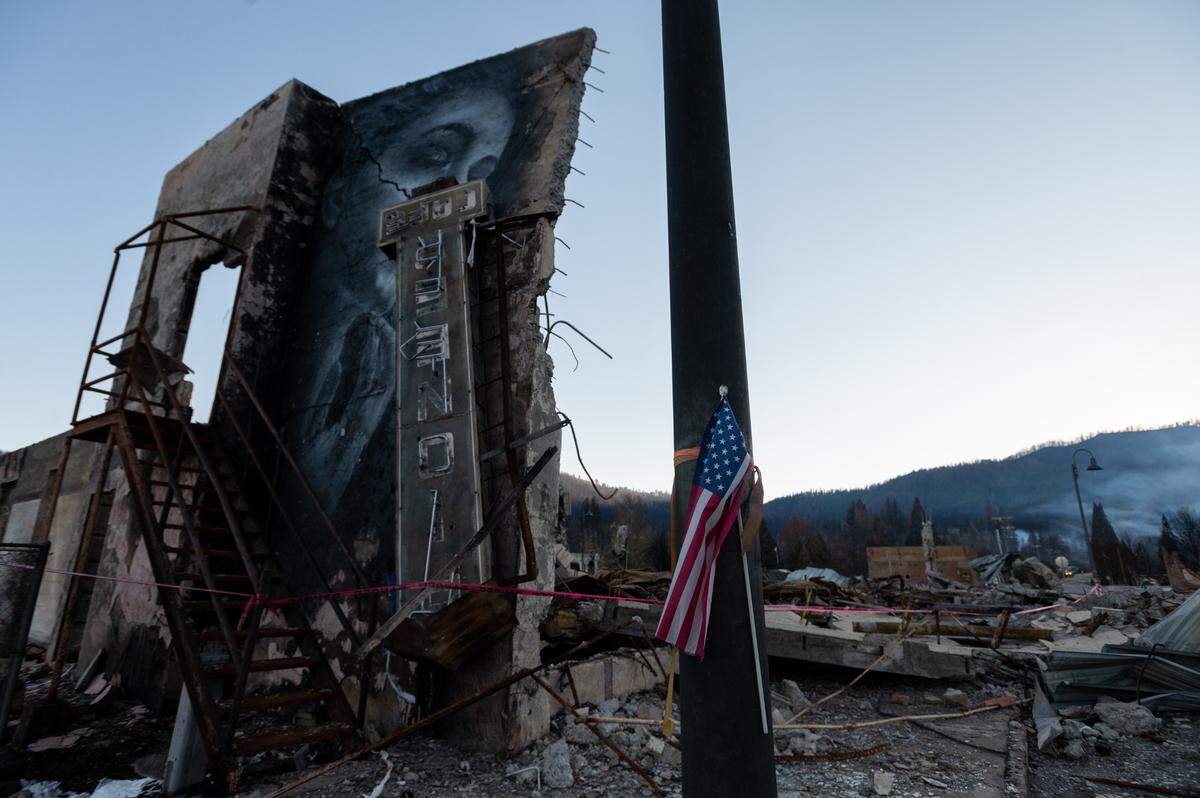
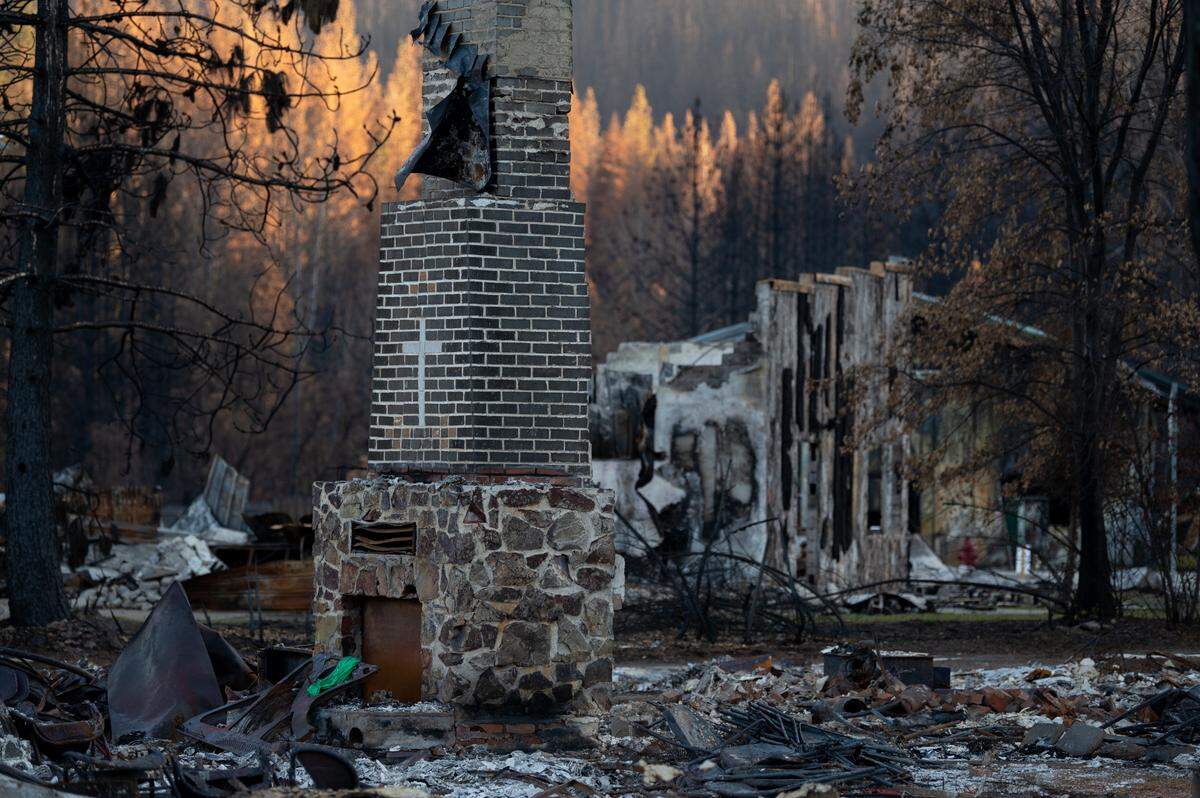
Hope is in short supply in the town of 1,200. Greenville lost 400 homes and most of its downtown; the landscape is littered with rubble and heaps of twisted, blackened metal.
Sitting at his desk recently at one of the few open businesses, the Indian Valley Community Services District, Jeff Titcomb said the fire “was really the death knell” for a town already in decline. Titcomb said he and his partner lost their home and a motel to the fire.
Titcomb is treasurer of the Chamber of Commerce but struggles to muster any of the optimism usually associated with that organization. Asked whether lumber from a new sawmill could bring Greenville back, he shrugged.
“Good luck,” Titcomb said. “It’s going to take two decades to do so.”
This story was originally published December 19, 2021 at 5:00 AM with the headline "‘Fuel for the next fire.’ Why California can’t unload the trees that worsen its wildfires."