
‘We have no beds open right now.’ Merced County hospital still reeling from COVID surge
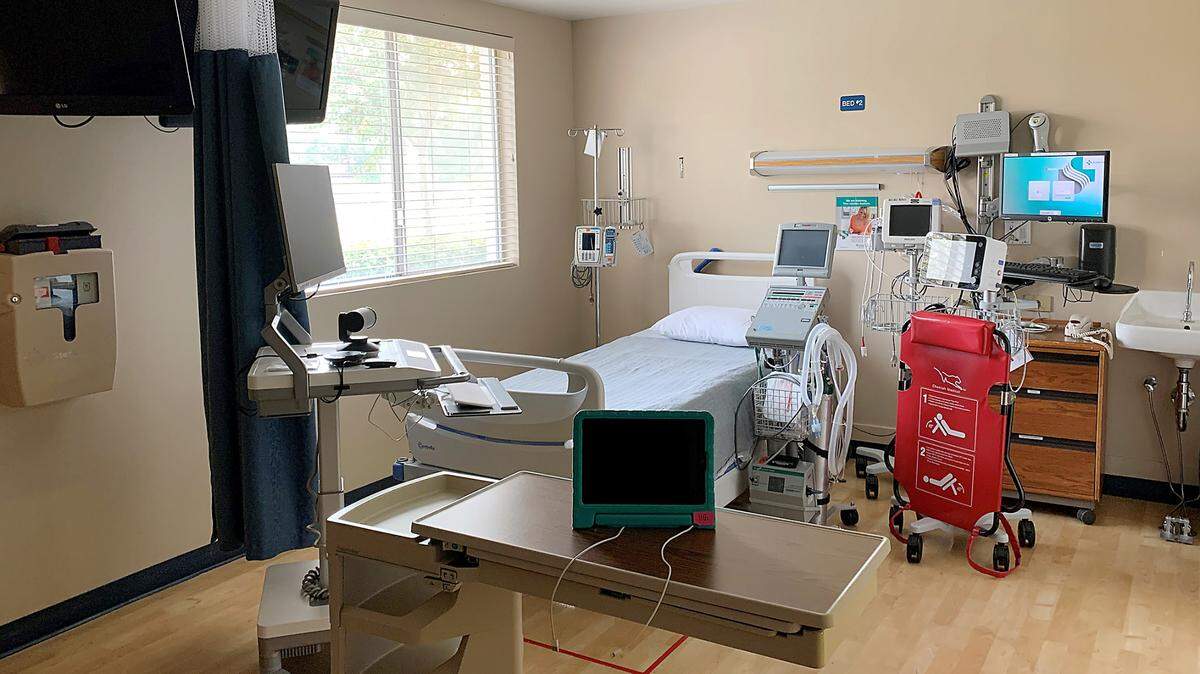
As California reached a grim milestone of 80,000 deaths from COVID-19, officials at one Merced County hospital say new infections are taking a toll on the space available for patients.
Dr. Phillip Yu, chief medical executive of Sutter Memorial Hospital in Los Banos, told members of the Los Banos City Council this week the hospital’s stretched to its limits on space.
“We are at zero percent ICU capacity, meaning we have no beds open right now,” Yu said. “The ICU is completely full. Typically about 70-80% of our ICU is impacted by COVID.”
While the ICU at Sutter Memorial remains full, between eight and 15 COVID patients are admitted to the hospital in Los Banos daily, Yu added. The most severely ill patients are unvaccinated, which Yu said stood at 90% of patients admitted with COVID-19.
“They were really going up very, very quickly, especially starting around January 3, 4 and 5,” Yu said. “We started seeing a lot of patients coming in. We’ve since seen that drop slightly, but we’ve kind of plateaued.”
Other infections, congestive heart failure, hip fractures and other illnesses and injuries have not stopped or slowed down since the pandemic started, leaving the Los Banos hospital more impacted and inundated with the sick and the hurt than ever.
“Most of the patients who are in the hospital have COVID,” Yu said. “There are some vaccinated patients who are also hospitalized but they tend to be less sick and stay for shorter periods of time and tend not to require intensive care, which is a really good thing.”
Yu added, “The unvaccinated, unfortunately, are being severely affected.”
Surge ongoing in Merced County, statewide
On Friday, California hit 8 million total lab-confirmed infections reported since the start of the pandemic, as the omicron variant of COVID continues its fast spread.
More than 3 million cases have come in the past six weeks amid the omicron wave, California Department of Public Health data shows, compared to 5 million in the preceding 96 weeks.
As of Friday, 752 Merced County residents have died from COVID since the pandemic began in March 2020 — an increase of three deaths over the previous day, according to the Merced County Public Health Department’s COVID-19 dashboard.
A total of 66,051 confirmed cases have been diagnosed in Merced County since March 2020. There are currently 71 active hospitalizations locally.
The number of probable active cases in the county numbers at 7,584 and only 50.32% of the county’s population that is eligible to be vaccinated is fully vaccinated.
Eleven people have died at Sutter Memorial since the beginning of the most recent surge in recent weeks.
This year’s surge is higher than 2021, Yu added, and hospital officials are concerned that the death rate will surge, considering the high rate of COVID-19 admissions at the hospital right now.
“That is still going up because unfortunately, it lags behind by about three or four weeks,” Yu said. “Once an individual becomes severely ill or sick, they come into the intensive care unit. It takes a while for them to go through that process. So you’ll see the mortality rate lag, and you’ll see that in the data from the previous surge.”
The omicron surge is the most intense one yet, Yu said. The quick pace of transmission, diagnosis and deaths have accelerated — a trend that’s been mirrored countywide.
Losing loved ones
The effects of COVID-19 are being felt outside the hospital system, too. On Wednesday, during the Los Banos City Council meeting, Mayor Tom Faria shared briefly that he was grieving the loss of a friend of his who recently died of COVID-19.
“I attended five funerals in January, and three were from COVID,” Faria said. “It’s tough stuff.”
The hospital has 38 total beds, including 22 general acute care beds and only four ICU beds. Twelve of those beds are perinatal, Yu said.
He said in 2021 the hospital had 1,816 admissions and 24,301 emergency room visits, as well as 52,572 outpatient visits.
Notably, the hospital had 6,230 total patient days over the course of 2021 due to COVID-19, far higher than before the pandemic. “Typically, we’re at about the 4,000 mark in terms of patient days in our hospital,” Yu said.
The omicron variant of COVID replaced the delta variant as the most prominent strain of the coronavirus.
Yu warned that there’s now a new strain of omicron – the BA.2 variant, or “stealth” omicron. This new variant contains more than 30 spiked mutations that make it different from previous strains.
“Fortunately, the vaccines remain highly effective at preventing severe illness, hospitalization and death,” Yu said.
“We have seen that in our vaccinated population, but the sheer number of individuals that are being infected with omicron even though they’re vaccinated has also touched the unvaccinated population and increased our numbers, as well, in this latest surge.”
Twenty different mutations separated the current strain of omicron from the initial BA.1 strain, and BA.2 has now been detected in 57 countries and in California. It is more transmissible than BA.1, although BA,1 is better at evading vaccines. BA.2 apparently doesn’t lead to more severe disease than BA.1, Yu said.
“In countries like Denmark, it’s starting to take over,” Yu said of BA.2. “We’ve already detected it in the United States and there are already cases of BA.2 here in California.”
Yu added hospital staff are exhausted, and everyone is working extra. Many hospital employees are burned out.
“We’re in this for the long haul,” Yu said. “We’re still here. We’re still standing.”
This story was originally published February 4, 2022 at 5:49 PM.