UC Merced forecast for 2020? More students, employees and campus space
UC Merced, the youngest school in the University of California’s 10 campus system, is growing up — and fast.
Opened in 2005, the size of the student population, number of employees and the size of the ever-expanding campus are on the rise.
As the UC campus thrives, so does the city of Merced and the region, university officials say.
Other sources tend to agree. The Merced metropolitan area was recently cited by Governing magazine as the top region for personal income growth since 2012, noting a 13.7 percent personal income boost when adjusted for inflation. UC Merced’s growth was cited as a primary factor reviving the Merced area.
As the campus nears its 15th birthday, the university continues to develop ambitious plans for the future. Take a look at how UC Merced grew in 2019, and what to anticipate in the New Year.
Looking back at 2019
The campus population gained 303 students in 2019, for a total of 8,847 during the fall semester. This continued the UC’s steady trend of growth.
The percentage of first-generation college students has consistently risen, too. At 74%, they make up a majority of fall 2019 undergraduates.
“They’re remarkable students,” UC Merced Interim Chancellor Nathan Brostrom said. “They’ve overcome a lot of challenges to be here, and you see that in their approach to their studies and their temperament.”
The New York Times observed that UC Merced’s undergraduate Latino population more closely mirrors California’s demographics than any other UC campus — almost 56% in 2019, up from about 53% last year. Many undergraduates are Central Valley locals, and 99.5% of all students are Californians.
This was the first year that incoming freshman were required to live on-campus for their first two years.
“Evidence shows that if they live on campus for two years, the four-year graduation rate goes up about 20%,” Brostrom said.
Development plan ongoing
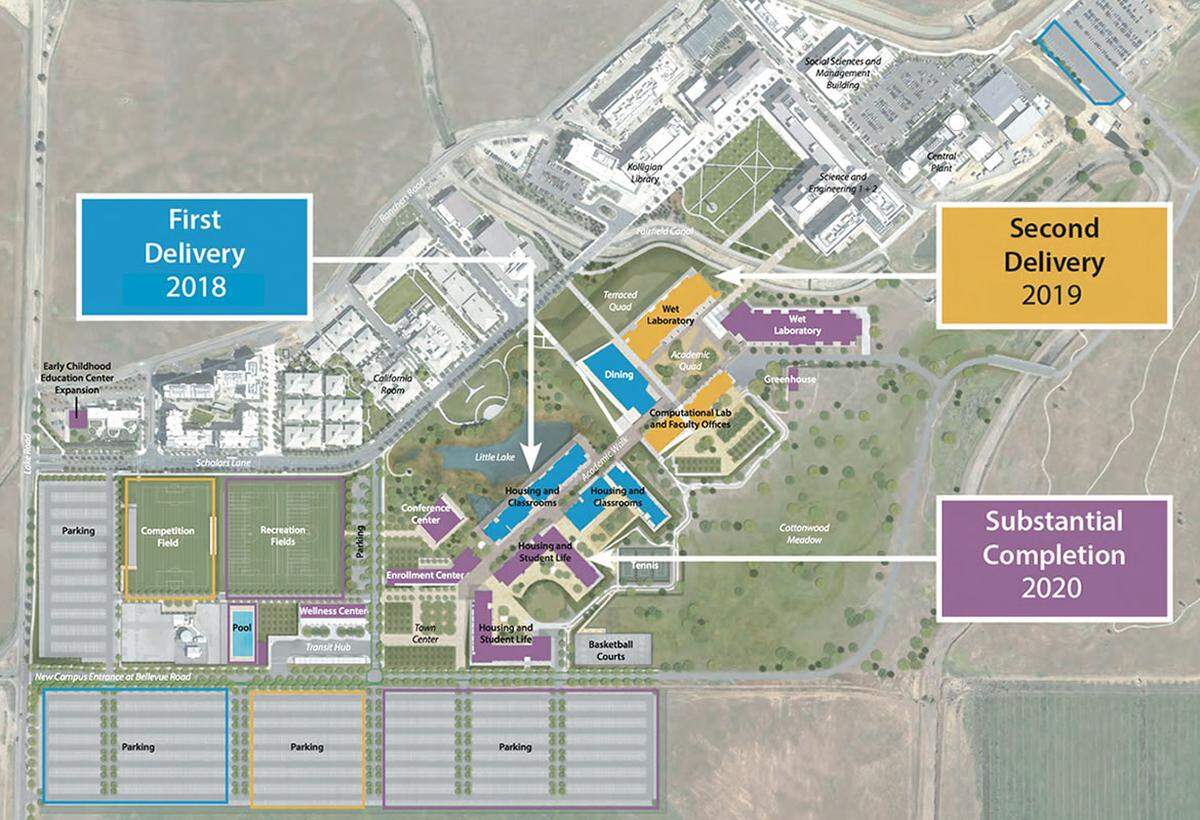
To accommodate the increasing student population, UC Merced is expanding. The third and final phase of its development plan, Merced 2020, is underway for fall 2020 completion.
“Merced 2020 gives us the ability to grow both our faculty and our student body to probably 12,000 before we’ll have to do another big round of building,” Brostrom said.
The school year kicked off with two new laboratories with faculty offices and a research server. The projects added 150,800 square feet to the campus.
“The two new research buildings are just phenomenal,” Brostrom said. “The fact that they were delivered on schedule and actually a little below budget is really important.”
UC Merced expects to hire more employees to serve its growing student body and campus size. At least 1,600 full-time and part-time employees generate a monthly payroll of more than $16.5 million. Brostrom estimates UC Merced is among the top three employers in Merced County.
To those who claim the university has not brought the changes or prosperity that was promised, Brostrom disagrees. Technology company Bitwise recently announced downtown Merced as its next hub. The company said the UC and its first-generation college students were major factors in the selection. Brostrom also cited the development of downtown lofts and a hotel as attributable to the campus’s growth.
To 2020 and beyond
Brostrom estimates that about 200 additional freshman will enroll in fall 2020. He said that UC Merced aims to increase transfer students, which are low compared to other UC campuses.
While UC Merced was recently recognized as the number one university in the nation for exceeding expected graduation rates, Brostrom said it will continue to aim higher.
“I would say our aspirations should be to achieve at the UC level, which is another 18 points higher than where we’re at,” he said.
Another chief initiative will be retaining graduates in the Merced region, as many of those former students often seek employment elsewhere.
“I’ve talked to several of them who say they really like it here, and could see settling if there were the right opportunities and the right jobs,” Brostrom said.
With its Venture Lab, the university is facilitating student entrepreneurs seeking to establish businesses in Merced, and looking to bring in a seed and pre-seed funding for financial support.
This next year will add 478,000 square feet to the UC Merced campus. A competition swimming pool, student wellness and counseling center, new parking spaces and housing with 980 new beds are among the facilities that will be ready for students next fall. A third research building larger than the two completed in 2019 will also open.
Long-term sustainability is a key focus. Passive solar strategies, drought tolerant native plants and storm water management are worked into campus development.
Once completed, the Merced 2020 project will have added 1.2 million square feet to the campus, doubling its size.
Brostrom estimates the project will have created 10,000 construction jobs in the valley and generated $1.9 billion for the local economy once finished. At 82%, most construction workers employed by the project are Valley residents.
As the project comes to a close, the university will look to deliver a medical school that was promised during initial UC Merced plans decades ago.
“After 2020, our highest priority will be behavioral sciences and medical education,” Brostrom said. The program would hopefully be ready within the next decade, Brostrom said.
San Joaquin Valley officials have said that a UC Merced medical school could help the disparity between medical providers and patients. Merced County has one of the lowest ratios in the state at 100,000 residents to 45 physicians.
“The longer you can keep medical students in the Valley, both through education and residencies, the more likely they will actually set up their clinical practices in that region,” Brostrom said.