
Merced County after the 1918 flu pandemic: How the economy bounced back from crisis
We cannot predict the future, in terms of what Merced’s post-coronavirus economic recovery will look like. Still, residents can learn from the past by taking a page from city’s century-old pandemic recovery playbook.
There was a brief, modest economic retreat in post-World War I America that lingered into the early part of 1919. This mild recession had much more to do with the decline in demand for goods in the post-war era than the flu pandemic.
Recent studies about the 1918 flu pandemic show cities and towns that implemented more immediate, aggressive measures to prevent the spread of the virus tended to have a faster, more robust economic recovery. This was the case for Merced.
As previously discussed in my column, because Merced took several decisive and preventative actions early on in the flu abatement campaign, its success became a beacon of hope in the much-infected San Joaquin Valley.
In 1919, Merced City and County witnessed the best economic growth in years as personal wealth, tax revenue, and building activities increased.
“Tax Payments in County Show People Have Prosperity” was one of the headlines in the Dec. 9, 1919 Merced Evening Sun. With $571,438.61 collected, the county set a new record in the first installment property taxes and had the smallest delinquent list ever known.
According to County Tax Collector J. J. Garibaldi, the first installment was almost as large as the total taxes in 1918. One of the heavy taxpayers for 1919 was Miller & Lux, whose first payment obligation was $81,649.21. Some taxpayers were so confident with their finances and the outlook of their personal income that they paid the entire year’s taxes instead of their first installments.
Financial security also led to more business expansion and investment. As was reported in the Dec. 31, 1919 Merced Evening Sun, “Two years ago, even one year ago, there were a number of vacant stores and residences in Merced. Today the storeroom and residences are at a premium.”
C. E. Kocher of Merced, for example, expanded his hardware business on the southwest corner of 18th and Canal streets by adding the corner room formerly occupied by a drug store. With the expansion, the establishment now had approximately 20,000 square feet in a three-story building and carried lines of machinery like Fuller & Johnson’s gas engines and Deering farm implements.
If there was any severe, permanent economic impact from the flu pandemic, it was not showing in Merced, not even in the case of Elite Theatre in which its manager C. H. Douglass was a victim (not a patient) of the pandemic. The theatre located on 17th Street (Main Street) between M and N Streets shuttered due to the city influenza ordinance.
It was a devastating financial loss for Douglass because this 550-seat theatre normally was open year round with performances each night and matinees on Sundays and holidays and enjoyed a good attendance on an average night.
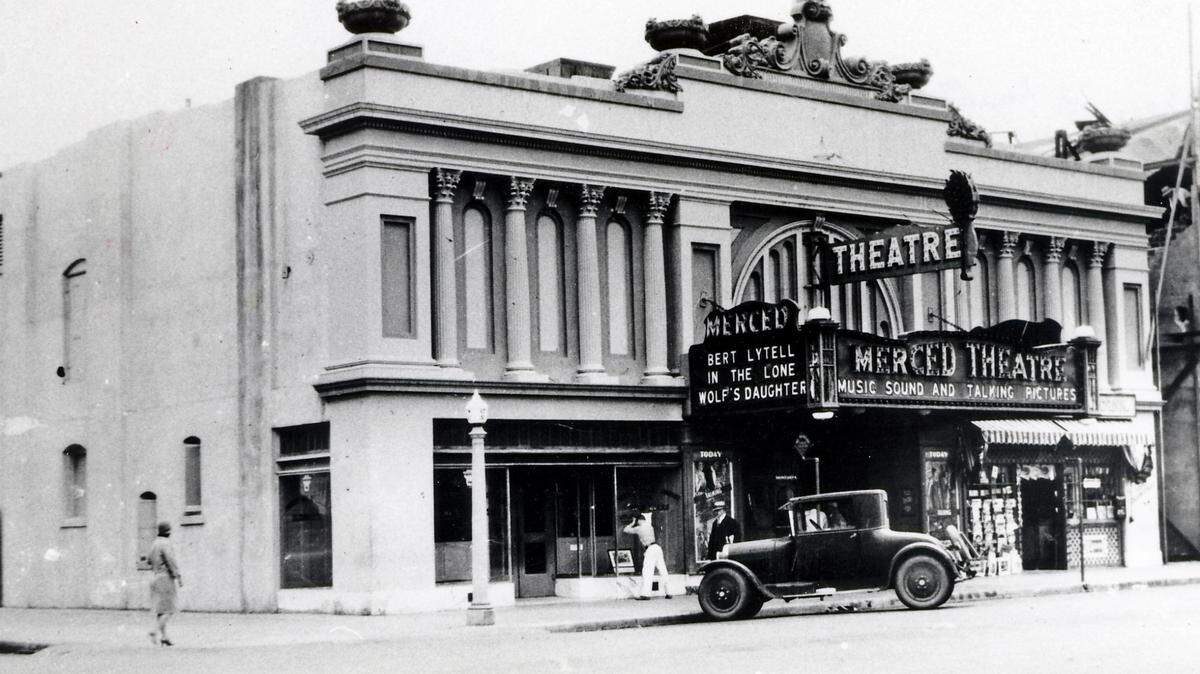
In addition to the shutdown, Douglass was arrested for reopening the theatre amid the pandemic after getting mixed signals from the City Trustees about the reopening. But by March 1919, Douglass not only had recovered from his humiliating experience, but also was ready to rebuild Merced’s economy by proposing the construction of a new theatre with 1,200 seats in the style of Roman Corinthian architecture.
While Douglass’s Merced Theatre was the leading permit for new construction in 1919, the remodeling of Hotel Merced at a cost of $63,420 became the biggest alteration project for existing buildings. This 1878 building (known as Moran Building or Cosmopolitan Hotel) was converted into a modern hotel of 60 rooms with 30 baths to accommodate travelers and Yosemite-bound tourists.
The investors’ decision was very much influenced by the newly proposed million-dollar Yosemite Highway project that ran from Merced to El Portal. In 1918 even with the temporary shutdown, Yosemite still saw 40,000 to 50,000 visitors. As the gateway to Yosemite, Merced benefited tremendously from the tourism industry.
The progress of 1919 culminated with the forming of the Merced Irrigation District in November. Despite a furious anti-MID campaign waged by the Merced Protection League, voters gave MID a resounding victory with a vote of 1,967 to 922.
The anticipation of MID’s formation had already created a hot real estate market, and the trend continued after the successful election. This contributed to Merced’s building boom. The total receipts for 1919 construction projects in both new and existing buildings were three times the value of $66,131 in 1918.
Merced was doing pretty good in the post-1918 flu era. Are we going to see a similar economic recovery in the post-coronavirus era?
There is a sign of optimism as Merced’s housing market remains competitive and building activities are going strong. On an interesting note, Douglass opened the Merced Theatre on the northeast corner of 17th and N Streets on March 4, 1920. A century later at the same site, the newly restored Mainzer Theater will soon open its doors.