
Are less people living on Merced County’s streets in 2022? What the latest numbers show
The latest estimates for Merced County’s homeless population are in — and although the numbers show there was a slight increase since last year, local officials say there is encouraging news.
The data is from the Point-in-Time Homeless Count report, which is based on information collected in January by volunteers and multiple organizations in Merced County.
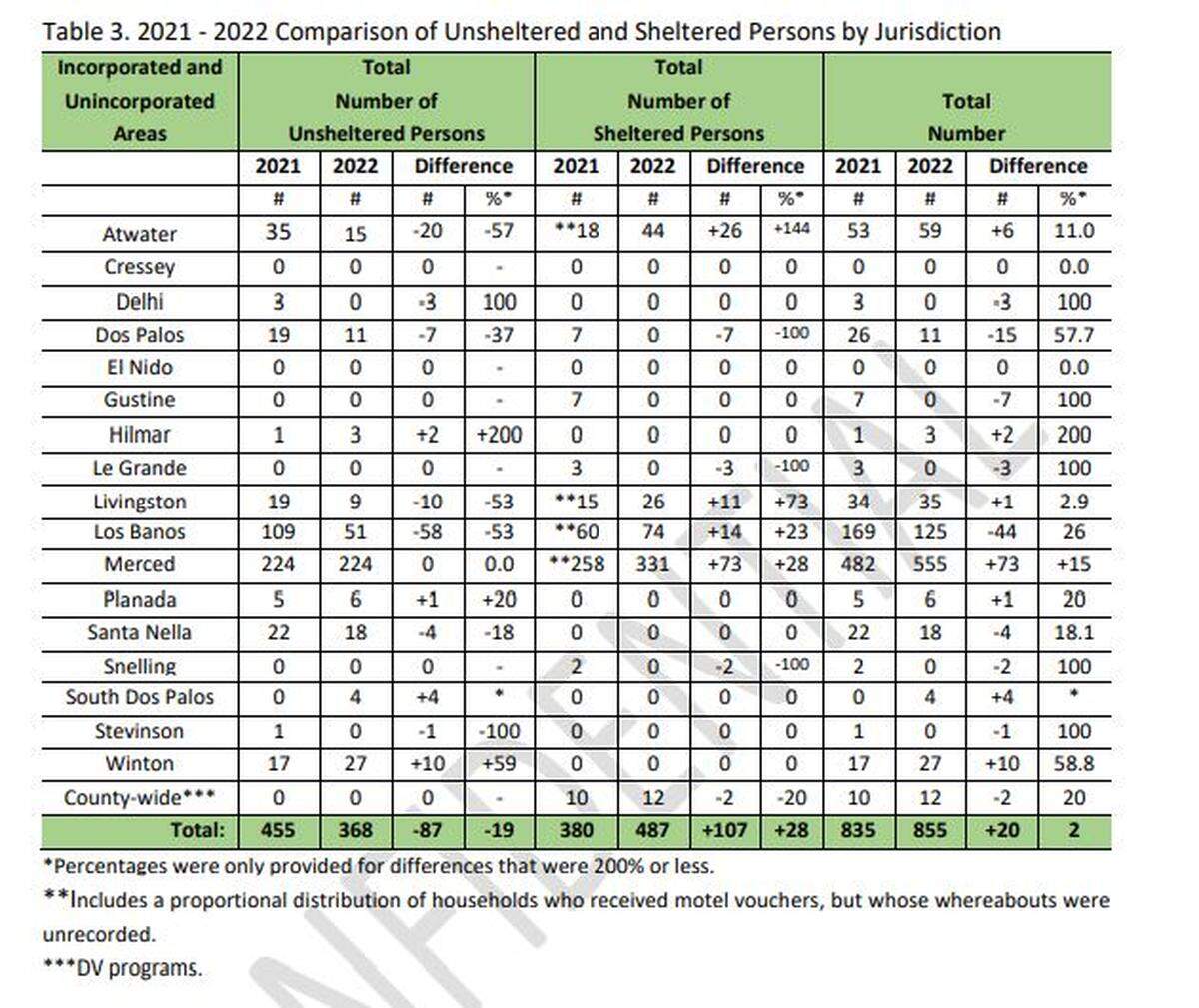
The report shows the overall number of homeless people went up countywide from 835 a year ago to 855 this year, an increase of 20 people — or roughly 2% more.
However, the annual homeless census makes a distinction between people who are unsheltered versus those who are sheltered. The former live on sidewalks, in parks, cars and abandoned buildings, while the latter live in homeless shelters or other short-term housing programs meant to help people transition into a stable environment.
The data shows the county’s unsheltered population decreased 19% to 368 this year from 455 last year. Meanwhile, 487 people were considered sheltered this year, compared to 380 people the year prior.
Count organizers say the fact that nearly 24% more people are now considered sheltered, rather than being on the streets, is a positive sign. “We have increased our emergency shelter capacity in the last year and our unsheltered count went down,” said John Ceccoli, deputy director of the Merced County Human Services Agency. “For us, that’s a big win.”
The numbers also show the total number of homeless people didn’t see a dramatic increase, as it did a year ago. Officials were stunned last year when the county’s number of homeless residents grew by a massive 31% from 636 people in January 2020 to 835 in January 2021. That had been the largest spike in the county’s homeless population in five years.
“The solution to homelessness is some type of permanent housing,” said Ceccoli. “Projects like a Place Like Home will end it. That’s when people move from unsheltered to sheltered.”
While efforts to get people off the streets might not be ramping up fast enough for some people experiencing homelessness in the communities of Merced County, local leaders say there have been successes in getting roofs over the heads of some individuals and families with nowhere else to go.
“When you look at the numbers, the most important thing to me is the emergency shelters,” Ceccoli said. “That is paying off, and it’s paying off quickly.”
But, he added, “We could’ve probably seen more improvement if not for COVID.”
With the number of unsheltered individuals going down this year, local officials said they hold out hope that community efforts to reduce homelessness are working.
“I think there’s a lot more we can do, and I think we’re doing it,” said Merced Mayor Matthew Serratto. “This is a humanitarian issue, it’s a quality of life issue, it’s a business issue. There’s so much at stake because it presents a lot of problems for everyone for a variety of reasons.”
County officials say while solutions to the homeless problem can’t all be rolled out overnight, ongoing efforts to expand resources and shelter are a priority for many groups.
“Everybody recognizes what kind of problem this is,” said Josh Pedrozo, who represents District 2 on the Merced County Board of Supervisors. “It takes a lot of time and it’s very frustrating.”
In recent years, Merced County has seen a big increase in local resources to help people who are homeless.
Among the most prominent, in March last year the county opened a $6.8 million navigation center at 1411 B Street to provide resources for the homeless. The center is considered a low-barrier” emergency shelter — meaning the main priority is providing minimum-restriction shelter for everyone — regardless of life circumstances.
There is also a lot that’s in the works. The state recently granted the City of Merced nearly $29 million in Project Homekey funds — money from a statewide initiative that aims to expand housing for homeless individuals and those at risk of homelessness, recognizing unsheltered people are impacted by COVID-19 and at risk for other communicable diseases.
That money’s going to be used to renovate a vacant hotel to house people who are homeless, among numerous other projects.
How the count was conducted
A variety of community members from government agencies, companies, churches, religious groups, non-profit agencies and businesses helped carry out the count the night of Jan. 27. Some volunteers are also homeless themselves.
The counters used a mobile app called “Counting Us” to help gather numbers, and survey data was sent to a regional command center.
Survey questions in the mobile app were focused on demographic information and sub-population groups, as required by the HUD. Sub-population indicators were broken down by age, ethnicity, gender and race.
“We had the option of doing the paper survey or using the survey app on an iPhone,” said Michael Belluomini, a former Merced City Council member and one of the counters this year. “One person we sat and talked to gave us information that we entered into the app and it was immediately tabulated for organizers.”
The sheltered count was collected by using a tool called Homeless Management Information Services, which counts the number of occupied beds and the number of sheltered people by sub-population.
Data provided by various programs throughout the county was also used to determine the number of sheltered homeless individuals, according to the report.
Other key findings
The Point-in-Time homeless population count is required by the U.S. Department of Housing and Urban Development for local jurisdictions to get Continuum of Care funding. The count is conducted during one night every year during the last 10 days of January.
All local governments that have a Continuum of Care program to oversee homeless program funding are required to conduct a sheltered homeless count every year and an unsheltered count every other year, although Merced County does an unsheltered count annually.
Among other highlights included in the report:
- Los Banos and Merced were the two Merced County cities that had the highest number of homeless individuals both sheltered and unsheltered – 60.9% of this year’s count were in Merced, while 13.9% were counted in Los Banos.
- About 19% of the individuals counted in Point-in-Time this year became homeless for the first time in the 12 months prior to the count.
- More than half of the adults, or 56.7% counted in this year’s count had no income, while 67.9% reported a monthly income of $500 or less.
Five children this year were unsheltered in the count, and 146 were sheltered.
People not counted in the Point-in-Time count included those who are “doubled up” — meaning those who are otherwise considered near homelessness.
While those individuals weren’t considered homeless for the purpose of the Point-in-Time count, the county considers them at risk of homelessness and does track them through other means.
What the county found is that 16% of Merced County residents live below the poverty level and are at risk of financially sinking even further, according to the 2021 American Community Survey.
The Housing Authority of Merced County says that poverty level in the county for a one-person household is $12,880 a year. For a two-person household, that rises slightly to $17,420, and for a four-person family, that rises to $26,500.
That amounts to 45,000 of the county’s 281,202 residents across 15,000 households that are at risk of becoming homeless, according to the Point-in-Time Count report.
“Because of their limited income, they frequently have to choose between paying their rent or mortgage and other daily living costs such as childcare, clothing, food, health care and transportation,” the report read.
“Many households can become homeless because of social structural issues such as increases in rent, loss of a job and rising health care costs.”
This story was originally published April 15, 2022 at 5:00 AM.