UC Merced chef builds community, promotes food advocacy, leads speaker series
AI-generated summary reviewed by our newsroom.
- Vanagten built a campus speaker series bringing award-winning chefs and authors.
- Vanagten advances food access and sustainability through pantry and plant-forward menus.
- UC Merced joined Menus of Change and prioritizes produce sourced within 200 miles.
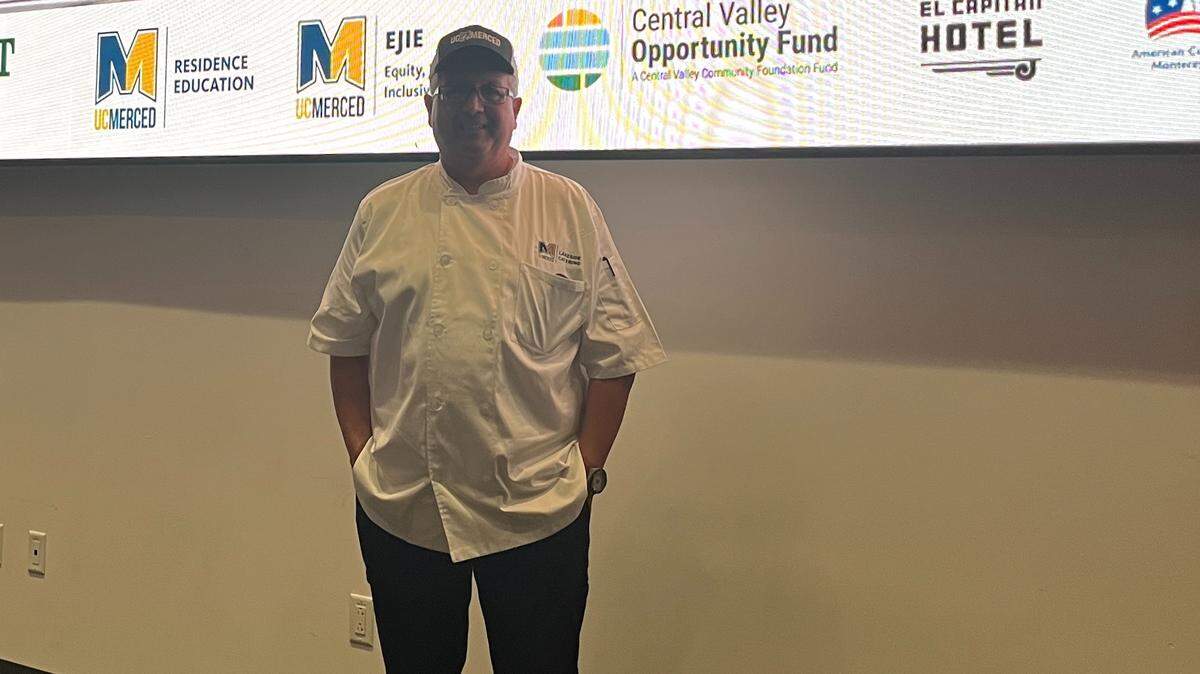
Mitch Vanagten is serving up more than just healthy meals as UC Merced’s executive chef. He is also building community by hosting events and advocating for food access and locally-sourced produce.
“I’m passionate about … food education,” said Vanagten, who has been at UC Merced since 2005. In that time he has hired kitchen staff and opened two dining halls on campus. As the campus has grown he has added more staff and stepped back from being “in charge of everything” to his current role as executive chef of catering, focusing on special projects.
Vanagten and his staff prepared a feast of dishes from “The Sioux Chef’s Indigenous Kitchen” for a fireside chat by chef and activist Sean Sherman last Wednesday in the campus’ conference center.
Vanagten said he was inspired after seeing similar events at larger universities. “Our students and our community deserve the same level of speaker,” he said, “[And] I usually try to pick food related speakers…be it chefs or people in the wine industry.”
Vanagten said he was excited for Sherman to share the importance of indigenous foods and Native American history. Previous chats included the chefs behind Cafe Ohlone in Berkeley, a restaurant that aims to educate and connect people to Ohlone culture.
And Siska Silitonga who has been listed in the Michelin Guide for her modern Indonesian cooking, celebrity chef Ed Porter, Dr. Claudia Serrato an indigenous culinary anthropologist and chef.
The series is about more than learning about food and history, because it also provides a networking opportunity for students who attend, Vanagten said. At, “a lot of my events there’ll be vice chancellors and deans attending…so [students] might have an opportunity to connect with them on a different level, where they’re…breaking bread together.”
In addition to the speaker series, Vanagten is also involved in projects to improve sustainability and access to food on the UC Merced campus. He was part of the initiative that became the “Bobcat Pantry,” the food pantry for UC Merced students. He was inspired by the Fresno State pantry which he described as “amazing,” and said he just had not realized before how many students are impacted by food insecurity.
A recent study of the University of California found that 44% of undergraduate students face food insecurity.
“We took the initiative to figure out how to have at least fruit vegetables available twice a week,” Vanagten said, “and then once they had the pantry, we didn’t have to do it anymore.”
He added that the Bobcat Pantry staff “always makes sure that there’s a lot of options — a lot of healthy options — and addresses a lot of different needs for …students on campus…you can make a lot of …healthy meals with what’s available.”
“I’ve been here twenty years,” he added, and “...a lot of our staff are [former UC Merced] students.You hear the stories, you talk with them, and you’re like, Well, what can I do? What little bit can I do? Or can we do?”
Vanagten has also led an initiative to serve “plant-forward food,” at least one station in the dining hall, which means the food is vegan by default and students can request to have animal products added. All of the other stations still have regular options available.
“We still have proteins at the stations,” said Vanagten, “It’s just to encourage more healthful eating and plant forward eating.”
Vanagten said he prioritizes using local produce that comes from within 200 miles of the Central Valley. For this reason, UC Merced was recently accepted into the “Menus of Change University Research Collaborative,” a network of universities using campus dining to experiment with new sustainable practices.
“I try to make sure that the food on the plate, or each course, is at least eighty to one-hundred percent locally sourced,” said Vanagten, “[and]... I always try to feature the farmers.”
Vanagten emphasized that he could not do this work by himself and concluded, “I’m proud to work with such a great culinary team and dining team, who are always open to collaborate, be partners, and have the same passion that I do…[for] food education and community support and supporting our students.”
This story was originally published October 15, 2025 at 1:12 PM.