Have thoughts on CA’s high-speed rail project? Here’s your chance to share them
AI-generated summary reviewed by our newsroom.
- Public comment period runs Feb 28–Apr 29, 2026 for the 2026 draft.
- Authority plans to reduce Central Valley route cost by $2 billion via right‑sizing.
- Plan seeks private partnerships, new revenue streams, and state legislative action.
At the end of February, California’s High-Speed Rail Authority released a draft of its 2026 business plan.
Now, Merced County residents and other Californians have the opportunity to ask questions and share comments with the Rail Authority during the 60-day public comment period for the plan.
The public comment period began Feb. 28 and ends April 29.
What does the business plan say?
In each even-numbered year, the Rail Authority is required to submit a business plan that includes a summary of progress over the last two years, information about current challenges and plans to resolve them, and updated cost estimates and revenue forecasts. The 2026 draft laid out the Rail Authority’s plan to reduce the cost of its initial Central Valley route by $2 billion .
To reduce costs, as noted in its 2025 Project Supplemental Update, the “Authority’s strategy is to right-size initial delivery to control costs and begin service sooner, and then expand infrastructure as demand grows.” That means focusing on delivering initial service sooner rather than beginning with the full-capacity build at the outset.
The first chapter of the report focuses on the authority’s plan to form public-private partnerships to contribute financing for infrastructure and maintenance, as well as plans to commercialize assets to support the long-term stability of the project. Assets could include things like clean energy generation, broadband infrastructure, and data centers that would, according to the Rail authority, begin generating revenue before the train begins operating.
The authority is currently engaging with private partners to identify opportunities for collaboration.
The report also details the current statutory requirements that the California High-Speed Rail Authority must fulfill, including compliance with public utility code, Senate Bill 198 — which prioritizes funding for the Central Valley portion of the line — and Assembly Bill 377.
One of the issues with the high-speed rail project has been uncertainty in funding.
The report notes that in 2008, when California voters passed Proposition 1A and authorized $9 billion for planning and constructing phase 1 of the system, “the state anticipated that federal participation would cover up to one-third of the initial program costs.”
“To date, California’s high-speed rail system has received $6.8 billion in federal funding, which is about 20 percent of total costs,” the report says. “That amount fell to $2.8 billion after the Trump-Vance Administration rescinded $4.1 billion in previously awarded federal funding, leaving federal support for the Authority’s program at less than 10 percent.”
The authority outlines sources of funding that could help address this gap, including the cap-and-invest program, which has been a major source of funding for the project, private sector participation, state grant programs, bond funding, and local and regional funding.
The authority makes a series of requests of the California Legislature to pass laws that would allow these sources of funding.
Some aspects, such as the ambition to capture local and regional funding, has drawn criticism from local politicians.
Merced residents lack clarity, study finds
A study conducted by UC Merced Labor Center sociologist Paul Almeida found that only about a quarter of people surveyed in Merced felt they are “fully aware of the project.”
Furthermore, it found that fewer than half of Merced residents interviewed planned to use the bullet train, but that more would be likely to ride if there were a discounted rate for locals.
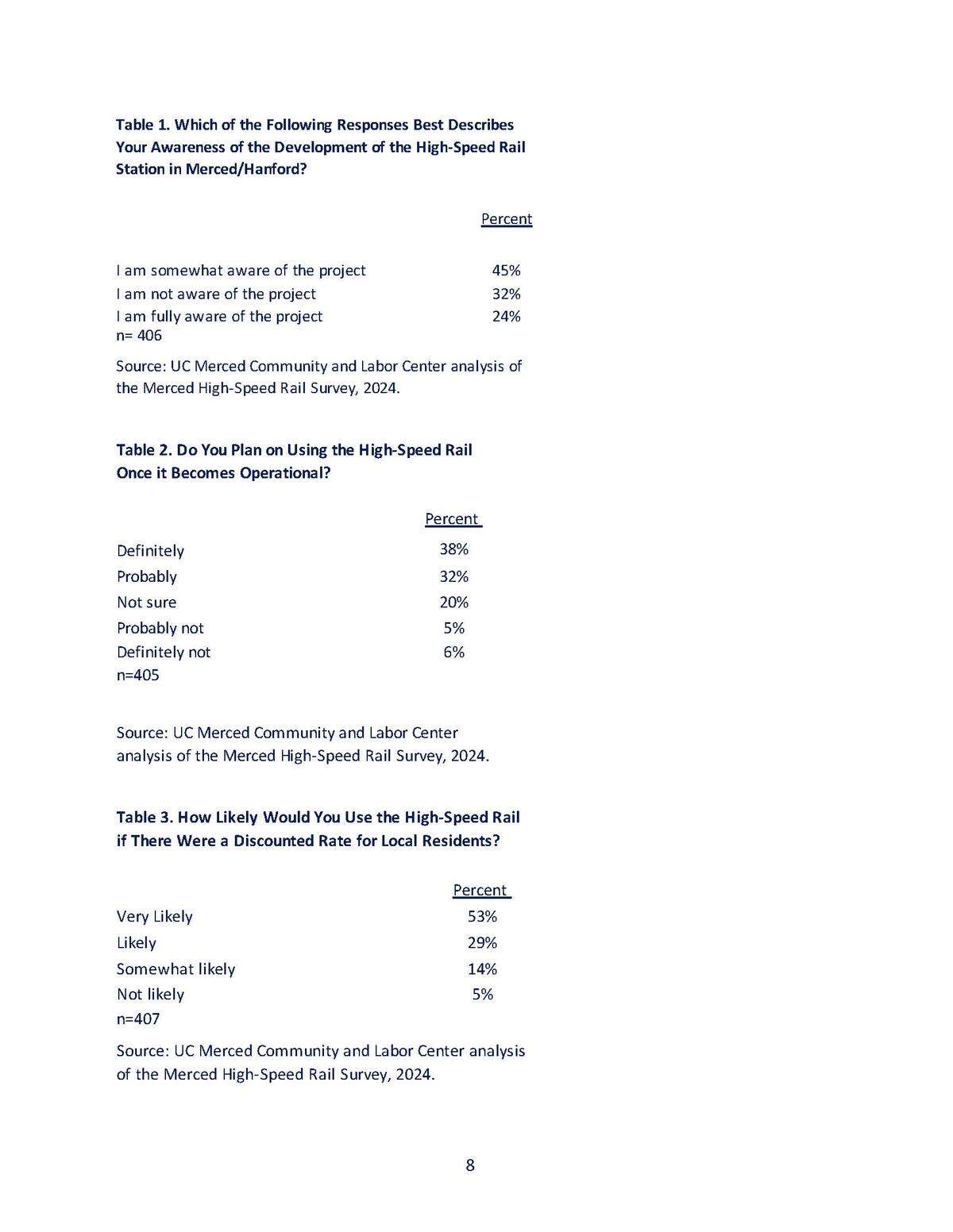
Rates to ride the high-speed rail have not been shared yet, but a representative for the Rail Authority told the Merced Sun-Star in an email, “We’ll have information about ticket prices available soon with the release of technical documents supporting the 2026 Draft Business Plan.”
Now is the time for members of the public to share their questions and concerns with the Rail Authority before the comment period ends April 29.
Questions and comments can be submitted through the online Draft 2026 Business Plan Comment Form or by sending an email to BusinessPlan2026@hsr.ca.gov.