Merced College’s production of ‘The Laramie Project’ is moving, thought-provoking
AI-generated summary reviewed by our newsroom.
- The Laramie Project depicts aftermath of Matthew Shepard’s 1998 murder in Laramie.
- Dennis Shepard joined talkbacks via video call after the April 10, 12, and 16 shows.
- The cast and crew reported the play prompted reflection and conversations about prejudice.
According to the cast and crew of “The Laramie Project” at Merced College, the play has prompted them to reflect on their own prejudices and sparked difficult but important conversations about hate and intolerance.
“The Laramie Project” examines the aftermath and community response to the 1998 murder of Matthew Shepard, a gay student at the University of Wyoming who was brutally beaten and left to die. The play was written by Moisés Kaufman and its dialogue is based on more than 200 real interviews with Laramie residents conducted by The Tectonic Theater Project.
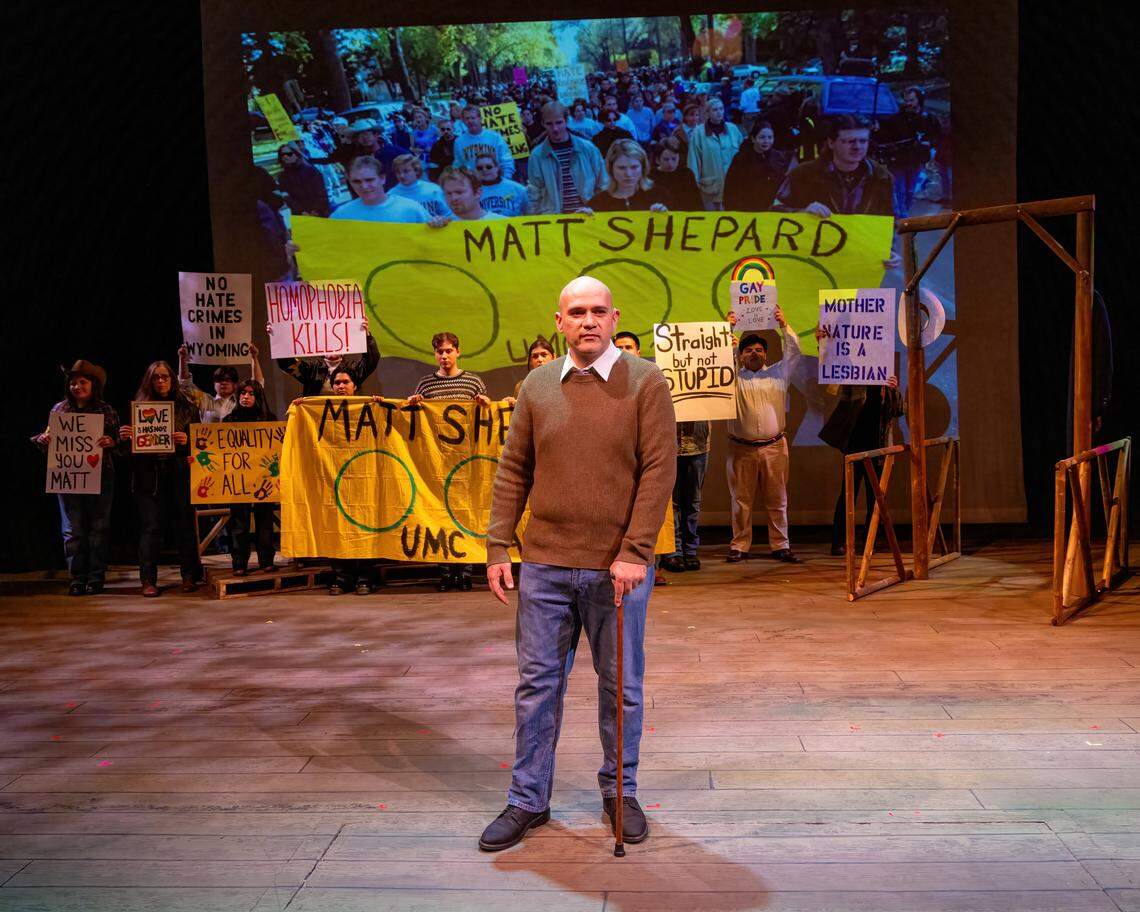
The play draws on a number of real moments following Shepard’s death, including vigils held in Laramie and across the country, a protest at his funeral by Fred Phelps and the Westboro Baptist Church, and sentencing of the perpetrators, Aaron McKinney and Russell Henderson.
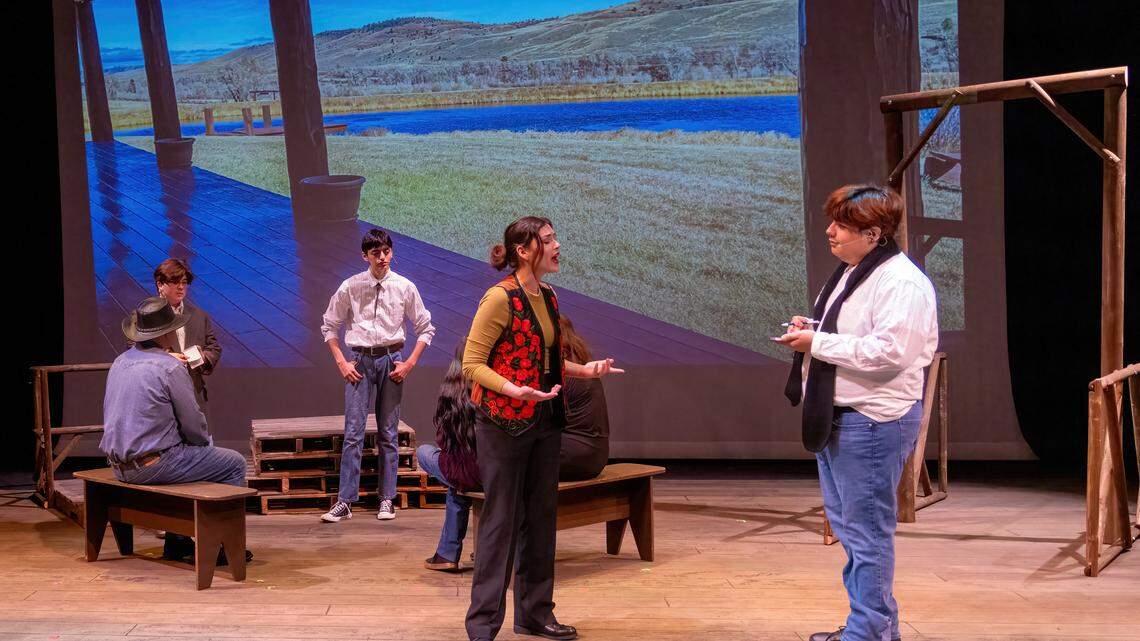
More than three dozen students, faculty, and community members participated in the production, with most actors playing multiple roles, and students handling the backstage elements of production such as lighting and sound design, costuming, makeup and props. The costuming was done beautifully, with everyone in Western fashion from bolo ties to cowboy boots, and the production was smooth throughout the show.
At its April 16 performance, the show was sold out. The room felt packed, especially because the audience sits on the stage for the performance, as though attending a town hall meeting.
The performance evoked audible responses from the audience. In some moments people gasped at the harsh language and slurs used in the play, all of which are taken directly from interview transcripts. In the second and third acts, audience members cried.
In total, there will be seven performances. After the performances on April 10, 12, and 16, Dennis Shepard, Matthew’s father, joined via video call for a talkback with the audience.
Dennis Shepard’s perspective
In the months following Matthew’s murder, his parents Dennis and Judy Shepard started The Matthew Shepard Foundation, with the mission of “(amplifying) the story of Matthew Shepard to inspire individuals, organizations and communities to embrace the dignity and equality of all people.”
The two have become advocates for parental support for LGBTQ+ children and stronger hate crime legislation.
Dennis said he speaks at performances of The Laramie Project, “to bring awareness to the audience and to the cast and crew that we need to be moving forwards, not backwards … I just wanted to make people aware … that we don’t have the equality that … we were supposed to have, and especially under this administration, it’s going backwards as quickly as possible.”
At the beginning, he said, “it was trying to educate the straight community. When we lost Matt, we were just part of the straight community. We knew nothing about the amount of violence and discrimination against the queer community.”
In the years after Matthew’s murder, Dennis said he saw American societal attitudes toward the LGBTQ+ community improve but that he now sees it trending in the opposite direction, particularly with the current administration’s focus on restricting the rights of trans people.
Cast and crew reflect on lessons from Laramie
For the cast and crew of The Laramie Project — many of whom were not yet born in 1998, and do not personally remember Matthew Shepard’s murder or the subsequent media storm — putting on the play was an opportunity to learn, as well as start conversations with family members about prejudice.
Several students said that they hope audiences find hope in the performance and absorb from it a message of tolerance for other people.
“It’s very easy to get sucked into the all the bad things and the death and the hate. But there’s still hope. There is hope for a better day. There is hope for a better tomorrow. And if we keep working and we keep showing people and spreading that information and that hope, we will get to that better tomorrow,” said stage manager Alyssa Thorp.
Michael Barba, an English professor at Merced College, played Dennis Shepard, Reverend Fred Phelps, and a few other characters.
“My character says one thing about how hope, everything ropes around hope,” Barba said. “And I do hope that … is one aspect of it they can take away ... hope they also take away from it a capacity to love… (and) a capacity for self examination and to be able to look at themselves and our society honestly.”
For many of the performers, the play presented an opportunity to tap into their own experiences of confronting homophobia and bigotry.
“My mother came to the show as well. And you know, I’m queer, so she relates. We had a lot of fights when I initially came out, just because she didn’t fully grasp … what she was seeing,” said Merced College student Evander Da Silva, who played five different characters over the course of the night. “When she came to the show, I think a lot of that came back to her, because apparently she was crying as soon as the end of Act 1, and she doesn’t cry easily.”
Raquel Castillo played a friend of Matthew Shepard.
“I actually did my research and auditioned for this play with the intention of knowing that my family members are going to come see me, just like they have watched me in any other play, … (and) get an eye-opening moment, because they … have always been homophobic,” Castillo said.
“What I do think is kind of important to understand about the show is that it’s not really about gay people. I would even argue to say it’s not even a show for gay people. It has a little bit of our stories in it, but it’s really not the focus,” Da Silva said.
He said the show portrays an environment that allowed hate and prejudice to form and emphasized how that was fostered by the “Live and let live” philosophy that Laramie residents described in their testimony.
He said that while on the surface that might sound innocent, “that kind of thought process is pretty destructive and it’s what led to things like what happened to Matthew Shepard. … But truthfully, you could change Matthew from a gay man into being like ... Black or Muslim or a woman, or you know anything else, and the story is still the same. It’s just about the culture that allows prejudice to foster.”
“This play helps to really bring into visibility the plight of the LGBTQ community,” said Aleta Mascorro, a community member who played several roles. “And I also want to add to the fact that visibility does not always equate safety. It does not always equate that you will gain the protection that you need.”
Other students said that while they had not experienced homophobia directly, the play allowed them and their families to relate to the parts of the story that are about family, friendship and the tragic loss of a child.
“When my parents came to see the show... they noted that they didn’t care much for the gay aspect,” said Isai Ramos. “The parts that made them the most emotional were the human aspects. It was when Dennis Shepherd, Matthew’s father, was talking about the love he felt for his son … it was the aspects that showed this to be a very human and tragic thing that most hit them emotionally.”
Talkback after the show
After answering questions about how it felt to receive so much media attention in the aftermath of Matthew’s killing and the process of founding the Matthew Shepard Foundation, Dennis Shepard had a message to all the students in the room.
He urged them to participate in politics, as Matthew had from the age of 7, to attend public meetings or at least find out what is going on, and to vote not only at the top of the ballot but in local elections, too.
He ended by saying: “Our national treasure is our young people.”
The Laramie Project is still showing at Merced College, with performances scheduled for April 18 at 7:30 p.m. and April 19 at 2 p.m.