Yosemite wildfire update: Where are Washburn Fire hot spots? Former hotshot explains
Fire managers in Yosemite National Park have revised the estimated acreage of the Washburn Fire downward slightly as crews continued to make gains in their firefighting efforts Tuesday night and Wednesday morning.
The fire, which was sparked July 7, was reported Wednesday at 4,863 acres, about 50 acres smaller than the estimate on Tuesday morning. Containment remains steady at about 58% as firefighters strive to strengthen fire lines on the eastern end of the fire in the Sierra National Forest.
The reduction in acreage was due to more accurate mapping of the fire, the National Interagency Fire Center reported.
Almost two weeks into the effort, containment lines have been established along the entire western portion of the wildfire’s perimeter, from its point of origin in the Mariposa Grove of giant sequoia trees along Mariposa Grove Road to Wawona Road (Highway 41), north to the community of Wawona, and east for about two miles along the south fork of the Merced River.
Part of the southern edge of the fire along the ridge of Mount Raymond is also considered contained.
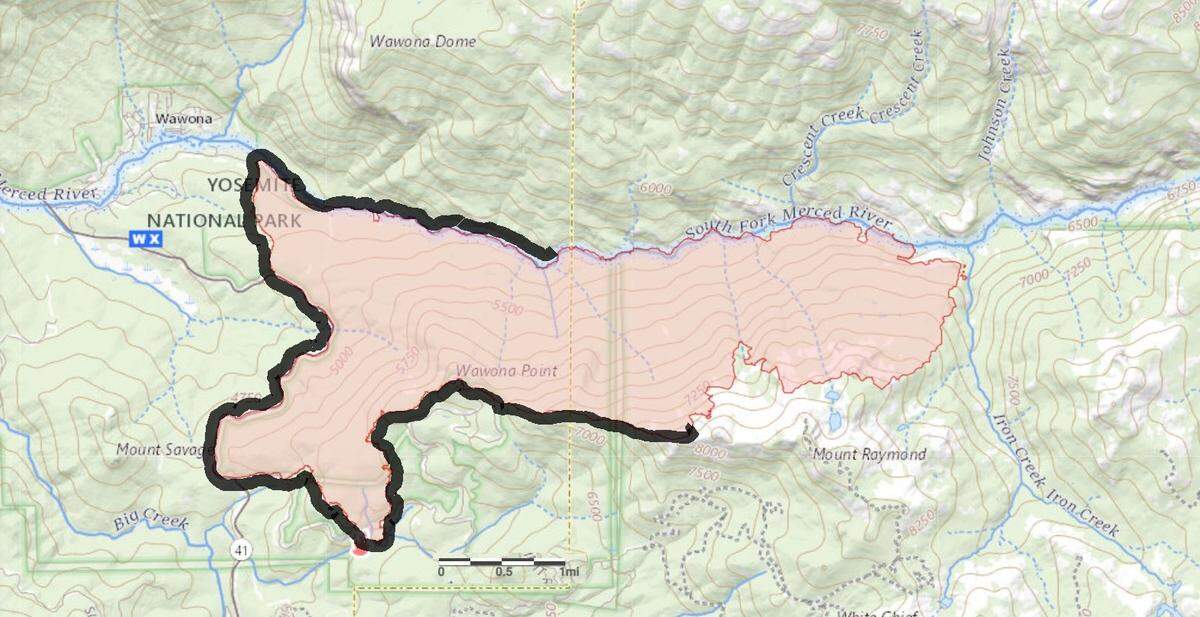
What remains officially uncontained is another two-mile stretch of the Merced River’s south fork and the eastern edge of the fire in the Iron Creek drainage. But in those areas, specialized 20-member “hotshot” teams of wildland firefighters are keeping the fire’s advance in check.
Along the Merced River fork, crews are using pumps to pull water from the river to secure their line and keep the fire south of the river, said Matt Ahearn, deputy operations chief with the state’s Interagency Incident Management Team that is managing the firefighting effort.
“The south fork … is looking much better,” Ahearn said Wednesday. “We continue to increase containment each day to the east and we’re checking that with (infrared) flights and boots on the ground where they can get in.”
In the Iron Creek drainage, more hotshot teams were making heavy use Tuesday of pumps that had been airlifted into the area this week. Additional crews were expected to enter the area Wednesday to clean up hazard trees to improve their lines.
While those eastern lines are not yet considered firm, Ahearn said, “it’s in a much better place now (with) a lot less smoke and heat showing.”
Pulling back firefighters
Between Tuesday and Wednesday, a slight drawdown occurred as some firefighting crews were able to be relieved from the fire lines, said Stan Bercovitz, a fire information officer for the incident management team.
It’s not that fire managers are taking their foot off the gas pedal, but “it’s a good sign,” Bercovitz said. “They took some aircraft away from the fire because they didn’t need them.” That makes those resources available for other wildfires if needed, and allows for some rest for flight crews and service to the aircraft.
About 1,444 people were assigned to the fire as of Wednesday morning, down by 135 from a day earlier, according to the National Interagency Fire Center.
As lines are strengthened amid the rugged terrain of the Sierra Nevada range, the containment percentage is less important than keeping the acreage stable, said Bercovitz, a former hotshot firefighter, on Wednesday.
“What I’m telling people at this stage is it doesn’t matter to look at the percentage containment,” he said. “If the percentage is stopped and heavy fuels in the deep areas (of the fire’s interior) are inaccessible, that will just have to burn out.”
“A lot of the work the hotshots are doing now is burning off fuel in the path of the fire and jumping on any spot fires, which are happening close because now it’s not wind-driven,” Bercovitz added.
In the Mariposa Grove, fire crews remain busy with mop-up efforts, using hand tools – and their bare hands – to check for and extinguish lingering hot spots after the fire burned through part of the grove.
Reopening 41; seeking cause
Yosemite National Park officials have enough confidence about the situation on the west side of the fire to announce that they tentatively plan to open the park’s south entrance from Highway 41 to the public at 6 a.m. Saturday. Wawona Road will be open from the south entrance to Yosemite Valley for the first time in more than two weeks.
The community of Wawona is open only to residents, property owners and park employees but remains closed to the general public. Park officials said both Wawona and the Mariposa Grove will remain closed to visitors for at least another week.
The cause of the fire is under investigation, but Yosemite National Park Superintendent Cicely Muldoon said July 11 that it appears to be human-caused.
This story was originally published July 20, 2022 at 1:15 PM with the headline "Yosemite wildfire update: Where are Washburn Fire hot spots? Former hotshot explains."