
New UC Merced professor working on making concrete more sustainable
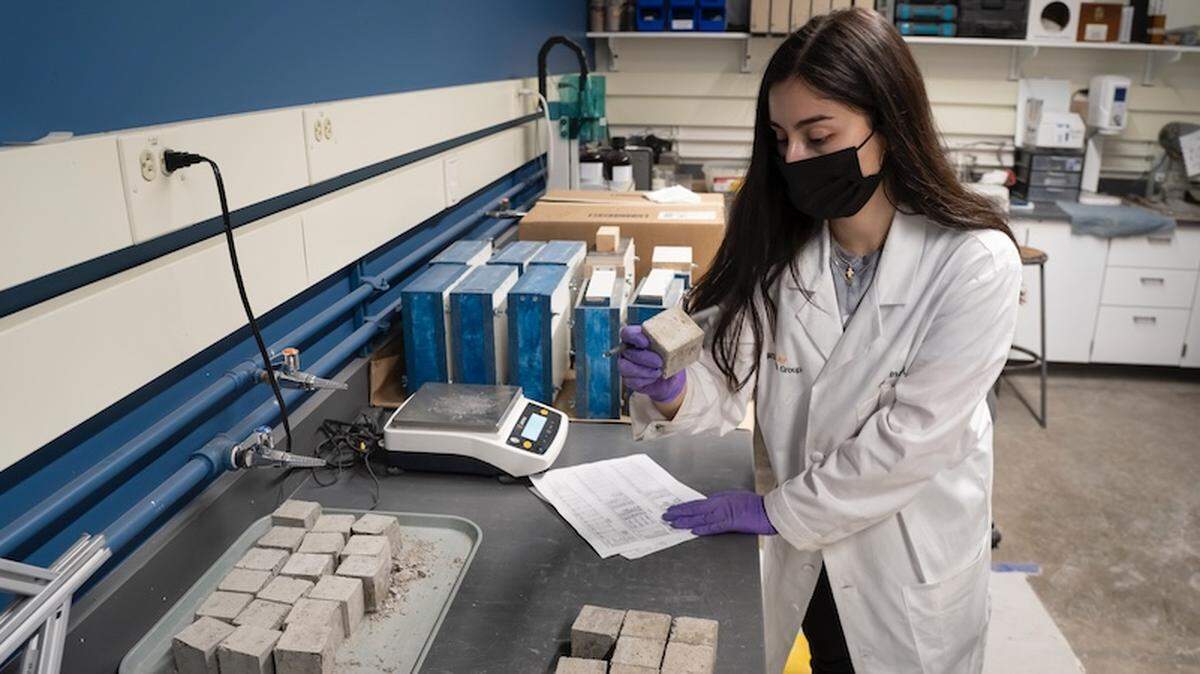
Cement is responsible for 8% of the world’s carbon emissions. Some building companies provide ways to mitigate those emissions to try to reach “net-zero” projects, so that their impact is offset
But what if the concrete itself could not only be created more sustainably but also act as a sort of filter, pulling pollutants out of the air?
That’s the focus of Marina Garcia Lopez-Arias, a new professor of civil engineering at UC Merced.
Garcia Lopez-Arias recently earned the Outstanding Postdoc Award from the College of Engineering at Purdue University. A native of Spain, Garcia Lopez-Arias went to Purdue to study concrete and better ways to make it.
This includes three methods so far: making it react to changes in temperatures so it doesn’t get overly hot in the summer and cold in the winter; enhancing its carbon capture capabilities using nanoparticles added into the concrete; and applying a surface treatment that decomposes air pollutants into harmless compounds that wash away.
As Garcia Lopez-Arias prepares to start teaching in the fall, she is building a concrete-research lab at UC Merced, which she said is a great fit for her work.
“What UC Merced has accomplished in just 20 years, becoming an R1 institution, made me feel this was a place that I could thrive in research,” she said. The high degree of social mobility also appealed to her.
“I feel like my impact here with students could be greater than at another institution,” she said.
And California offers a good environment for advancing concrete research.
“In California, we are dealing with wildfires, earthquakes and the coast — there are a lot of constraints and needs; so many properties we can do research on to improve the resilience of California’s structures,” she said. “The state can really benefit from it. That is what I want to accomplish.”