
Can you pass the new US citizenship test? Take a look at the more difficult questions
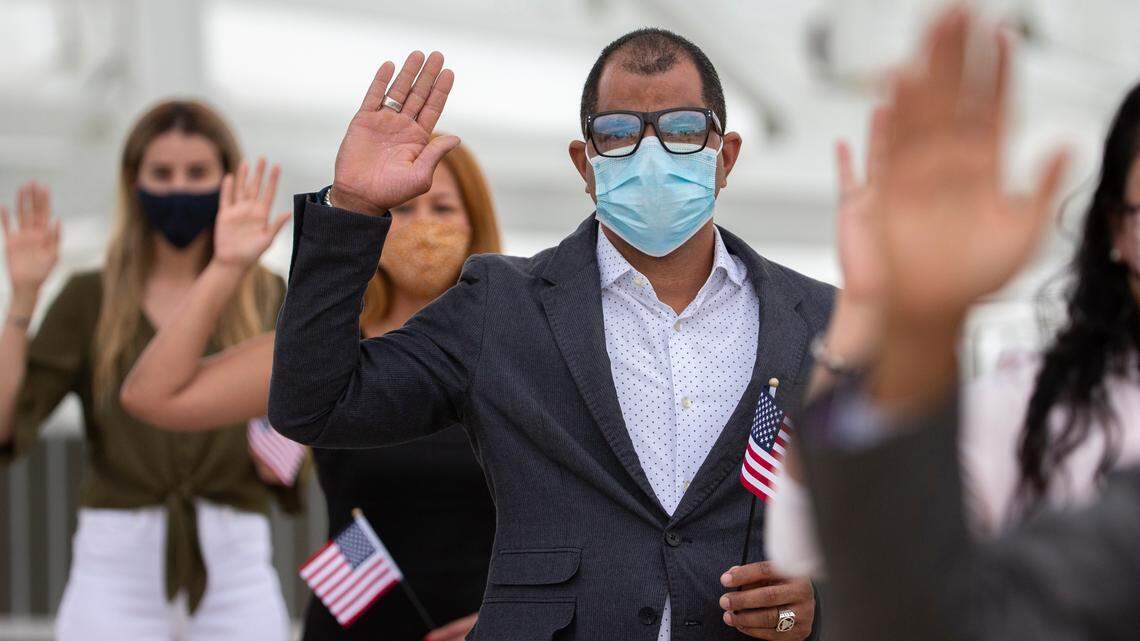
The Trump Administration added several questions to the U.S. citizenship test that some say will make it more difficult to pass.
The changes went into effect on Dec. 1, according to the U.S. Citizenship and Immigration Services website.
U.S. legal permanent residents who apply for citizenship through naturalization on or after that date will have to prove they can read, write and speak English — and know basic functions of government, U.S. history and the names of officials who represent them, the Miami Herald reported.
Immigration advocates have expressed concerns about the changes in the citizenship test. That includes Doug Rand, co-founder of Boundless Immigration, who called it “unnecessary, unjustified, overly complex, & shamelessly ideological.”
“This is an obvious attempt to throw one more obstacle in front of immigrants legally eligible for US citizenship,” he wrote on Twitter.
Joseph Edlow, the deputy director for policy at USCIS, said in a press release that the agency “has diligently worked on revising the naturalization test since 2018, relying on input from experts in the field of adult education to ensure that this process is fair and transparent,” The Miami Herald reported.
But could you pass the test? Here are some of the new questions — and answers.
New questions, answers on the Civics Test
Who is the Chief Justice of the United States now?
John Roberts/ John G. Roberts, Jr.
What is the capital of your state?
(Answers vary)
The U.S. Constitution starts with the words “We the People.” What does “We the People” mean?
Self-government
Popular sovereignty
Consent of the governed
People should govern themselves
(Example of) social contract
Why does each state have two senators?
Equal representation (for small states)
The Great Compromise (Connecticut Compromise)
What does the Bill of Rights protect?
(The basic) rights of Americans
(The basic) rights of people living in the United States
Why is the Electoral College important?
It decides who is elected president.
It provides a compromise between the popular election of the president and congressional selection.
Supreme Court justices serve for life. Why?
To be independent (of politics)
To limit outside (political) influence
What is the purpose of the 10th Amendment?
(It states that the) powers not given to the federal government belong to the states or to the people.
What group of people was taken and sold as slaves?
Africans
People from Africa
Name one example of American innovation.
Light bulb
Automobile (cars, internal combustion engine)
Skyscrapers
Airplane
Assembly line
Landing on the moon
Integrated circuit (IC)
Other changes
Applicants still need to pass the test with at least 60% correct answers or better — but will now have to answer 12 out of 20 questions correctly instead of 6 out of 10, according to WTOP. Applicants who are 65 or over and have had lawful permanent resident status for 20 years or more may still take the older version of the test, USCIS says.
The number of questions that may appear on the test was also expanded from 100 to 128, so applicants will need to study more to prepare for the test, according to the Miami Herald.
There are no longer questions about geography on the test and applicants must know all three branches of government rather than just one.
Immigration advocates also worry that the changes to questions are incorrect. For example, the answer to a question asking whom U.S. senators represent changed from “all people of the state” to “citizens in their state,” WTOP reported.
“This is not true,” Aaron Reichlin-Melnick, policy counsel at the American Immigration Council, a nonprofit and nonpartisan immigration advocacy group told WTOP. “Members of Congress represent everyone who lives in their district and…this country has always relied on the principle that you don’t have to be a citizen in order to be represented.”
The application fee also doubled, from $640 to $1,170, but that change has not yet gone into effect because it was blocked by a federal district court in California, according to WTOP.
Most U.S. citizens would have failed the old test
A 2019 study from the Woodrow Wilson Foundation found the majority of people in only one state — Vermont — were able to pass the multiple-choice test, McClatchy News reported. Only 27% of Americans under the age of 45 nationally could “demonstrate a basic understanding of American history,” a news release from the foundation said.
Some of the questions that tripped people up the most were about how many amendments there are to the U.S. Constitution (27), which 75% of respondents could not answer correctly, and when the Constitution was written (1787), which 85% of people did not know.
This story was originally published December 2, 2020 at 1:26 PM with the headline "Can you pass the new US citizenship test? Take a look at the more difficult questions."