
A Delta island came dangerously close to flooding. How California is ignoring the risk | Opinion
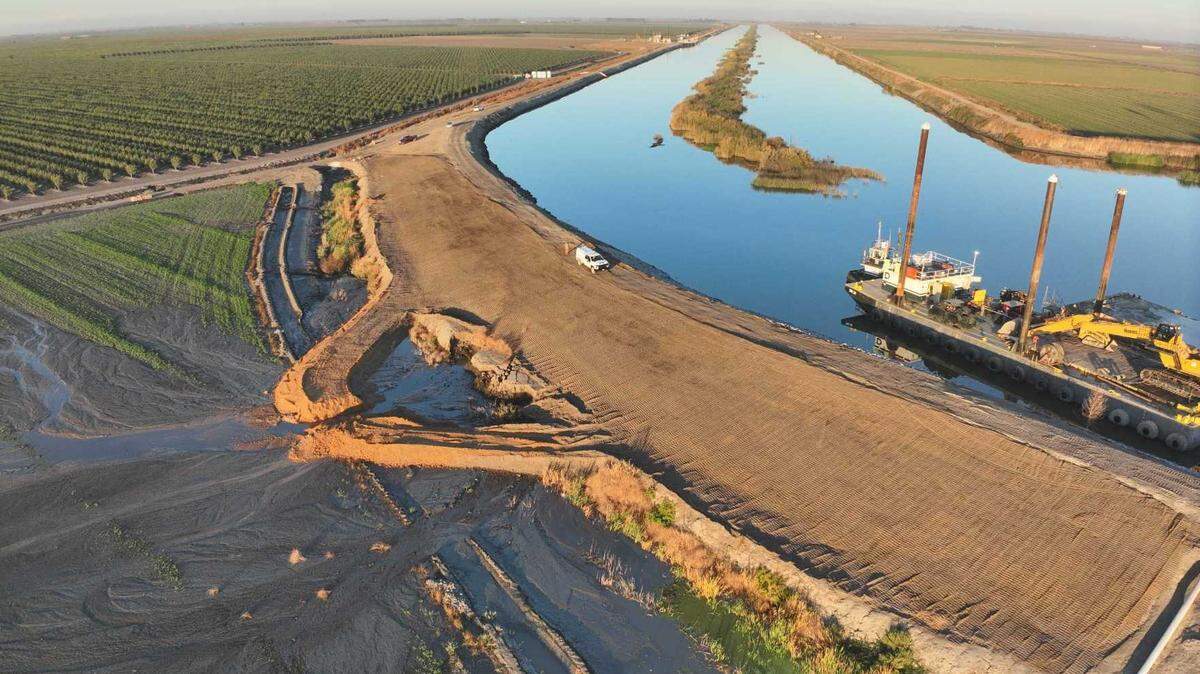
Imagine living right next to the Sacramento River on land many feet below sea level — the river next door running above the elevation of your land — and the only thing keeping you dry is an earthen berm never failing that is between you and the river.
That is today’s Sacramento-San Joaquin Delta.
Now, imagine if an unknown weak link in the levee began to fail, water seeping onto your land at a rate that could fill a typical swimming pool in three minutes.
This recently happened on San Joaquin County’s Victoria Island. Had the levee failed, Highway 4 would have been under more than 10 feet of water, and key power lines to run the California grid would have been suddenly inaccessible. Yet crews managed to plug the levee before a collapse that would have flooded 7,200 acres of land — about 30 times the size of downtown Sacramento.
This near-levee failure on a dry and unremarkable day reminds us of a common enemy — flooding — and the unaddressed risks in the Delta and throughout the Central Valley.
State planning bureaucracies have repeatedly warned it will take tens of billions of dollars to prepare for the coming cycles of floods, which experts repeatedly say will be worse due to climate change.
Political response
Our political response, meanwhile, is to starve funding for flood protection compared to the need.
So if there is no commitment to preventing unspeakable flooding in the Delta and elsewhere, isn’t that what we should begin to plan for?
“Nobody wants to talk about it,” said Jeffrey Mount, a retired UC Davis geologist whose predictions about Delta levee failures have earned him the moniker “Doctor Doom.” “These are not discussions you have in polite company.”
Mount became a controversial figure in the Delta when he and Environmental Planning Professor Robert Twiss of UC Berkeley warned in 2005 of widespread levee failures in the Delta and its 1,100 miles of levees. Farming in the Delta has erased peat soils to the point that the land elevations of many islands like Victoria are far below sea level. Were it not for the levees, these islands would be under water right now. That means the levees cannot fail for the islands to continue to exist. And with the islands continuing to subside and the sea level rising, the water pressure on the levee system is predicted to increase.
Is this a big deal? Researcher Steven Deverel and others have found that the probability of a levee failure is increasing exponentially as the Delta islands become deeper bowls, making them vulnerable to river flows seeping under levees and collapsing them.
“We’re at a place where maybe this is something that’s going to occur more frequently,” Deverel recently said.
Disaster strikes
And then, suddenly, on Victoria Island, it began to happen on the morning of Oct. 21.
A routine inspection drive atop the islands’ levees that morning found nothing. Then, a few hours later, engineer Christopher Neudeck got a call from 911 dispatchers. A follow-up inspection a few hours later found that a section of levee near Old River and Victoria Canal had collapsed five feet. Water was rushing onto Victoria Island at the base of the failing levee, fed by whirlpools in the river.
“Before it was a very dry section of levee,” said Neudeck, chief engineer of the island’s flood control authority, Reclamation District 2040. “It happened in a matter of hours.”
Crews working feverishly for hours managed to control the seepage by dumping an expansive form of clay (bentonite) onto the levee and building a U-shaped berm on the land side to surround the seepage. The San Joaquin County Board of Supervisors quickly convened to declare an emergency.
Now, the State Department of Water Resources is stepping into plan a more permanent fix.
Flooding costs
As for the cost? “It’s likely going to be somewhere in the millions of dollars,” said Sean de Guzman, manager of flood operations.
The likely culprit, said Neudeck, was a layer of sandy soil more than 20 feet below the top of the levee. Sands, which are ubiquitous in the soil profile throughout the Delta, are vulnerable to water pressures moving them until they push out onto the land surface and start a seepage process known as piping. Victoria Island was victim to the worrisome natural forces Deverel back in 2016 had predicted would increase over time.
The Delta hasn’t seen such a levee crisis since 2004, when, on a hot summer day with low river flows, a levee on nearby Jones Tract suddenly collapsed, flooding 12,000 acres and costing $90 million to fix.
Credit engineers like Neudeck for 20 subsequent years of few levee crises in the Delta with only modest outside support. The work hasn’t solved the problem, but has bought us some time. Time, in this case, however, is not on our side.
Meanwhile, California has other priorities. Proposition 4, the $10 billion water/climate/parks bond drafted by legislative Democrats and passed by voters, is a telling example. Feeding the coffers of so many environmental interests, the Democrats only had enough money for $150 million toward the Delta and $400 million for Central Valley flood protection. That is “virtually nothing,” Mount said, when compared more than $33 billion in needs identified by the Delta Stewardship Council and the Central Valley Flood Protection Board.
As these plans largely sit on shelves, the real emerging one is to avoid getting serious about flood protection until it is too late. The Delta will be among the regions that will suffer from the consequences.
This story was originally published November 26, 2024 at 6:00 AM with the headline "A Delta island came dangerously close to flooding. How California is ignoring the risk | Opinion."