
President Trump cannot use the military for domestic law enforcement | Opinion
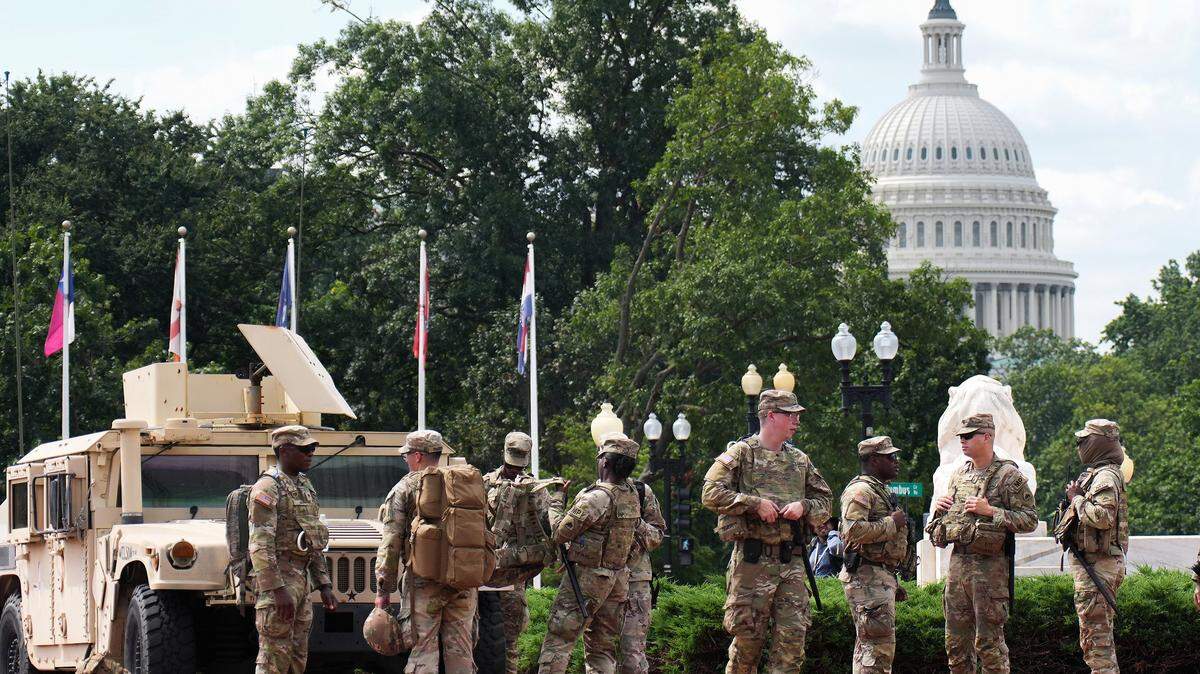
President Donald Trump’s use of the military for domestic law enforcement is blatantly illegal and should be deeply disturbing to us all. At a televised press conference on Aug. 26, Trump said “(I have) the right to anything I want to do. I’m the president of the United States.”
In a nation committed to the rule of law, the president cannot just do anything he wants. There is a word for a chief executive who can do whatever he wants: a dictator.
The courts, Congress and the country must make sure that does not happen here. And it is especially important that Trump’s use of the military for domestic law enforcement be stopped.
On Tuesday, Federal District Court Judge Charles Breyer found that Trump’s use of troops in Los Angeles violated federal law law. This should be upheld on appeal and a model for courts across the country.
In the first decades of American history, the military was used to suppress opposition to federal taxes, quell rebellions by enslaved persons and end labor strikes. But in 1878, Congress passed and President Rutherford B. Hayes signed the Posse Comitatus Act. The current version states: “Whoever, except in cases and under circumstances expressly authorized by the Constitution or Act of Congress, willfully uses any part of the Army, the Navy, the Marine Corps, the Air Force or the Space Force as a posse comitatus or otherwise to execute the laws shall be fined under this title or imprisoned not more than two years, or both.”
A “posse comitatus” was where people were called into service to function as police.
The legislative history of the law is clear: It was about prohibiting the military from being used for domestic law enforcement purposes. Federal courts have held that this law forbids the military from engaging in activities such as making arrests, seizing evidence, searching persons or buildings, interviewing witnesses, pursuing escaped criminals and searching for suspects.
There is now a case pending in federal district court in San Francisco as to whether Trump violated this law in his use of the California National Guard in Los Angeles. In a brief filed in that case, the Trump administration asserts that the federal court cannot enforce this law. In other words, the Trump administration is claiming the power to use the military however he wants for policing.
Indeed, in his public statements, Trump has talked of sending troops to other U.S. cities — including Chicago, New York, Baltimore and Oakland. Is it a coincidence that these are cities in blue states with Black mayors? Secretary of Defense Pete Hegseth testified before Congress that the plan is to increasingly use the military “to protect the homeland.”
Trump has already used the National Guard — with governors of several red states sending troops — for law enforcement in D.C. Although the president has more authority over D.C. because it is part of the federal government, the images from that city are deeply disturbing. National Guard troops with guns patrol grocery stores, parks and sidewalks, and there are federal checkpoints through the city.
There is a strong tradition of not using the military for domestic law enforcement. Both Democratic and Republican presidents have followed this, with very rare exceptions (such as to desegregate the Little Rock, Arkansas public schools and to protect civil rights demonstrators in Selma, Alabama).
There is very good reason for this strong tradition. Military personnel are trained for combat situations, including using lethal force. They are not trained for domestic law enforcement tasks, such as community policing, de-escalation tactics and crisis intervention.
Police are trained about the constitutional rights that must be observed in law enforcement, such as the Fourth Amendment, which allows people to be stopped only if there is reasonable suspicion that they have committed or are likely to commit a crime, and to be arrested only if there is probable cause. This is not part of military training or military operations.
In the U.S., most policing is supposed to be done at the state and local level. It is striking that the governors and mayors have been clear that they do not want Trump to send troops. Gov. Gavin Newsom has sued to stop it and Illinois Gov. JB Pritzker has said that it would be an “invasion” of his state.
Under federal law, the president can use troops in domestic situations only in very limited circumstances, such as by invoking the Insurrection Act of 1807. Trump has not done so, and the circumstances allowing for that law to be used have not been met.
So much of what Trump has done in the last seven months has violated the Constitution and federal laws, as well as ignored long-standing traditions and norms. But among the most chilling is his use of the military for policing. The federal courts must declare this illegal, and Congress must act to put a stop to it by preventing federal funds for the military from being used for domestic law enforcement.
Erwin Chemerinsky is dean and professor of law at the UC Berkeley School of Law.
This story was originally published September 4, 2025 at 6:00 AM with the headline "President Trump cannot use the military for domestic law enforcement | Opinion."