Cal Poly president called to testify before House committee. Who will be next? | Opinion
By The SLO Tribune Editorial Board
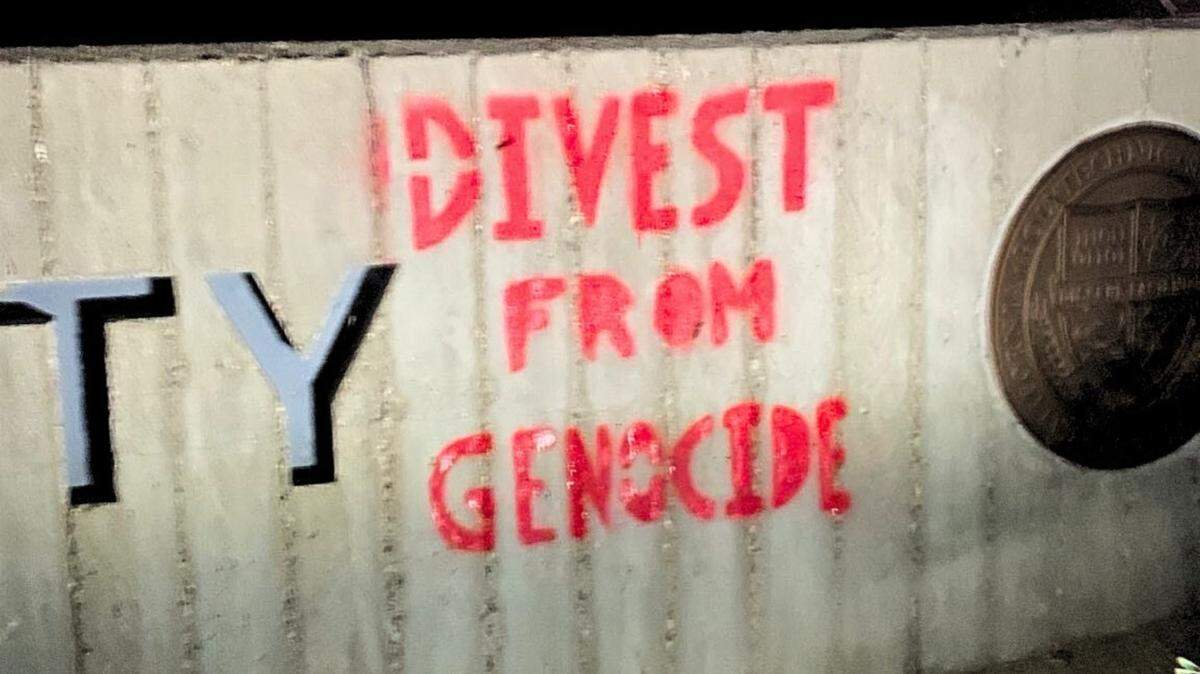
Protesters vandalized the Cal Poly campus with graffiti on Oct. 31, 2024. The university said it would not meet demands to divest from companies that aid Israel’s war effort.
Anonymously submitted
Cal Poly President Jeffrey Armstrong has been called to testify in front a Republican-controlled congressional committee looking into “rampant antisemitism” on college campuses.
The House Committee on Education & the Workforce is demanding that college presidents “answer for mishandling of antisemitic, violent protests.” In addition to Armstrong, it also is summoning leaders of DePaul University in Chicago and Haverford College near Philadelphia to testify on May 7.
This is the same committee that grilled presidents from major universities like Columbia, Harvard, Yale and UC Berkeley over their responses to pro-Palestinian protests.
Why the committee is now singling out a small university in San Luis Obispo, California — and one that has a reputation for conservatism — is a mystery.
Cal Poly is not exactly an epicenter of campus protests against the war in Gaza. There have been no mass encampments or violent confrontations between student groups as there have been at other campuses.
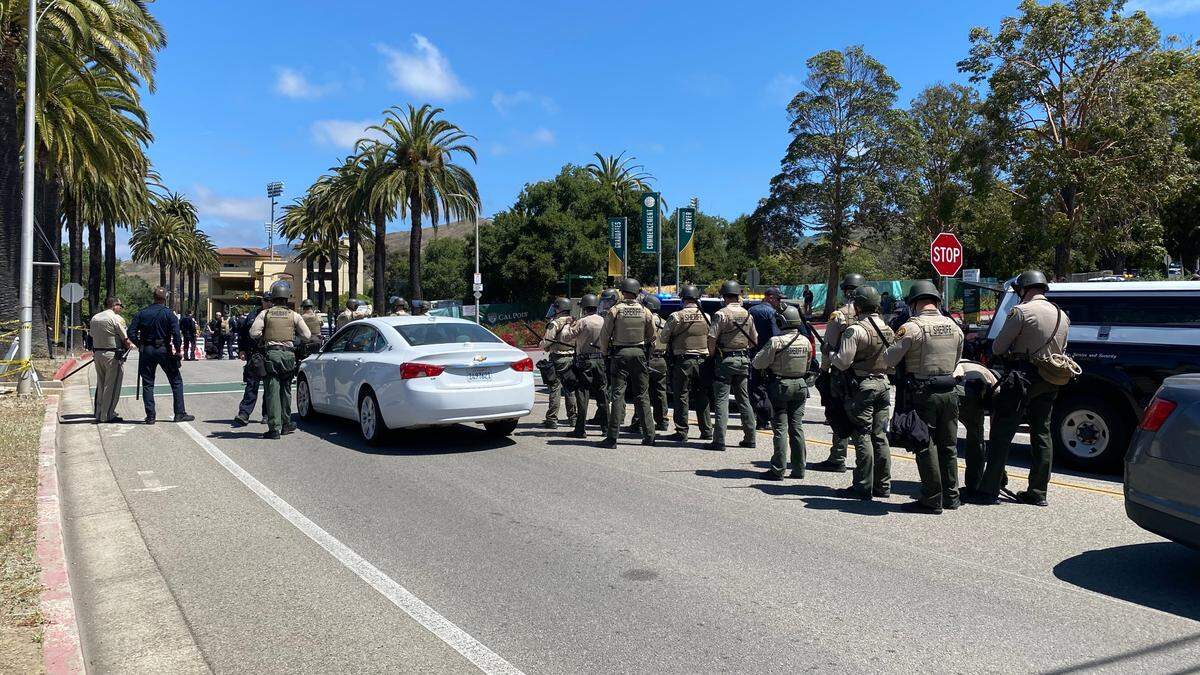
Pro-Palestinian protests have, for the most part, been peaceful. There were two confrontational actions by small groups of protesters — including one attempt to storm a campus career fair and another to block an entrance to campus. Both were heavily policed and ended in arrests.
Cal Poly administration issued stern warnings following both incidents.
“We are a public campus, and we support the rights of all campus community members and visitors to speak their minds — but we will not tolerate violence, disruption, trespassing or other criminal activity,” Armstrong said following the career fair protest.
The administration also made it clear that it would not accede to demands that itdivest from companies aiding Israel’s war effort.
That hardly sounds like a university that needs to be “held accountable” by a congressional committee.
Sheriff’s deputies in riot helmets assemble as backup during arrest of eight pro-Palestine protesters who blocked the intersection at California Boulevard and Campus Way near Cal Poly on May 23, 2024. Stephanie Zappelli szappelli@thetribunenews.com
Antisemitic acts
This is not meant to imply that there have been no antisemitic incidents at Cal Poly.
Students have been verbally harassed and subjected to hateful graffiti — including swastikas spray-painted on the sidewalk outside a Jewish fraternity house. And there is no doubt that behavior at recent protests has made some Jewish students uneasy.
“When I see people screaming on my campus things like, ‘From the river to the sea, Palestine will be free,’ ‘F--- the Jews,’ and all this stuff, how am I supposed to feel when someone random comes up to me and asks if I’m Jewish?” I feel judged; I feel unsafe; I feel like I can’t even be myself. I can’t say that I’m Jewish. I can’t wear my star out in public,” a Jewish student told New Times last October.
We should point out that Jewish students have not been the only victims of harassment at Cal Poly.
Black, brown and Native American students also have been targeted by racist language and displays.
Just last weekend, for example, a truck flying a stylized Confederate flag with the word “redneck” participated in a campus tractor pull, eliciting outrage on social media.
In such instances, universities find themselves caught in the middle.
They are required by law to protect students who belong to a federally protected class due to their race, nationality, gender, disability, age, etc.
But at the same time, they are obligated to respect students’ right to free speech. A couple of things to keep in mind about that:
Hate speech is considered protected speech — which is why Cal Poly has allowed provocateurs like far-right firebrand Milo Yiannopoulos to speak on campus.
Criticizing Israel’s war in Gaza is not antisemitic. The very definition of antisemitism used by the United States government confirms as much: “Criticism of Israel similar to that leveled against any other country cannot be regarded as antisemitic.”
House committee says free speech ‘may be regulated’
The Committee on Education & the Workforce has a more restrictive view of free speech.
In a report issued last fall, it accuses universities of attempting to “hide behind the First Amendment’s free speech protections.”
“Speech that rises to the level of incitement, fighting words, true threats, or speech integral to criminal conduct may be regulated. Additionally, speech that provokes imminent lawlessness and would result in a breach of peace is unprotected,” the report says.
So what would the committee have universities do?
Should they have lawyers attend every protest to determine, on the spot, whether speech “rises to the level of incitement” and order protesters to disperse if that level is reached? Or perhaps issue a list of forbidden words and phrases in advance of every protest rally, every march or die-in?
What a legal quagmire that would be.
Cal Poly cannot be held responsible for every word uttered by every student.
It can, however, be expected to create a climate of tolerance and understanding so that all students feel safe and protected, be they Jewish, Black, brown, gay, transgender or any other protected class.
Such a climate would make it clear that, while demonstrating against the war in Gaza is allowed, that does not give protesters license to violate the rights of their fellow students.
Armstrong will be fine — but his appearance is unwarranted
In an effort to improve the campus climate for Jewish students, Cal Poly is creating a task force that will develop an action plan focused on Jewish student life, antisemitism education and cultural awareness.
Armstrong is said to be looking forward to sharing that information with the House committee.
We don’t doubt that Armstrong will avoid the pitfalls that brought down other university presidents. He is smart, personable and articulate. He will do a fine job representing the university.
But he should not have to do so. Cal Poly did not “mishandle” any violent, antisemitic protest.
If anything, there was an excessive police presence at the small demonstrations that threatened to cross the line, and the university was quick to condemn them.
This is yet another power play by an administration intent on exerting total control over every aspect of American life.
Let’s hope it’s the last one Cal Poly must endure.