
Cal Poly president aced congressional hearing — others, not so much | Opinion
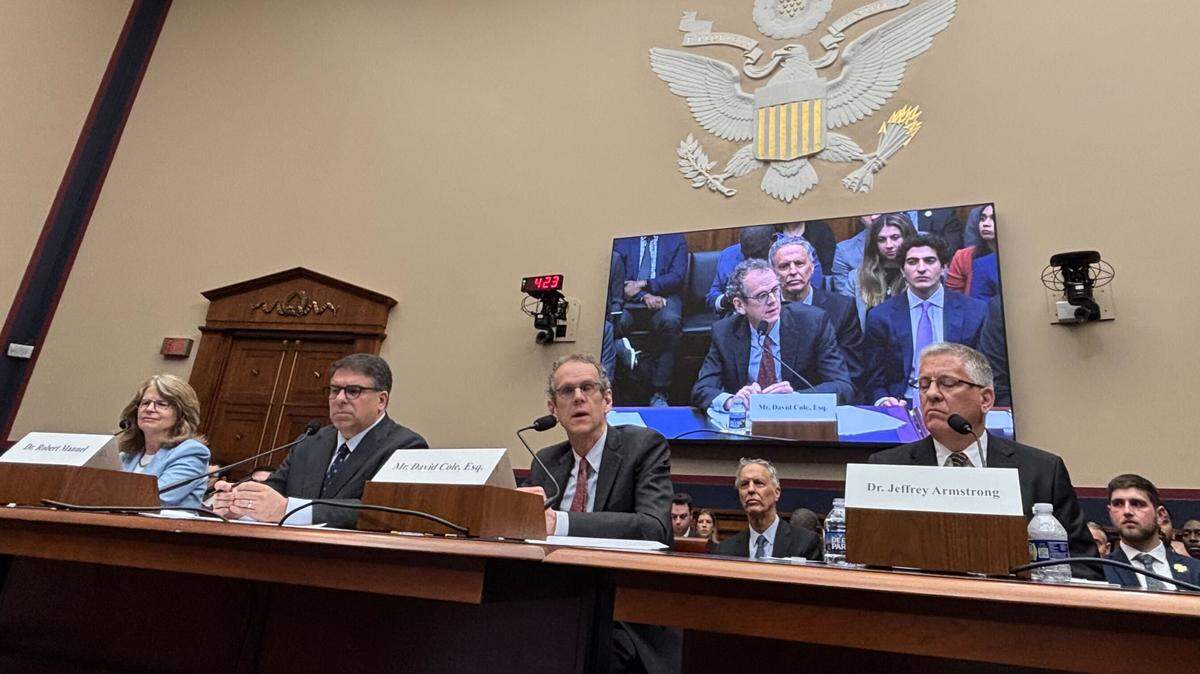
Cal Poly President Jeffrey Armstrong survived a confrontational House education committee hearing on Wednesday largely unscathed, as Republican lawmakers continued to blame “left-leaning” university presidents and faculty for the rise in antisemitism on college campuses.
Though Republican Rep. Joe Wilson of South Carolina disapprovingly referred to Armstrong as “an outspoken DEI proponent,” Cal Poly’s president escaped the kind of harsh criticism that has been directed at other university officials previously called in to testify.
So we’re left wondering: Why was Cal Poly targeted by the committee in the first place? Was it an act of intimidation? Does the Republican-controlled committee really believe that the San Luis Obispo campus is some radical university? If so, it failed to do its homework. Cal Poly — known for its strong programs in engineering, architecture and agriculture — has a long-standing reputation as leaning more conservative than most California public universities, though that has been slowly changing.
As we’ve said before, there were no pro-Palestinian encampments at Cal Poly, and the two unsanctioned protests that did occur — a brief blockade of an entrance to campus and a failed attempt to storm a campus career fair where defense contractors were recruiting — were heavily policed and resulted in arrests.
Protests were far more problematic at the other two campuses represented at Wednesday’s hearing: DePaul, a private, Catholic university in Chicago, and Haverford, a private university in Philadelphia that was founded by Quakers but is now non-sectarian.
Pro-Palestinian encampments were setup at both campuses, and there were numerous reports of ugly, and even violent, acts of antisemitism. At DePaul, for example, two masked men attacked two Jewish students, leaving one with a concussion and the other with a broken wrist. According to news reports, the victims were “visibly showing” their support for Israel at the time of the attack. Authorities are prosecuting the case as a hate crime.
DePaul President Robert Manuel and Haverford President Wendy Raymond were on the receiving end of far more questions — and vitriol — than Armstrong.
Republican committee members were especially critical of Raymond, who repeatedly refused to say whether any students or faculty had been disciplined for antisemitic incidents that occurred during protests of the war in Gaza.
Haverford threatened with loss of funding
Time after time, Raymond tried to satisfy the committee with some variation of a stock answer: “We do not tolerate discrimination.”
In one especially painful exchange, Rep. Kevin Kiley, a Republican from Rocklin, California, asked about posters advertising Jewish events on campus that had “disappeared.”
“You said it was the wind. Was it the wind that caused the posters to come down?”
“We, we do not tolerate any discrimination ....” Raymond began to respond.
Kiley interrupted: “Nowhere close to my question. Was it the wind that caused these posters to come down?”
Raymond never offered a direct response.
Multiple times, Republican committee members threatened Haverford with the loss of federal funding, which has already happened to multiple universities whose presidents got on the wrong side of the committee at previous hearings.
Placing — and shifting — blame
Republicans left no doubt that they regard so-called “leftist” universities as the enemy, responsible for radicalizing students.
“They (student protesters) intimidate, threaten and attack people who hey don’t know because they’ve been taught to hate by their college professors,” Rep. Burgess Owens of Utah said.
Democrats, meanwhile, tried to shift blame onto Republicans by accusing them of failing to root out antisemitism in their own party. There were multiple references to the 2017 white supremacist march in Charlottesville, when Trump commented that “there were very fine people on both sides,” and to the pardoning of antisemitic Jan. 6 protesters who were among those criminally convicted.
They repeatedly drew parallels between the Joe McCarthy hearings of the 1950s, when hundreds of Americans were accused of being communists, and the current accusations of antisemitism on college campuses.
And they pointed to the decimation of the Department of Education’s Office of Civil Rights, which is charged with investigating discrimination complaints, including accusations of antisemitism.
“According to public reports, nearly half of the OCR staff has been laid off and so one is left to wonder, how can OCR carry out its important responsibilities with half the staff?” asked Virginia Rep. Robert Scott.
Scott — the senior Democrat on the committee — also faulted Republicans for their lack of concern about other forms of discrimination on college campuses.
“Curiously, my colleagues on the other side of the aisle have not had any hearings addressing other forms of discrimination and hate, such as racism, Title 9, gender violations, Islamophobia, homophobia, or the challenges of meeting the needs of students with disabilities,” he said.
It is curious. So is the perfunctory way Republicans on the committee have been treating the First Amendment guarantee of free speech on college campuses.
David Cole, an ACLU attorney and Geogetown University professor who testified alongside the three college presidents, accused Republican members of “making no effort to discern the difference between protected speech and discrimination.”
Indeed. Given what’s happening, university officials must be wondering if it’s safe to allow any criticism of the Israeli government at campus events.
Is it over?
All three presidents said they are working to combat antisemitism.
Armstrong was able to point to multiple steps that have either already been taken or are in the process of being implemented to improve the campus climate for Jewish students. Those include appointment of an antisemitism task force; conducting training for staff and students to increase awareness of antisemitism; and fundraising to endow a chair in Jewish studies and to build an Interfaith Center.
That earned praise from some Democrats. The Republican chair of the committee, Tim Walberg of Michigan, credited both Armstrong and Manuel for responding to questions — another dig aimed at Raymond.
At the end of the day, Armstrong played it safe and smart. He was respectful, he acknowledged there is work to be done to counter antisemitism and he presented a clear plan of action.
That’s the most you ask for in a political venue that is, above all, an opportunity for performative showboating by members from both sides of the aisle.
It remains to be seen whether more college presidents will be hauled in front of the committee, but it appears Cal Poly has passed its test.
Nice job, President Armstrong.
This story was originally published May 8, 2025 at 5:00 AM with the headline "Cal Poly president aced congressional hearing — others, not so much | Opinion."