
How many millions to buy 2016 election?
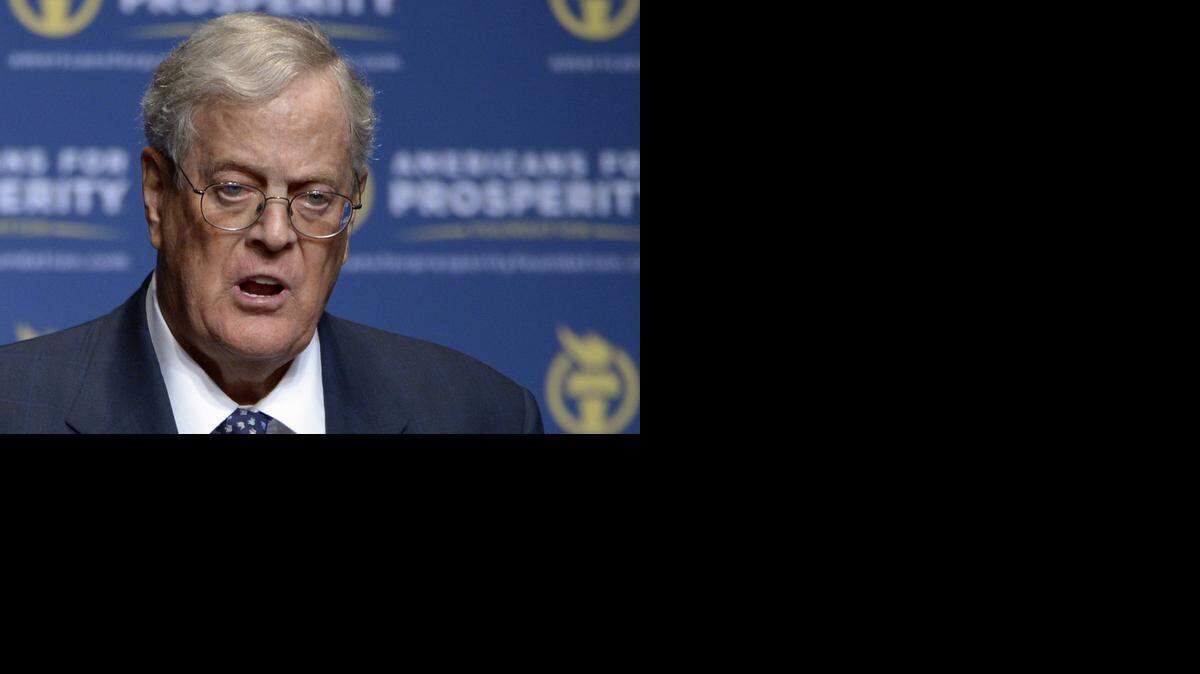
It was the political equivalent of a beauty pageant, candidates parading through Palm Springs to win favor with brothers Charles and David Koch and 450 of America’s wealthiest citizens.
Kentucky Sen. Rand Paul, Sen. Ted Cruz of Texas, Sen. Marco Rubio of Florida and Wisconsin Gov. Scott Walker strutted their conservative bona fides in earnest efforts to charm and impress some of the nation’s richest people. Who can blame them? Campaign 2016 is underway, and you need rich friends to win elections in America.
Meanwhile, The Washington Post reported the Koch brothers set a fundraising goal of $889 million for 2016. That’s more than double the $407 million the Koch network spent during last 2012 presidential election. Much of that mind-numbing sum will be spent on presidential and congressional races. Hence the political pageant.
The magnitude of the effort makes clear the billionaire brothers and their wealthy friends are creating a shadow political party. We say “shadow” because that’s where it will carry out its campaign efforts. Using antiquated Internal Revenue Service code sections to avoid having to publicly disclose their spending, the Koch-funded nonprofit organizations will operate in the dark.
The Republican National Committee and Democratic National Committee, by contrast, identify contributors and expenditures in regular public campaign finance filings. It’s the law.
The travesty is not merely the amount of money being spent to purchase your vote. It’s the lack of transparency we find more abhorrent.
By failing to disclose, the Kochs ignore the public’s right to know who is trying to influence the elections, further sullying their reputations and diminishing the democracy they claim to cherish.
The Koch brothers aren’t your run-of-the-mill billionaires. They place No. 4 and 5 on the Forbes list of billionaires, at $40billion each, earned in part from inheriting an oil company founded by their father, a founding member of the John Birch Society. They took that seed money and added enormously to it through mineral extraction, pipelines, paper products, gasoline and even Teflon.
The Keystone Pipeline debate isn’t so much about what is good for America as it is about is good for the Koch brothers. They have long been significant investors in the Canadian tar sands that will flow through the pipeline, earning them an estimated $70 billion or more. That makes their $889million political investment seem like a bargain, along with millions more they are spending on political campaigns in Canada.
To be sure, wealthy Democrats also spend heavily. Liberal Tom Steyer, whose $1.6 billion places him No. 383 on Forbes’ list, spent $73.7 million to elect Democrats in 2014. That’s more than anyone else last year – at least that we know of. Unlike much of the Kochs, Steyer disclosed how much he spent, and where he spent it.
The U.S. Supreme Court says rich people and corporations can spend as much as they want on independent campaign efforts. It is a First Amendment right. That money amplifies their message beyond that of others is of no concern to the courts.
The Kochs are free to espouse any political philosophy they choose. That’s not the point. So much money can do good or harm, which is why elections have rules. No one wants to see a rigged beauty pageant or a rigged election.
This story was originally published January 30, 2015 at 12:11 AM with the headline "How many millions to buy 2016 election?."