
Kansas Jayhawks on quest for another banner, a century after first ‘national championship’
Sweet 16 teams typically boast their share of trips down memory lane
It’s been 25 years since Providence’s last run to the second weekend of the men’s NCAA Tournament, and 35 since the Friars’ Final Four under Rick Pitino.
Michigan’s Fab Five freshmen reached their first championship game in 1992, and 10 years before that, another freshman, North Carolina’s Michael Jordan, buried a 17-footer to give coach Dean Smith his first title.
And this year marks the 70th anniversary of Kansas’ first NCAA basketball championship, a feat followed by international acclaim when half of that Jayhawks roster captured Olympic gold in the 1952 Summer Games.
But according to banners hanging from the Allen Fieldhouse rafters, that’s not the only anniversary for a championship team from Kansas this week.
Can we get a huzzah for the 1922 Kansas Jayhawks?
That KU team didn’t plot a course through a bracket. The NCAA Tournament didn’t begin until 1939, so there was no postseason play for the championship. And there were no opinion polls around then to produce a final ranking for that year’s team.
The term “national champion” simply didn’t exist for college basketball 100 years ago. But the banners say KU was just that in 1922 and 1923: national champs.
How, then, is this possible? The history of national championships announced by the Helms Foundation begins with a Los Angeles-based sports historian and researcher named Willrich “Bill” Schroeder.
A project to determine top teams from the pre-tournament era retroactively concluded that the Jayhawks were college basketball’s best team during the years of Babe Ruth, the Model T and Prohibition.
“One of the most successful seasons in years,” is how the KU yearbook, Jayhawker, described the accomplishment in its 1922 edition.
But there was no mention there or anywhere else of Kansas being better than anyone outside of the Missouri Valley Conference — nor is there mention of KU owning supremacy in the league. In 1922, Kansas was co-champion with Missouri.
So Schroeder dug deeper. His platform was funded by a fellow sports enthusiast Paul Helms, an Ottawa, Kansas native who owned and operated bakeries in Southern California..
Helms found great success in supplying bread for athletes at the 1932 Olympics in Los Angeles and wanted to expand his presence in sports. He hired Schroeder, who sought to create the world’s most complete sports library. Together, they formed the Helms Foundation, which was essentially a one-man operation — Schroeder — working out of an office at one of Helms’ bakeries.
Schroeder got his start in honoring individual players and teams by organizing local newspaper editors and writers to select high school all-star squads. He later acted on his belief that athletes, coaches and teams from earlier eras deserved recognition. And not just in his region, but nationally.
When it came to college basketball, Schroeder solicited opinions from coaches and sportswriters around the country. But when he finalized his list of the nation’s best teams from 1920-42, there is no evidence that anyone other than Schroeder made the selections.
Ranking teams from this era was no simple task. Schools from different regions rarely met, although Kansas coach Phog Allen, sensing the 1922 team could be special, changed his preseason routine. He took the Jayhawks to Minnesota to practice with the Gophers in the preseason. The week culminated with a game: a 32-11 KU victory.
But there was no easy way to compare teams beyond win-loss records and contacting those who had witnessed the games. Impressive as the Jayhawks’ 16-2 final record was, at least 21 programs exceeded the victory total in 1922.
Schroeder nevertheless made his decision and the reports were delivered to newspapers in February 1943. The Kansas City Star’s story didn’t lead with the 1922 and 1923 teams’ accomplishments, but the fact that Schroeder had selected Allen, who was about to complete his 26th season across two stints at KU, as “the greatest basketball coach of all time.”
Later in the story, the two Kansas teams were “chosen as the national champions and almost captured the title again in 1936.” Additionally, star player Paul Endacott was honored as an “all-time All-American.”
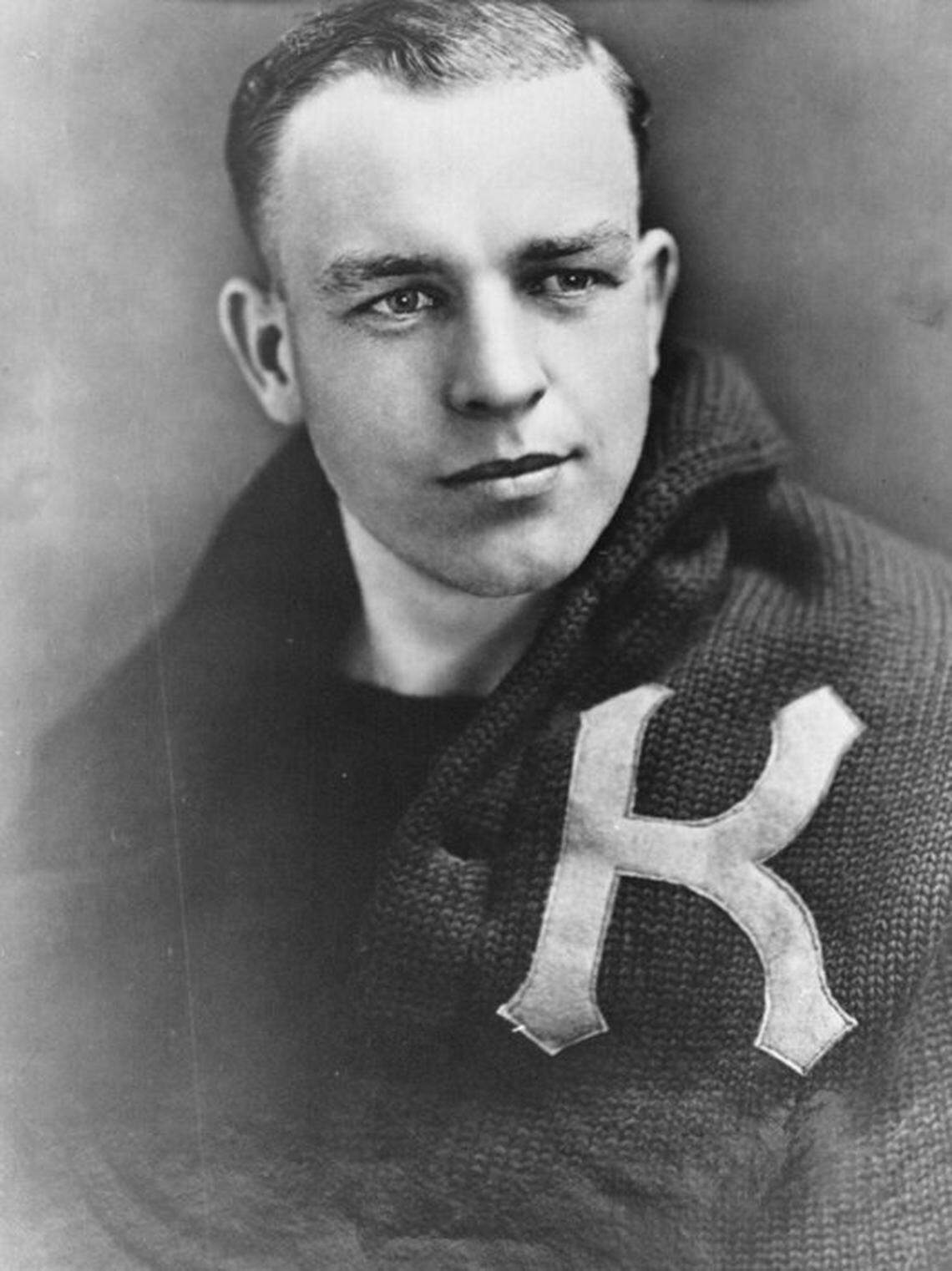
That was the first instance of KU and other teams from those decades being called “national champions.” Those seasons were highlighted in KU’s media guides starting in the 1980s, and the school updated its banners in 2006, giving equal measure to the Helms and NCAA titles.
One can argue that KU should distinguish between those championships. The school chooses not to do that. The 1922, 1923, 1952, 1988 and 2008 banners are uniform in size and appearance.
The same is true at North Carolina, which hangs a 1924 Helms national champion banner alongside its five NCAA championship flags. Pittsburgh identifies the Helms Foundation on its banners for 1928 and 1930.
Kentucky doesn’t consider its 1933 Helms championship banner-worthy.
Make no mistake, the 1922 Jayhawks were an exceptional team, as was Missouri. KU and the Tigers split their season series and won all other conference games to finish 15-1. Kansas’ other loss came against the Kansas City Athletic Club, an AAU team comprised mostly of former college stars.
The Jayhawks’ victory at Missouri late in the season proved to be significant in multiple ways. KU had lost nine straight to the Tigers — Missouri’s longest stretch of success in the rivalry. Seven of those losses were by Allen-coached teams.
Allen was desperate to end the streak. He had served as the program’s coach from 1907-09 and returned in 1920. Allen’s first two teams finished a combined 20-15. With his 1922 team setting a torrid pace, he saw the late-season game at league-leading MIssouri as a chance to make a stand.
The bigger the game, the more passionate the pre-game speech, according to star guard Paul Endacott in a 1996 interview. And this was Allen’s first big moment.
“He would make these talks in the dressing room just before we’d go out,” Endacott recalled. “We didn’t remember what he said, but he was full of fire. And It got us to play hard.”
Kansas pulled away after halftime for a 26-16 victory, avenging a 10-point loss to Missouri in Lawrence. The teams would go on to share the conference championship.
In the Missouri Valley’s first 15 seasons, KU, Missouri, Kansas State and Nebraska had won or shared multiple championships. No school controlled the conference. But the 1922 league title was the first of six straight for Kansas.
This season, 2021-22, the Jayhawks won their 63rd conference championship — the most of any major college program — in 115 years of league play.
After the 1922 season, Missouri attempted to arrange a game or series with Kansas, but the Jayhawks refused. The Tigers turned down offers to play in the national AAU tournament in Kansas City and the first attempt at a postseason national college tournament in Indianapolis.
There’s an historical footnote here. Missouri was every bit Kansas’ equal in 1922 and had the better recent history. In another opinion poll, this one researched in the 1990s by St. Bonaventure professor Pete Premo and computer programmer Phil Porretta, the Tigers — and not the Jayhawks — were declared the nation’s best team for that season.
The Tigers also got the nod for 1921. Premo and Porretta didn’t just pick a winner, they came up with a top 20 for most of the pre-tournament seasons. For 1922, Kansas was second. The Jayhawks also were No. 2 in 1923, behind Army.
Missouri doesn’t hang banners for its best opinion-poll finishes. Kansas does, and KU even honored its 1922 team this season with a throwback-uniform game. The same likely will be true next season for the century celebration of the 1923 team.
There will be another anniversary to acknowledge next season: the 80th of the letter informing Kansas of its two retroactive championships that mark banner seasons.
This story was originally published March 23, 2022 at 3:00 AM with the headline "Kansas Jayhawks on quest for another banner, a century after first ‘national championship’."