
Six more coastal hikes to enjoy seals, trails, waves
Last week, I featured five favorite coast hikes in the Monterey Bay area: Wilder Ranch, Natural Bridges, Asilomar, Point Lobos and Elkhorn Slough.
I’m adding six more this week, stretching from 20 miles north of Santa Cruz to the Big Sur coast south of Carmel.
Furthest north, Ano Nuevo State Reserve is one of the best places to see elephant seals of all sizes, from males who sometimes weigh 4,000 pounds to newborn pups. Twenty miles north of Santa Cruz on Highway 1, access is offered through daily ranger-led tours from December through March. Over the course of about 2 1/2 hours, groups walk about 3 miles over the sand and bluffs to view and learn about the seals up close.
Reservations are a must because these tours are extremely popular. Although many weekend tickets have been sold, weekday tickets are relatively easy to obatin. You can get yours starting in October each year at anonuevo.reserveamerica.com or by calling (800) 444-4445. For information about the park, go to http://www.parks.ca.gov/?page_id=523 or call (650) 879-2025.
Accessible tours are available – call the park for information.
Henry Cowell Redwoods State Park – This Santa Cruz-area park showcases the giant redwoods that are nourished by the coast’s frequent fog. Everyone can enjoy the half-mile Redwood Grove Loop Trail near the visitor center. It’s designed to be accessible, and it passes among some of the largest trees in our part of the state. If you’re up for a bit more, you can pick up the River Trail near the John C. Fremont Tree and follow it to Pipeline Road (a fire road closed to private vehicles) and use it to form a loop with Ridge Fire Road, the Pine Trail and the Eagle Creek Trail.
There’s a great observation deck with expansive forest views at the top of Ridge Fire Road. Use the River Trail to return to the parking lot after you have made the loop. By the time you’re done, you will have walked about 4 miles. Before you make the whole loop, however, call the park to verify that the seasonal bridge over the San Lorenzo River is in place. If it isn’t, ask for alternate trail suggestions – the park has lots of trails for hikers, bikers, dogs and equestrians. For information, go to http://www.parks.ca.gov/?page_id=546 or call (831) 335-4598. The day-use fee is $10/vehicle. The main entrance is located on Highway 9, north of Santa Cruz.
On clear days, Fremont Peak State Park provides grand views of the mountains, hills and agricultural valleys that stretch from Hollister toward Monterey Bay. To get to the 3,170-foot summit of Fremont Peak, your car does most of the climbing on narrow, winding San Juan Canyon Road. The hike itself is a half-mile round-trip climb to the peak on a rough trail with a lot of broken rock. It’s not exactly easy, but it’s not very long and is well worth the climb.
With a map and binoculars, you can easily identify the bay and many of the surrounding communities. To find the park, turn off Highway 156 in San Juan Bautista and follow the signs. For information, go to http://www.parks.ca.gov/?page_id=564 or call (831) 623-4255. The day-use fee is $6/vehicle.
A few miles south of Carmel, Garrapata State Park is the northernmost of the state parks along the Big Sur coast. Big Sur was named for dramatic cliffs that plunge into the ocean – a sharp contrast to the more gentle landscape of Monterey Bay. The Soberanes Point Trail is a relatively easy 2-mile loop that follows the edge of a bluff above rocks that are regularly pounded by violent waves. The trail doesn’t climb much, but it is narrow in places, with poison oak sometimes close to the path. There’s no parking or day-use fee, but the trailhead is a bit hard to find.
Set your odometer at Highway 1 and Rio Road in Carmel and follow the highway south for about 7 miles, looking for mile marker 13. Look for the path to the edge of the bluff and follow it. You can also pick up parts of this trail at mile markers 15 and 16, and there is parking and access to a beautiful beach at the southern end. Go to http://www.parks.ca.gov/?page_id=579 or call (831) 624-4909.
McWay Falls at Julia Pfeiffer Burns State Park is one of the icons of the Big Sur coast. Although it is most impressive in the rainy season, the water falls gracefully over a cliff onto a sandy beach year-round. This is an easy, paved, half-mile round-trip walk along a paved path. Although some people park in narrow spaces along Highway 1, it is much safer to pay the $10/car entry fee and park in the official lot.
This lot also provides access to longer trails such as the Ewoldsen Trail, which climbs through redwoods to a second waterfall tucked into a canyon and an overlook of the coastline at 1,600 feet. Go to http://www.parks.ca.gov/?page_id=578 or call (831) 667-2315.
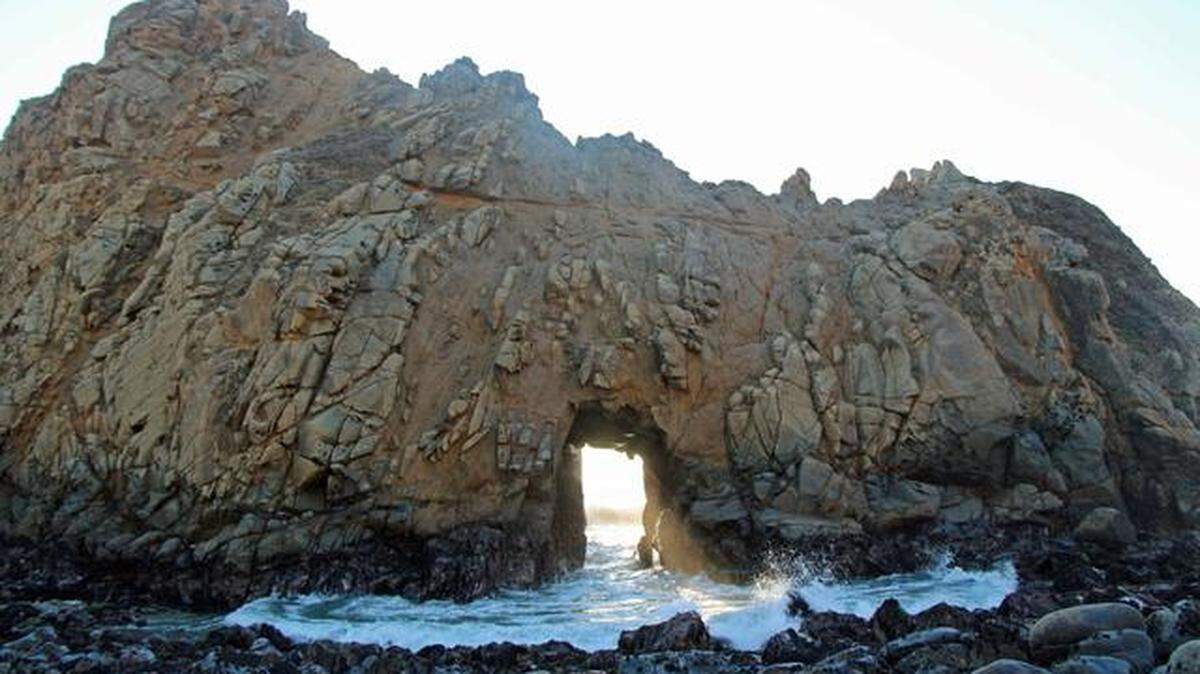
Pfeiffer Beach is less known but equally beautiful. The turnoff from Highway 1 isn’t marked, but you can find it by setting your odometer when you pass Big Sur Station and look for a right turn onto Sycamore Canyon Road a half-mile south. Parking is at the end of a one-lane road. It’s worth the $10/vehicle fee to enjoy the beach and marvel at the tunnels the waves have eroded through Keyhole Rock.
The rays of the sun often pass through the rock as the sun sinks into the Pacific. The wide expanse of sand is set against a backdrop of mountains and cypress trees, and there are tidepools near Keyhole Rock. It’s a short walk from the parking lot to the beach, and there’s plenty to explore and it’s a great place to spend a relaxing afternoon. Go to http://www.fs.usda.gov/recarea/lpnf/recarea/?recid=10918 or call (831) 667-2315.
Adam Blauert is an avid outdoorsman who enjoys fishing, backpacking and exploring the western states. He can be reached at
adamblauert@yahoo.com.
This story was originally published December 3, 2014 at 12:27 AM with the headline "Six more coastal hikes to enjoy seals, trails, waves."