
Water is scarce at refuge, but there are still birds aplenty
As the drought continues, it’s hard to not worry about the potential consequences of another dry year for farms and cities if we don’t get more rain soon.
In the meantime, the shortage has also negatively impacted winter recreation. Badger Pass, Dodge Ridge and Leland Snowplay are currently closed, China Peak and Bear Valley are only partly open, and most snoparks have very limited snow.
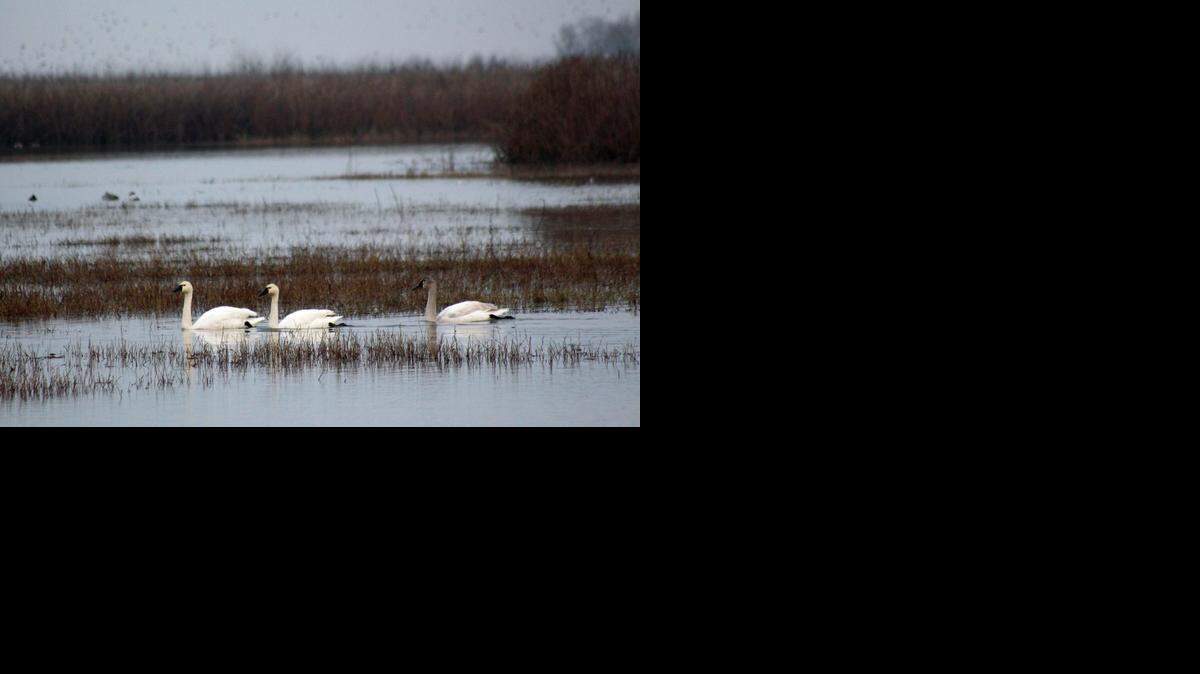
The water shortage is also affecting wildlife. On Monday, I drove to the Merced National Wildlife Refuge. Less than 30 minutes from the heart of Merced, it’s my favorite close-to-home place to enjoy the outdoors.
Due to the drought, there’s a lot less water at most refuges this year.
As I drove the 5-mile auto tour loop around the refuge, I stopped multiple times to point my camera at an impressive variety of swans, cranes, herons, geese, ducks and hawks. It seems like nearly half of the area that is normally flooded during the winter is dry this year. There weren’t many birds in some of the dry areas, but there were large concentrations of geese and cranes in others.
In normal years, about half of the loop road follows the edge of wetlands and about half runs through grasslands. There’s a large wheelchair- and stroller-accessible viewing platform with a spotting scope at the start of the loop. There are several turnouts with interpretive signs and a couple of places to park and walk short nature trails. In between these points you’re supposed to stay in your vehicle, and it actually works to your advantage. The birds are far less easily spooked by vehicles than people on foot. I’ve taken many of my best photos from inside my truck.
There’s also a photo blind set up on the east side of the loop. The parking area accommodates one vehicle, and there’s a limit of two people in the blind at any time. Unfortunately this year, the area it overlooks is dry. In wet years, it can be a great place to sit and wait for birds to land and take off.
The second viewing platform overlooks a pond that is partly full this year. It’s often a good place for photos, but this time there wasn’t much activity.
Sunset is usually the most reliable time to see large flocks return to the water for the night. The two viewing platforms and the blind are designed to face the sunset, and it’s not hard to get great shots of birds silhouetted against a brilliantly colored evening sky. If there isn’t much bird activity when you arrive, you’ll probably see something impressive if you drive the loop or wait at the first platform for a while.
The refuge can seem like a wilderness, despite its proximity to town. It’s busiest on weekends, but only in a relative sense – it never feels crowded. On Monday evening, I only saw two other private vehicles and one ranger.
It’s a place where you can relax and be awed as birds darken the sky and fill the air with a cacophony of calls and cries. The more I’ve visited, the more I’ve learned to distinguish the multitude of species. Nearly 300 species have been seen at this refuge and the others that make up the San Luis National Wildlife Refuge Complex. They aren’t all there in the same season, but a majority of the species may be glimpsed in the winter. The variety is truly amazing.
December through February is the best time to visit if you’re interested in seeing sheer numbers of birds. The refuge is open daily from one-half hour before sunrise to one-half hour after sunset. There is no entry fee or day-use charge.
I enjoy the challenge of capturing wildlife on my camera, but you don’t need a camera for a good visit – a pair of binoculars is sometimes better for getting a close-up look at the birds. You may also see coyotes, rabbits and rodents.
To find the refuge, drive 8 miles south from Merced on Highway 59 and turn west on Sandy Mush Road for another 8 miles. The refuge entrance is well-marked. For more information, go to www.fws.gov/Refuge/Merced or call (209) 826-3508.
Adam Blauert is a Sun-Star correspondent. He is an avid outdoorsman who enjoys fishing, backpacking and exploring the western states. He can be reached at adamblauert@yahoo.com.
This story was originally published January 27, 2015 at 8:29 PM with the headline "Water is scarce at refuge, but there are still birds aplenty."