
Flattening Merced’s 1918 flu curve, a century before coronavirus
“The ‘flu’ struck Merced Falls! The first morning there were 42 cases, all at once. From that date on until the end of the year, every house in the camp had its quota…What a dreadful experience. Sometimes, when my thoughts run back to the autumn of 1918, it seems to me as if I had lived through a nightmare — night and day for three months, without adequate rest or sleep.”
Dr. Hjalmar Kylberg, 1934
Dr. Hjalmar Kylberg, the physician of Yosemite Lumber Company at Merced Falls, recalled his experience of the 1918 influenza in his autobiography, “40 Years in the Wilderness.”
This horrible experience was amplified by the fact that he had recently arrived at his post. There was no nurse or cook, and the lumber company hospital was poorly equipped.
But it was medical experts like Dr. Kylberg and many others, including United States public health surgeon Dr. Charles Baker and Merced City health officer Dr. Walter Lilley, who did much of the heavy lifting and helped guide local residents through that difficult time.
The county had over 1,200 flu cases and about 33 fatalities from October 1918 to February 1919. The flu affected all ages and ethnicities. One of the most tragic losses was the leader of this fight, Dr. Charles Baker. A month after he completed his Merced post, he died of influenza-pneumonia in San Francisco.
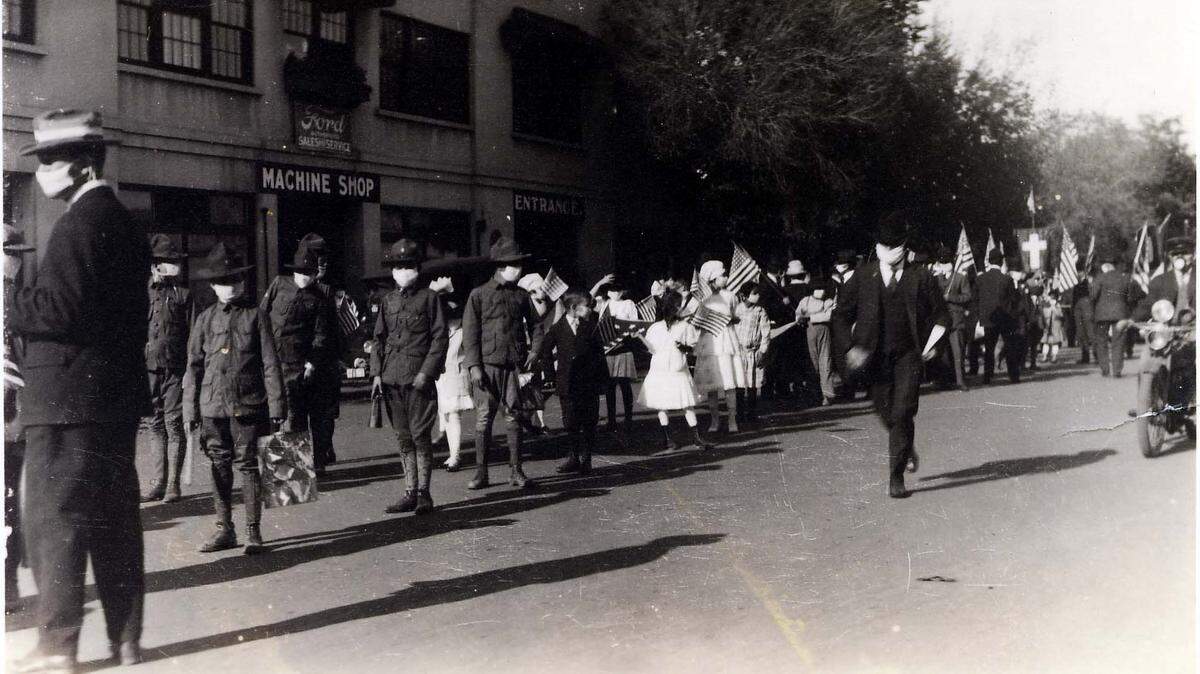
Some of the important measures implemented in the fight against the 1918 flu epidemic included home isolation, the closure of schools, churches, and theaters, mask wearing, and banning of public gatherings.
It was the collective effort of medical personnel, city and county officials, and the residents that flattened the curve and reopened businesses and schools.
Following are some major developments of the 1918 flu epidemic in Merced County.
On Oct. 15, 1918, Merced County reported its first case of Spanish influenza when Mrs. L Curtzwiler of Merced was quarantined with the disease.
By that time, California had already reached 8,092 flu cases. County health officer Dr. J. L. Mudd raised concerns about public gatherings. As a result, the annual picnic of the Merced County Farm Bureau was the first event canceled.
The condition in the state developed rapidly as the epidemic reached 13,000 cases and 120 deaths by Oct. 16. Merced, however, remained quiet with only two cases.
Schools continued to operate. Merced City health officer Dr. Lilley issued notice to enforce State law requiring all drinking cups in restaurants, drinking fountains, and other establishments to be sterilized.
While the number of confirmed cases in Merced remained low as of Oct. 21, more preventative measures were taken, including the closure of the Elite Theatre and voluntary cessation of church services by the St. Luke’s Episcopal, Central Presbyterian, and Union Methodist Churches.
The closure of Merced schools was ordered the next day when the total number of flu cases in Merced and vicinity reached 10.
More reporting came in by Oct. 25. That included 20 cases from the Snelling area, 25 from the West Side, and an unofficial count of 200 cases in Gustine. While infections in Merced County were increasing, the state was actually turning a corner as flu vaccines became available for distribution.
The first flu-related death in Merced County was reported on Oct. 26 when John V. Silva of Hopeton succumbed at the County Hospital. He was only 27 years old.
Meanwhile, some local churches continued to hold services and meetings. A second death, another Hopeton resident, occurred two days later as the reported cases reached 125 in Merced County and 67,350 in the state.
The hotspots appeared to be anywhere but Merced City. It was mostly because of the precautionary measures Merced took early on in requiring social distancing and closures.
But the City Trustees took no chances, and they required their residents to wear gauze masks in public and imposed a hefty fine up to $100 or imprisonment for offenders.
The situation on the West Side, however, continued to worsen with close to 300 cases by November 8. Stores in Los Banos were closed, churches were turned into makeshift hospitals, and men and women were recruited for nursing service.
On Nov. 19, Merced finally reached the apex of its curve according to city health officer Dr. Lilley. The Hospital was inundated with flu patients.
By Nov. 21, there were 50 patients hospitalized and several more deaths. The call for more hospital beds, medical supplies, nurses, and doctors became even more urgent. Meanwhile, the local Red Cross tried to alleviate the burden by making home visits, sewing pneumonia jackets, and making gauze masks.
One brighter spot was the arrival of Dr. Charles Baker, assistant surgeon of the United States Public Health Service, who immediately made several important recommendations in the flu fight, including the relocation of a surgical ward to the sanatorium building and the establishment of an ambulance service.
The flu infection rate in Merced County began to decline, and the epidemic seemed to be under control by Nov. 26 as the new cases had subsided 75%.
Satisfied with the progress of the influenza abatement campaign, Dr. Baker, on Nov. 30, told the public that it was safe to visit stores again if they wore masks and schools could be reopened by Dec. 9.
Then, there was another outbreak at Merced Falls School two days after Dr. Baker’s initial statement, prompting the closure of all schools in Merced County and foreshadowing the second wave of the Spanish influenza.
This story was originally published May 17, 2020 at 5:00 AM.