
In Devil’s Garden, California’s majestic wild horses trapped in no-win fight for survival
READ MORE
Nothing Wild
Click the arrow below for more stories in Nothing Wild, a Sacramento Bee series on California’s broken relationship with its wild places.
Expand All
‘We can’t just walk away.’ California’s wild places are under siege and dying
In Devil’s Garden, California’s majestic wild horses trapped in no-win fight for survival
A remarkable high-desert bird may go extinct in California. What must die to save it
Disease is decimating California’s wild ducks and shorebirds. What’s really responsible
An endangered wolf was shot to death in California. Then the armed agents showed up
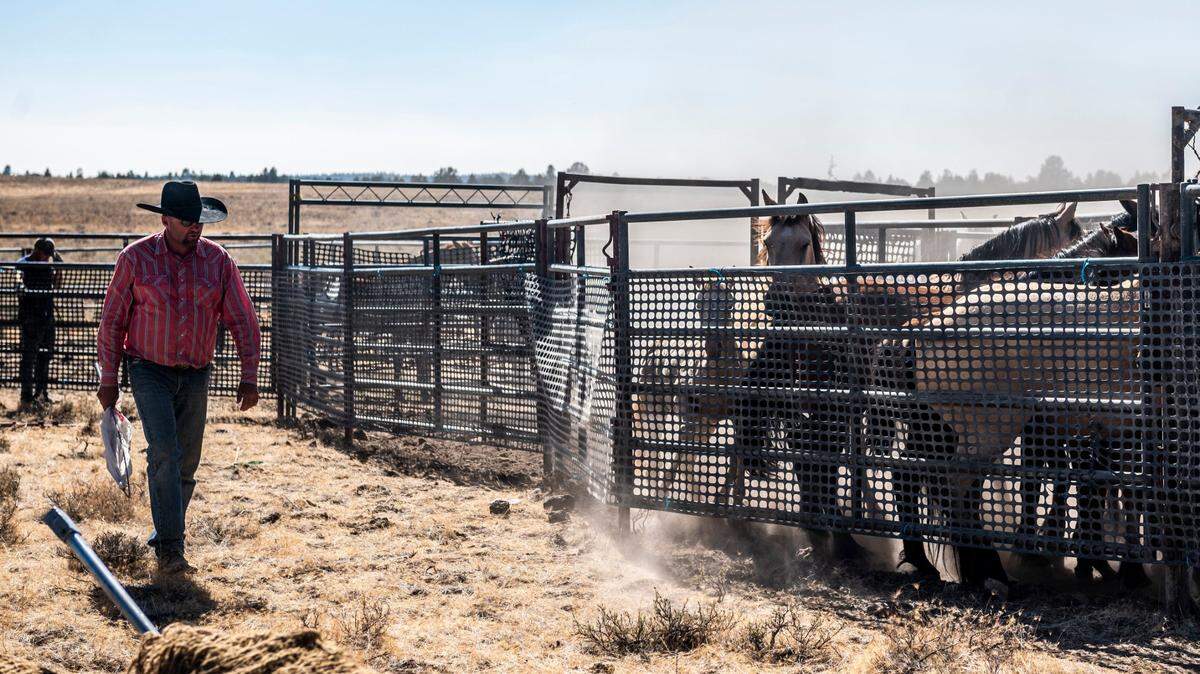
The six horses in the pen whinnied and stamped their feet, their eyes wide with fear.
A helicopter had just chased them off their grazing lands deep in the Modoc National Forest and into a temporary holding corral. They were terrified of their confinement and the smell of humans.
Their ancestors rode into battle across America, hauled wagons, pulled plows, and provided meat and the raw materials for products like glue and dog food. A million were sent to the bloody battlefields of Europe during World War I, most never returning.
The horses in front of me, born on this lava-rock crusted high desert in far Northern California, had no idea that the small group of humans at this September “gather” had planned to find them loving homes and a life of fresh hay, warm barns and veterinary care.
To them, we were as dangerous as the 200-pound mountain lion that had recently developed a taste for Devil’s Garden foals.
For years, I’ve been wanting to write about these horses and the wild herds that have grown to unsustainable levels across rangelands and Western deserts.
And now I was here, a five-hour drive northeast from Sacramento into their barren homeland, named by a U.S. Army major, John Green, who in 1872 described a hellish landscape as he led a cavalry regiment along the Applegate Trail.
“For miles neither wheel of wagon nor foot of horse ever touched the soil. Ground covered with loose rocks as thick as they can be planted,” he wrote in his journal. “A ‘Devil’s Garden’ yet found.”
In a romantic narrative painted by movies and steeped in nostalgia about the West, there is a battle here between horse lovers and a federal government taking these majestic creatures off the landscape — and possibly being sold for slaughter — to appease ranchers whose cattle compete with the horses for grass.
I wasn’t so sure. Maybe there was a way to end this war. I sat there in the dirt watching those skittish horses, itchy nonnative medusahead grass creeping under my shirt.
That’s when Glenna Eckel asked me a question.
“That one horse,” she said, softly, gesturing to one of the terrified horses in the pen, “what’s best for him?”
Eckel, a former federal wild horse specialist helping with the roundup, wanted me to think — and think hard — about what that horse’s life would be like if that helicopter hadn’t chased him into that corral.
It didn’t take me long to imagine.
Every once in a while, someone will find a deer, a lamb or a calf that’s still alive, even though coyotes have eaten the flesh off its hindquarters. The coyotes don’t leave these animals to suffer because coyotes are cruel. The coyotes just stop being hungry.
That, to me, is what it means to be wild. Nature is indifferent to suffering.
And, yes, these horses out here on the Devil’s Garden — one of California’s most inhospitable landscapes — will suffer by the end.

Sickness. Bullets. Festering wounds. Barbed wire. Raging wildfires. Legs broken in cattle guards.
Feet of snow covering their feed. Watering holes frozen solid at -10 degrees.
The slow misery of dying from thirst after getting stuck in the mud. Foals’ necks getting broken in the jaws of that big tom cougar, his sharp claws dug deep in their flanks. He’s killed at least 30 of them already.
Eckel’s words rang true. Maybe life in a paddock isn’t so bad. Hardly the “concentration camps” advocates describe when they talk about what happens to these horses after one of these roundups.
“How do you get the attention of the public who doesn’t want to see past the romance?” she asked as her gaze locked mine under her dusty gray baseball cap.
The simple answer: I don’t think I can.
Too many children — my daughter included — have posters of horses on their walls.
And, when it comes to this overpopulated invasive species, romance has a tendency to trump facts and reason — even if it’s to the detriment of the horses and to the landscape they inhabit.
For the first half of the 20th century, wild horses were an expendable resource, much like cattle. Cowboys would round up wild horses and send them to slaughterhouses, a practice called “mustanging.”
But after World War II, a generation raised on shows like “Mr. Ed,” films like “Bambi” and living increasingly in subdivisions instead of on farms changed the way Americans thought of animals. Dogs and cats were brought in indoors.
And, for many, horses were no longer just livestock. They became pets.
“They’re considered to be part of the family,” said Terry Messmer, a professor at Utah State University.
Mustangs, in turn, came to symbolize the romance of the rugged American West, popularized by the hundreds of Western movies and television shows of that era.
The first wild horse activist, a Nevada woman named Velma Johnson, galvanized public opinion against mustanging. Known as “Wild Horse Annie,” she told gruesome stories about wanton cruelty and mustang wranglers using vehicles to rundown and maim the animals.
In 1959, Congress passed the Wild Horse Annie Act that prohibited the use of vehicles to round up wild horses. In 1961, “The Misfits,” starring Clark Gable and Marilyn Monroe, featured down-and-out cowboys in Nevada lassoing terrified wild mustangs to sell to dog food factories.
With public sentiment decidedly pro-horse and wild horse populations on the decline, President Richard Nixon in 1971 signed the Wild Horse and Burro Act — two years before he signed the Endangered Species Act.
“Congress finds and declares that wild free-roaming horses and burros are living symbols of the historic and pioneer spirit of the West; that they contribute to the diversity of life forms within the Nation and enrich the lives of the American people; and that these horses and burros are fast disappearing from the American scene,” the act reads.
The law requires that wild, free-roaming horses and burros “be protected from capture, branding, harassment, or death; and to accomplish this they are to be considered in the area where presently found, as an integral part of the natural system of the public lands.”
The law has given federal land managers headaches ever since.
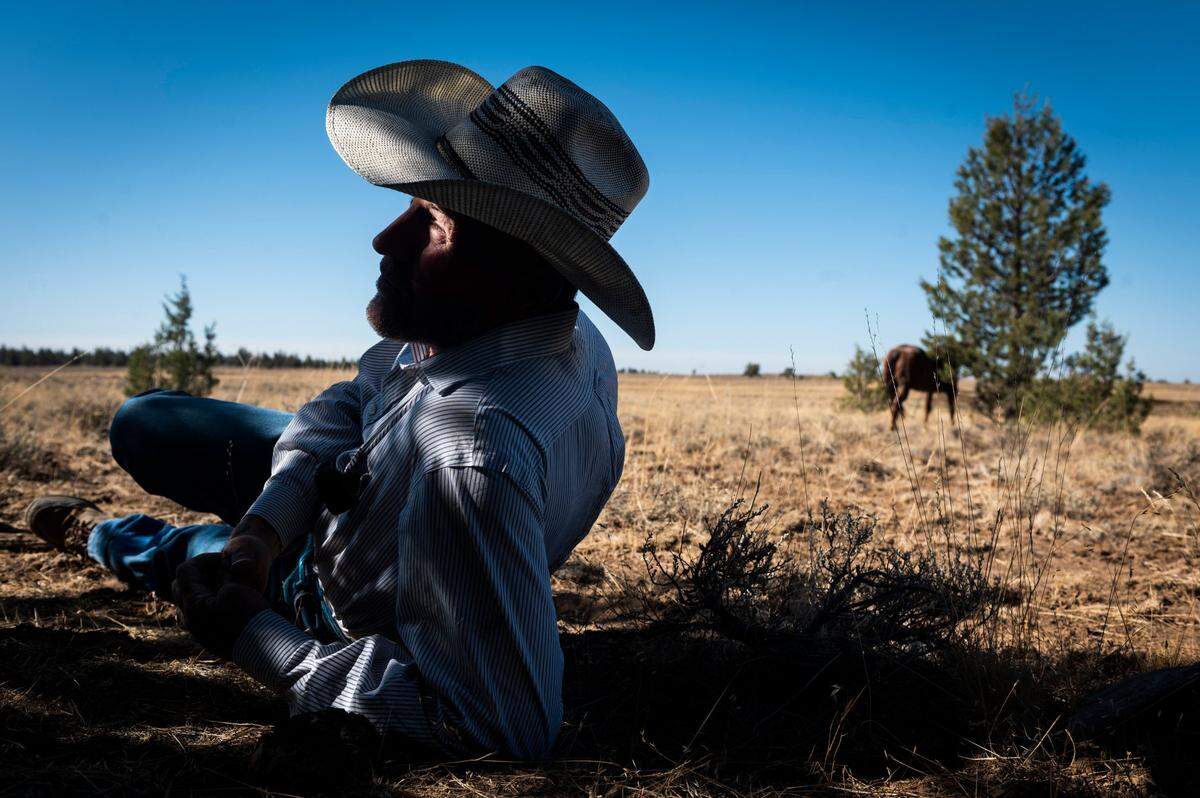
200 horse breeds in Devil’s Garden
There are an estimated 100,000 wild horses on Bureau of Land Management lands, half of them in Nevada. They are found across the West, including on private and Native American rangelands, and national parks.
The number of horses and burros on BLM land is three times higher than the landscape can sustainably support, according to the agency. Scientific studies have shown overpopulated horse herds cause major damage to the deserts they inhabit. They are voracious eaters of native plants, and they trample fragile soils. They’re bigger and more aggressive than native animals, and they keep wildlife from drinking at watering holes.
The federal government says it will cost at least $5 billion over 15 years to get the herds down to manageable levels and to care for the animals when they’re captured.
Since federal authorities are prohibited from euthanizing the horses or selling them directly to slaughter, these herds must get adopted or sold for a small fee.
But adoption is no easy task. The cuter and younger horses tend to go first. It’s much harder to find an owner with the horsemanship skills and resources to care for an aging mare or stallion whose first instinct is to tear through a fence or kick someone’s head in.
Tens of thousands of those unwanted horses have ended up in permanent BLM corrals or private wild horse sanctuaries across the country.
The same overpopulation problems plague the Devil’s Garden Plateau Wild Horse Territory, managed by the U.S. Forest Service. The feds in 2013 set a population management goal of no more than 402 adult horses on the territory’s 258,000 acres.
In 2016, aerial surveys estimated there were at least 2,246 adult wild horses on the Garden. Federal officials say it could have been an undercount, given the difficulty of spotting horses inside the hilly juniper forests, unlike in the open deserts elsewhere in the West.
For decades before they were federally protected in the 1970s, ranchers actively managed the “wild” Devil’s Garden herds, taking stock out and adding new animals to get desirable genetic lines, and even renting out horses to fellow farmers.
That makes Devil’s Garden horses easier to adapt to a life in captivity than the mustangs elsewhere in the West, some of which can trace their ancestry to stock Spanish explorers brought to America in the 16th and 17th centuries.
DNA analyses show the Devil’s Garden herd contains traces of 200 types of horse breeds, but none from Spanish mustangs, said Ken Sandusky, a spokesman for the Modoc National Forest.
Because they’re from more docile breeds and have only gone a few decades without some form of human handling, people line up to take one home, even the older horses.
“People are in love with Devil’s Garden horses, and there’s a reason for that,” Sandusky said.
Last year, of the 499 horses rounded up, 323 were adopted or sold “with limitations,” meaning the buyer agreed never to sell, give them away or trade the horse “for processing into commercial products.”
The rest were transferred to BLM’s long-term holding corrals near Susanville. Only 12 of the horses, less desirable because of their age or their common coloration, gathered last year remained in the Devil’s Garden corrals.
Three consecutive years of helicopter roundups — each costing taxpayers more than $600,000 — have taken close to 2,000 horses off the Garden.
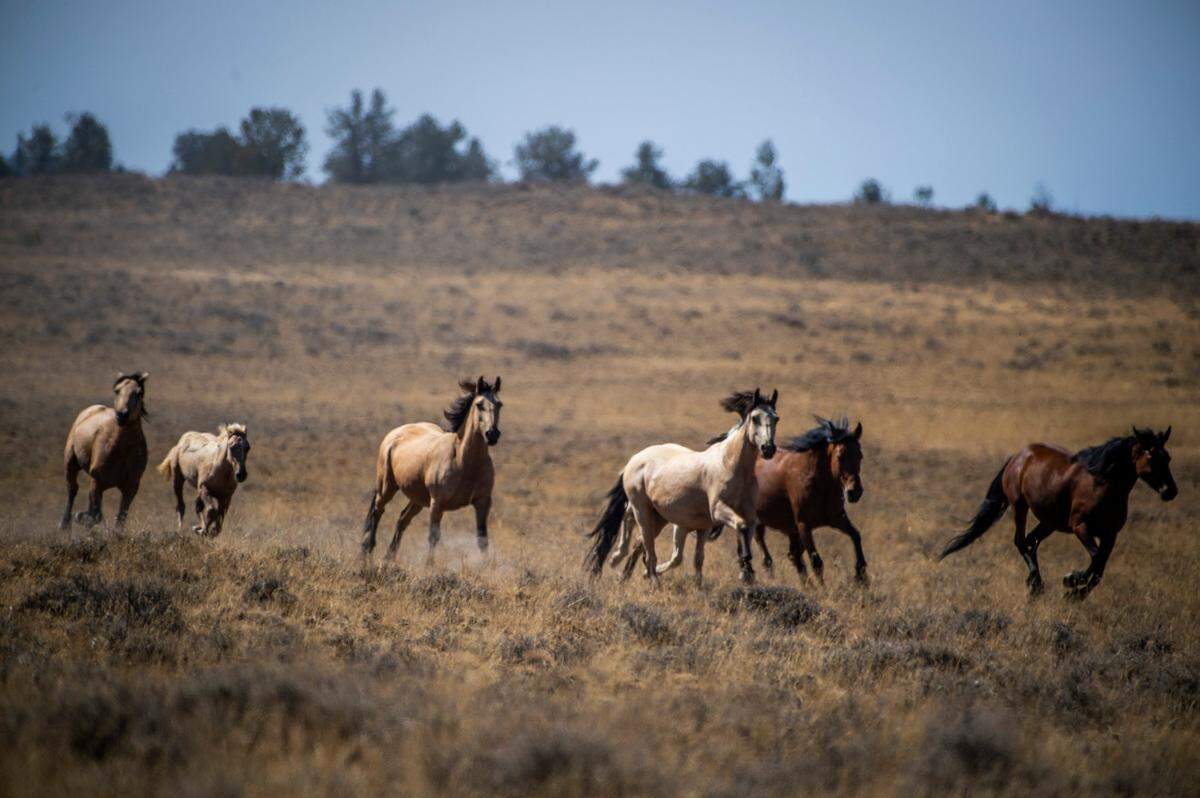
But horses keep breeding. Even after this year’s roundup took 506 of them off the range, the population is estimated at over 1,000 adult animals, more than twice the number that this troubled landscape can support.
‘It should be a little oasis. And it’s gone’
Out here, the ranchers who have a permit to graze cattle are required to build barbed wire fences to keep their livestock out of some of the protected springs that bubble up from the lava rock. These permanent riparian areas are critical to the long-term survival of native wildlife in this high desert.
The fences, which deer and elk are able to leap, must have a smooth wire along the bottom to allow local pronghorn antelope, which can’t jump very well, and smaller animals to crawl under.
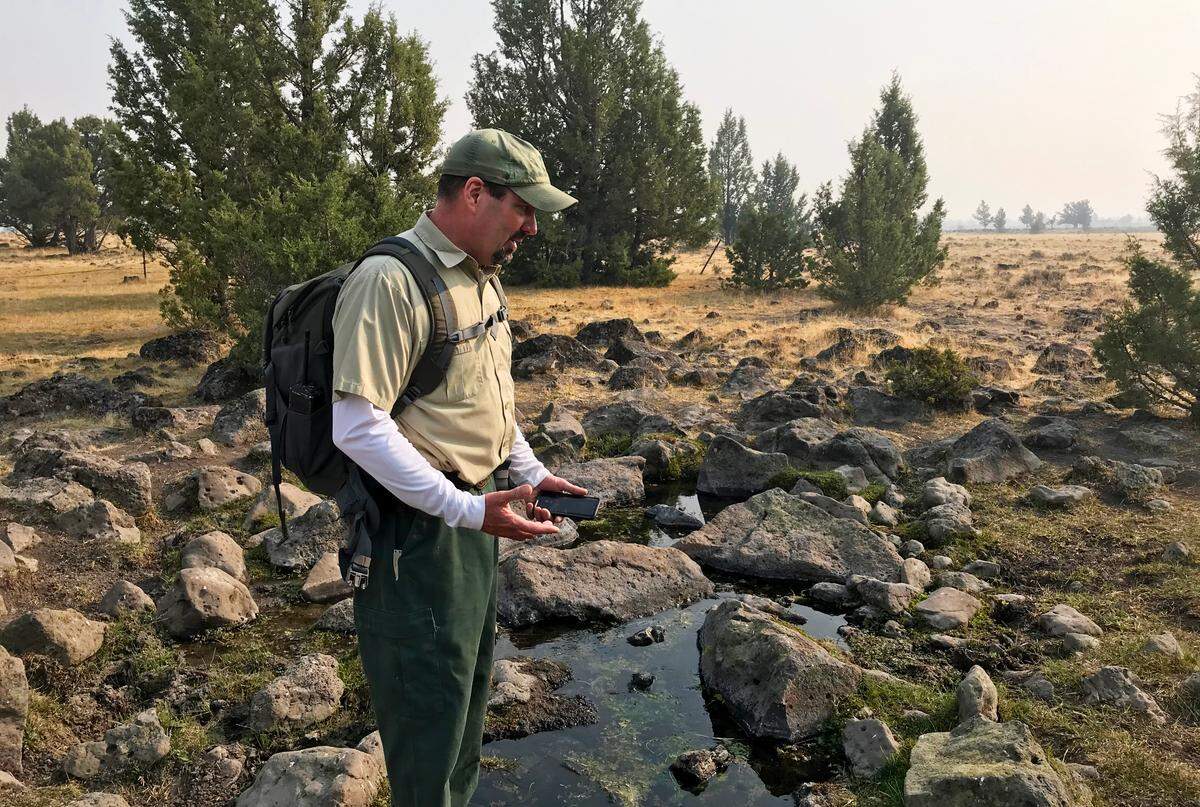
The fences can be no match for the horses. At one site I visited, the horses pushed down the barbed wire, shearing many of the metal T-posts off at the base. The lush native grasses around the protected spring were so mowed from horses’ teeth it looked like a putting green covered in piles of horse droppings.
“This site should be surrounded by vegetation,” said Sandusky, the Modoc National Forest’s public affairs officer. “It should be a little oasis. And it’s gone.”
The horse hooves had turned much of the soft soil around its rock-armored headwaters into a pockmarked bog. Sandusky told me in other parts of the forest, the horses had trampled less-rocky springs so much that they had actually stopped flowing.
Horse hooves trampling wetlands like these are bad news for fairy shrimp, a unique species of crustacean that hatch in seasonal Devil’s Garden “vernal pools” that bloom to life after the spring thaw.
Horses are one more stressor for larger Devil’s Garden animals.
In the mid-20th century, there were close to 45,000 animals in what’s known as the interstate mule deer herd that winters on the Devil’s Garden. As of 2010, the herd was down to fewer than 5,000.
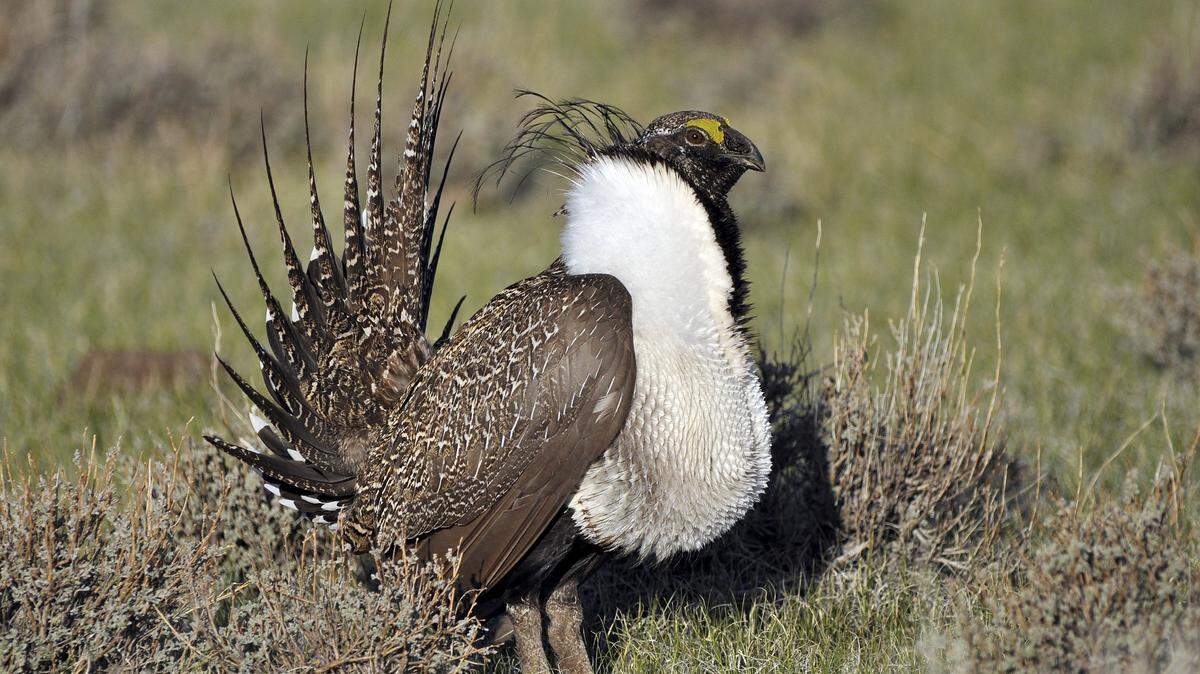
The Devil’s Garden sage grouse population — which as recently as the 1970s numbered 14,000 across 56 breeding sites — is down to just a handful of birds on one remaining breeding area.
Christian Hagen, an Oregon State University associate professor who studies sage grouse, said wild horses aren’t the only problem causing declines in native wildlife, but they are a factor.
“We need to give every child ‘My Little Sage Grouse’ instead of ‘My Little Pony,’ ” he said.
As Sandusky and I walked around the hoof-stomped oasis, we spotted small groups of horses that had come to drink and graze on what was left of the grass. They trotted away at our approach.
As we were about to leave, I heard a horse let out an aggressive snort. A few yards ahead of us, a huge bay-colored stallion with a white star between its eyes shook its head and pranced, tail and head erect. Before trotting out of sight, he was letting us know he was the boss of this watering hole.
That horse could have stepped right out of the poster in my daughter’s bedroom. The romance I felt faded outside the broken fence around the spring. The horse had been standing in a sea of yellow invasive grass. Every few steps, we’d come across clumps of Ventenata dubia lying on the ground.
The horses had tried to take a bite of the wiregrass and spit it out.
It was a reminder of the struggles these animals face as they try to eke out a life on a landscape suffering from a century of human-caused problems — unnaturally destructive wildfires, invasive plants and habitat loss from development and agriculture.
Wild horse advocates have their culprit: cows
For activists like Mary Koncel, horses would be doing fine out here, if not for the cows they share the land with.
Koncel is a program specialist for the American Wild Horse Campaign, one of the influential groups fighting horse roundups. Hers was among the groups that have sued to block the Devil’s Garden gathers.
I met her the day after I had visited the spring. She’d just flown in from her hometown in Massachusetts to watchdog the helicopter roundup. She showed me a picture on her phone of Rain, her pet mustang — a once-wild Nevada mare — wearing a purple browband she called the horse’s tiara.
“Wild horses are scapegoated for an awful lot of damage, not only on Forest Service land but also on BLM land,” she said. “And, first of all, if you look at how cattle outnumber wild horses, I think the average is 35 cows to one wild horse.”
She’s not wrong about the disproportionate numbers. Each year, some 26,537 cattle graze on the Modoc National Forest under 82 federal permits issued to ranchers.
The Forest Service defends the practice, saying it’s obligated under federal law to allow grazing. Cattle ranchers are required under the terms of their permits to leave a percentage of the forage, and they’re required to keep their cattle from grazing around protected springs.
On the Modoc, the cattle are allowed on these lands only for three to five months.
“You take them to another range or you take them off the range altogether,” Sandusky said. “With horses … they’re out here 365. There’s no way to manage the overuse of the resource.”
Koncel, though, was having none of that. She insisted that cows — not horses — are responsible for the majority of the damage to riparian areas.
“Wild horses don’t do that,” she said. “They drink, and they move out.”
At the spring I visited, there were only a few cowpies scattered among the piles of horse apples, and it was clear the horses had been in there for months.
Koncel’s solution to addressing the overgrazing issue: reduce the numbers of cattle on the range, and use a type of birth control called PZP, shot from a dart, to keep the horses’ numbers in check.
While it’s shown promise in some areas, it would be a major challenge to dart mares multiple times across hundreds of square miles of rugged terrain in Devil’s Garden.
A more practical solution might be to round up mares once and surgically sterilize them — a plan the Trump administration proposed on BLM lands — but horse advocates believe that is inhumane. This month, they sued the feds over it.
At a conference in Reno last year, San Stiver, the sagebrush initiative coordinator with the Western Association of Fish and Wildlife Agencies, saw just how emotional wild horse advocates get at the prospect of their beloved animals getting surgically mutilated.
There, a veterinarian gave a talk about how he and a small number of colleagues could spay 40 mares in an afternoon using a livestock “squeeze chute.” Each procedure would take 15 minutes and the horses would be fully mobile and ready to return to the range within a couple of hours.
Stiver thought it was a good compromise that could quickly limit the number of horses while allowing them to live out their days in the wild. Everybody wins.
The horse advocates at his table didn’t feel the same.
“I looked over at them, and they were crying,” Stiver said.
Even if sterilization works, the horses still have to live out here in the elements, without reliable food and veterinary care, the prospect of a miserable, indifferent death around every bend and hill.
I asked Koncel about that. How come these horses don’t deserve the comfortable life that her mustang, Rain, has?
Her response was that if given their fair share of resources, these horses “can have a very good, long life.” To her, the roundups are exceedingly cruel.
“Do you think those horses are happy being crowded into a pen away from their family bands?” she said. “Do you see the eyes of those horses? It’s called white eye. That is stark terror. I mean, that’s not just for a few days. There are horses that can’t be gentled, because this is their life. Do you think taking off a 25-year-old stallion is humane?”
But what about the mountain lion preying on those foals out here?
“That bothers me. But I also think if we think of wild horses as being wildlife, then we have to accept that.”
What about a bad winter causing horses out here to starve or their watering holes to freeze?
“There are areas that have been suffering from drought, and there have been emergency gathers, but one then has to step back and say, ‘OK, truly, instead of taking the horses off, why not give them supplemental hay or water and keep them on?’ ”
Some of the concerns about roundups are rooted in the fear that unwanted horses would end up at slaughterhouses. Originally, the Forest Service sought to sell unwanted horses after a gather “without limitations” on slaughter, but it was blocked after public outcry spurred lawsuits and changes in state and federal law.
After horse advocates complained, the BLM limited the number of horses a person could buy to four in a six-month period, Koncel said. But the Forest Service still allows a person to buy 24 horses a day for only $1 each. She calls that “essentially dumping horses and undermining the ban on slaughter.”
I have little doubt wild horses end up on kill floors each year, despite a federal ban on horse-meat slaughterhouses and new wild horse owners being required since the 1980s to sign affidavits saying they won’t sell their animals for slaughter.
A 2015 Inspector General report describes how easily it can happen. The report found BLM officials sold 1,700 horses to a buyer who admitted he sold the horses to others who took the animals across the border to Mexico, where horse slaughter for the international horse-meat trade is legal.
But the horse advocates’ resistance to roundups can cause the overpopulation problem to get worse, and that means more wild horses are more likely to end up in the slaughterhouse.
In 2013, before Koncel’s group sued the Modoc National Forest in an attempt to block its round-up plan, there were around 1,000 adult horses inside the Devil’s Garden wild horse management unit.
During the years the government fought the suit, putting roundups on hold, the population had more than doubled to 2,246.
‘The stallion is going to be the one that drinks first’
For experts like Messmer, the Utah State professor, the arguments that wild horse advocates make about the animals undergoing emotional trauma is anthropomorphizing — putting human values on animal behavior.
Horses on the range are just as indifferent to the suffering of their herd mates as the landscape they inhabit. It’s not a talking-animal Disney movie out there.
Horses brought off the range often are covered in scars from getting bitten during battles for dominance. Messmer gave the example of a herd of horses — some frail and some very young — in a drought approaching a small spring with just enough water for a few of the horses.
“The stallion isn’t going to stand aside and keep everybody away to let the foal or the mare drink,” he said. “The stallion is going to be the one that drinks first. These are instinctive behaviors these animals have for survival.”
In late November, a month after the round-up chopper quit flying, I returned to the Garden on a morning when temperatures had dipped to the low 20s, so I could watch a group of 4-H kids come with their families to pick out horses they were going to adopt in the coming weeks, as part of a program that gives the kids first pick after a gather.
The horses were still a touch skittish and moved into the opposite end of the pens from the families who peered through the corral fences. But after weeks of fresh hay and veterinary care, they weren’t bucking. That white-eyed terror had turned into more of a suspicious glare.
At one point, one of the foals walked up to sniff the outstretched hand of 9-year-old Mason Sedillo, who’d come up from the Los Gatos area to find his horse.
For Mason’s mother, Christine, who’s already adopted two mustangs from other roundups, it was an opportunity to do something positive for the ecosystem, while also giving Mason a lifelong bond with an animal born free, born wild.
And that horse — that one horse — will live out its days in comfort and kindness.
“They do get definitely spoiled compared to out here,” she said. “When it gets down to 28, they get a blanket and a barn.”
This story was originally published December 21, 2020 at 5:00 AM with the headline "In Devil’s Garden, California’s majestic wild horses trapped in no-win fight for survival."