
From Plumas County to LA — a wolf’s 500-mile yearlong trek to find love
AI-generated summary reviewed by our newsroom.
- Three-year-old BEY-03F journeyed from Plumas-area origins to LA County over a year.
- California is home to nine packs and an estimated 60–70 wolves, officials say.
- Beyem Seo pack’s livestock losses cost at least $2.6M and caused stress.
Looking for a mate in Los Angeles could easily put you in the path of a few wolves.
Or so the 3-year-old female wolf dubbed BEY-03F may have felt as she made her way to LA County last weekend, part of a yearlong 500-mile journey that started in northern end the Sierra Nevada mountain range in Plumas County.
Peak mating season for wolves is around Valentine’s Day, said Axel Hunnicutt, state gray wolf coordinator for the California Department of Fish and Wildlife. The young female, who left her pack in the North State this time last year, is likely searching for love, an odyssey that can lead a wolf to traverse hundreds of miles through country where suitable mates are scarce, Hunnicutt said.
“It’s a real Valentine’s month story,” Hunnicutt said. “The search for a mate.”
The wolf’s travels began last January or February, when she left the Beyem Seo pack in Plumas County, likely to seek a partner. Her name is really a record-keeping identifier by state biologists, showing she was born into the Beyem Seo pack, was the third wolf from that pack to be collared and is a female.
“A pack is usually monogamous,” Hunnicutt said. “It’s usually just a male and a female, and their pups.”
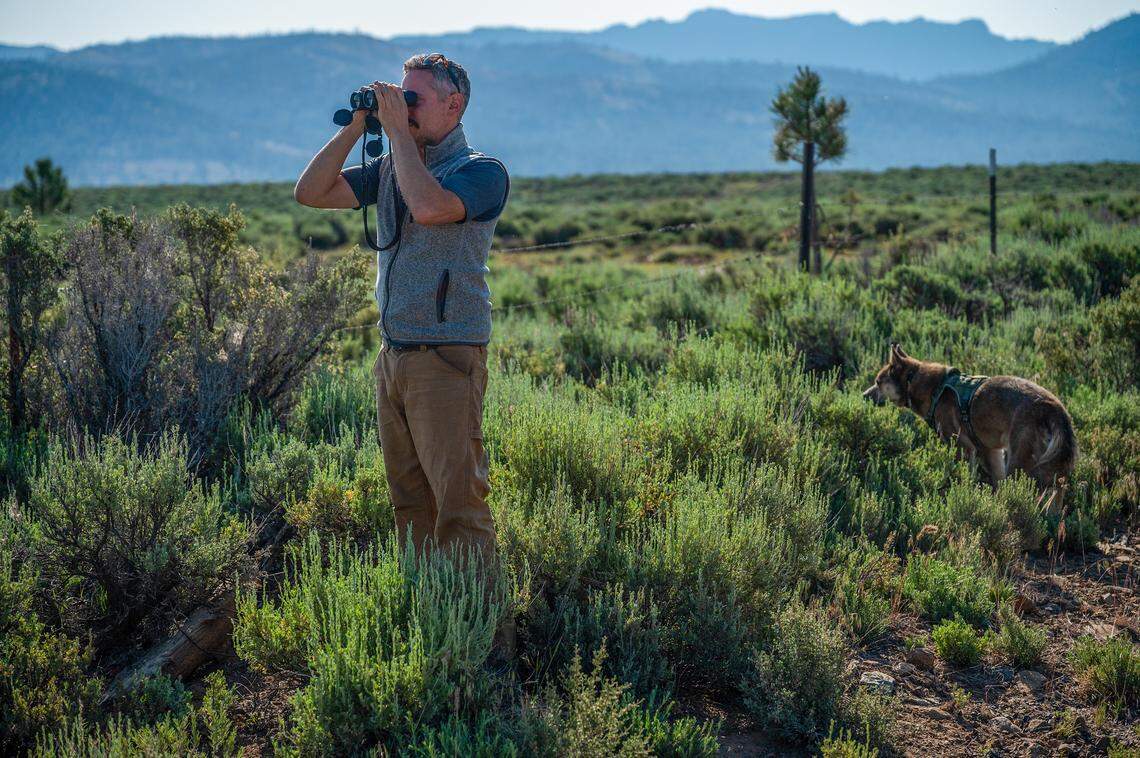
So when the young female set out on her journey, he said, she was likely looking for a mate of her own.
“Every once in a while, a different female will breed with the male, but by and large, they’re a nuclear family,” Hunnicutt said. “Once they reach a year or two (of age), they leave and go in search of unrelated animals to breed with.”
Searching for a mate?
Soon after BEY-03F left the pack she was born into, a new male wolf came along, killing or pushing out the male who had been her father and leading the group into Sierra County, where it made headlines by becoming unusually fixated on preying on livestock. The pack killed 92 calves in just over six months, and in October three of its adults were euthanized by state wildlife officials. A juvenile wolf mistaken for an adult was also killed during the operation.
Because the fate of two remaining juvenile male wolves from the pack is still unknown, it is possible that BEY-03F is its last remaining member, and any pups she has could be the only descendants of the group’s original breeding pair.
“She’s traveled over the last year or so,” Hunnicutt said. “We recorded her last year, down near the Tehachapi range, and then she went back up to the Yowlumni pack in Tulare County.” She was collared in Tulare County, and also ranged with the Yowlumni pack in Kern County, near the LA County border.
She was with the Yowlumni pack for about eight months, and after its elderly female matriarch died last year, biologists thought that BEY-03F would likely stay with the group, Hunnicutt said. But her foray into LA indicates that may not be the case.
“For some reason she hasn’t,” Hunnicutt said. “Either because the male has chosen a different female, or there isn’t a male in that pack right now.”
Her long journey, he said, is indicative of how few wolves are in most of California, because if she had found a mate before now, she would have stopped traveling. On her way, she ranged through much of the Sierra before making her way through Tulare and Kern Counties and finally into the northern tip of LA County. She crossed State Route 58 three times and I-80 at least once.
The return of wolves
Wolves have been slowly returning to the state for the past 10 years, ever since a wolf dubbed OR-7 crossed into California from Oregon. He was the first wild gray wolf to enter the state after nearly a century of local extinction.
Today, the state is home to nine packs and an estimated 60-70 wolves, Hunnicutt said.
The apex predators are protected by both the federal and state endangered species acts, and the presence of some packs near North State cattle ranches and pastureland has led to widespread fear and considerable stress. The killing of nearly 100 livestock by the Beyem Seo pack cost ranchers and the state at least $2.6 million, a recent UC Davis study showed. Even after the pack was removed, ranchers and residents experienced stress and fear as wolves from other packs began ranging closer.
Sheriffs in five counties declared states of emergency for public safety as they sought the authority to harass, trap or kill wolves that were posing a threat to people, pets and livestock. A wolf in Lassen County attacked a pet horse and killed a calf on New Year’s Day, and local law enforcement in Sierra County, El Dorado County and elsewhere have been posting wolf-sightings on social media, garnering hundreds of comments.
All told in 2025, wolves killed about 200 livestock animals, mostly calves and some sheep, state records show.
All of which may leave the impression that more wolves are in the state than really are.
BEY-03F’s trip to LA marked the farthest south a wolf has traveled in the state in more than a century, Hunnicutt said. She stayed there only briefly, moving back into Kern County near the Tehachapi range of the Yowlumni pack by Monday, the state’s wolf tracking map shows.
And if she doesn’t find a suitable mate there, she may come all the way back to the mountainous North State landscape where she started. After all, the state wolf tracking map this week showed that a male wolf, believed to have set out on his own from the Harvey pack, is in Lassen County, perhaps also looking for love at the peak of wolf mating season.
“There could be a male right there in Kern County waiting for her that we just don’t know about,” Hunnicutt said. “Or there might not be, and she wanders the rest of the Sierra Nevada until she bumps into something.”
This story was originally published February 14, 2026 at 5:00 AM with the headline "From Plumas County to LA — a wolf’s 500-mile yearlong trek to find love."
