Should California bring back grizzlies? Lawmakers to consider reintroducing them
AI-generated summary reviewed by our newsroom.
- Senate to hear a bill directing a scientific assessment on grizzly reintroduction.
- Tribes and conservationists support a cautious assessment; others oppose.
- Officials warn reintroduction strains local resources amid budget cuts and conflicts.
These days, the closest grizzly bears to the Sacramento Valley and Sierra foothills — areas that were once part of their vast California range — are at the Oakland Zoo, where admission for a family of four costs more than $100, not including parking.
The quarter-ton bears, apex predators who are revered by some Native American tribes but also feared for their attacks on livestock and sometimes humans, became locally extinct in California in 1924, the same year that the last California gray wolf was captured and killed.
Now, with the wolf population edging up to about 70 animals, the state is considering bringing back grizzlies.
A proposal to study the possibility of re-introducing grizzlies to California will have its first hearing before the Senate Committee on Natural Resources and Water on Tuesday. Backed by the Tejon and Yurok tribes and authored by Los Angeles County Senator Laura Richardson, the measure would direct state wildlife officials to develop a scientific assessment looking at all aspects of grizzly reintroduction, including ecological impacts and potential conflicts with humans and livestock.
As currently written, the bill would also formally declare the state’s ultimate goal to be restoration of the animals, once so ubiquitous that they are enshrined in the state’s flag.
“It is the policy of the state to restore the grizzly bear (Ursus arctos), our official state animal, to California,” it reads.
The proposal comes as California is already struggling to manage its populations of wild predators, several of which, like the grizzlies, are protected under state and federal environmental laws that limit hunting, hazing and other actions that individuals can take against animals that threaten human settlements or livestock.
In his budget plan for the 2026-27 fiscal year, Governor Gavin Newsom has proposed to reduce expenditures for the state’s biodiversity conservation program as well as the enforcement division of the California Department of Fish and Wildlife, which employs game wardens and wildlife officers.
Last year, the department struggled to help ranchers in the state’s Sierra Valley north of Truckee respond to an unprecedented wave of livestock attacks by the state’s newly resurgent wolf population that led to the removal of an entire pack.
The proposal has drawn fierce opposition from law enforcement officials, ranchers and homeowners in the northern part of the state where wolf attacks on cattle and the presence of wolves near homes have become so prevalent that Natural Resources Secretary Wade Crowfoot called it a crisis at a January legislative hearing.
“We’re very concerned about the reintroduction of grizzly bears on top of wolves and black bears and mountain lions,” said Sierra County Sheriff Mike Fisher, who plans to attend Tuesday’s hearing along with sheriffs from Lassen, Siskiyou, Trinity and El Dorado counties. In 2023, a Downieville woman was “eaten alive” by a black bear, Fisher has said, and in 2024 an El Dorado County man was killed after a mountain lion attack.
Fisher says he understands the importance of grizzlies to the tribes and to conservationists, but he just doesn’t think the state has the resources to safely manage their reintroduction.
“It just shifts so much of the burden on to the local counties,” he said. “In Sierra County we don’t even have a game warden.”
How did the state animal become locally extinct?
Grizzlies were once plentiful in California, ranging across its wide valleys as well as along coastal and inland mountain ranges. The golden animals, a type of brown bear, are still depicted on the state flag and in the names of university college teams.
But government hunting programs and other efforts to reduce their numbers as the human population grew led to the local extinction, or extirpation, of the animals from California more than a century ago. Nationwide, similar efforts reduced the grizzly population in the continental United States from about 50,000 bears in the 1700s to less than 800 in 1975, according to the U.S. Fish and Wildlife Service.
Today, under protection from endangered species laws, there are about 1,900 grizzlies in the 48 contiguous states, most of them in the area around Yellowstone National Park and the northern continental divide in Montana, the U.S. Fish and Wildlife Service says.
To the Yurok Tribe, the large bears are considered relatives who could teach humans lessons, said Tiana Williamson-Claussen, a biologist who directs the tribe’s wildlife department. The Yurok followed the grizzlies, eating similar foods and considering them “aunties,” she said.
Tribal leaders are well aware of the trepidation that many Californians have, including some of their own members, regarding reintroducing grizzlies, said Williamson-Claussen.
For this reason, backers of the bill are likely to propose removing the language formally declaring it the policy of the state to bring the animals back, focusing instead on a study that will look at all aspects of possible reintroduction, she said. That is also reflected in the latest analysis of the bill by senate staff, which includes possible new wording focusing only on the assessment and not on establishing a new policy to bring back grizzlies.
“If the analysis says this absolutely cannot work, then it’s not going to happen,” she said.
When grizzlies were plentiful, she said, the Yurok did follow them, but people were also very aware of the dangers they posed, Williamson-Claussen said. Tribal members specifically built their homes in ways that prevented bears from getting in, and learned to always sing or make noise when walking down a trail, so as not to surprise them. Bears were also hunted, she said.
“There were absolutely occasions when bears, either because they were becoming threatening to human populations, or for other reasons, like meat or materials, were killed by Yurok and other people,” she said.
Even so, if it is feasible to bring them back, the grizzlies could help restore a long-missing balance to ecological systems in the state, she said.
Would grizzlies pose the same problems as wolves?
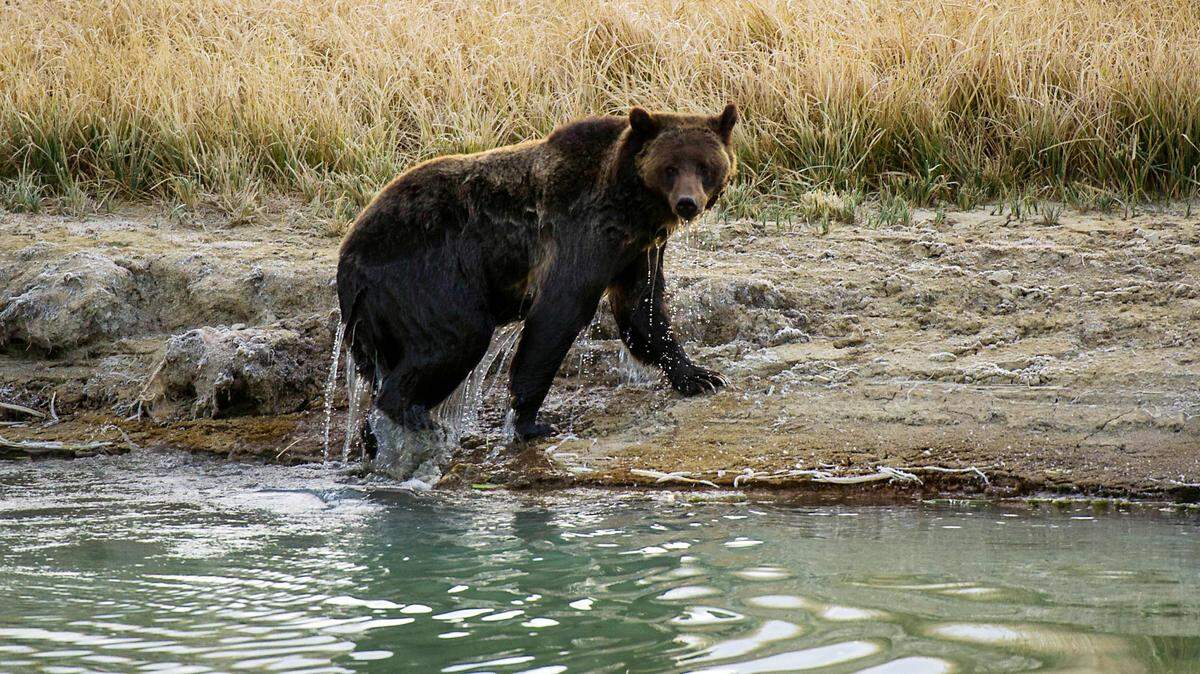
Grizzlies are large, with the average adult male weighing 400-600 pounds, according to the U.S. Fish and Wildlife Service. In areas where food is plentiful, including salmon-rich river habitat in parts of Canada, some can grow to 1,000 pounds, or half a ton.
Their claws are longer than those of black bears, and used for digging and scraping. Those claws, as well as the animals’ size, make them particularly dangerous on the rare occasions when they are encountered by humans.
Their fur ranges from light brown to nearly black, with a sometimes “grizzled” appearance at the tip.
At the Oakland Zoo on a recent sunny day, three golden grizzlies dug in the soft earth, looking for insects or small prey animals to eat. They had earlier gone for a swim in a pool that is enclosed by glass on one side to allow visitors to see in — by late afternoon, the pool was littered with tufts of fur that came off while they played.
If grizzlies are brought back to California, they are not likely to pose the same threats to human settlement and livestock as the wolves have, said Brendan Cummings, who advocates for the bears for both the Center for Biological Diversity and the California Grizzly Alliance.
Grizzlies don’t disperse or range over the same wide distances as wolves, he said, making it more likely that they will stay in the few far-northern and Sierra Nevada wilderness areas that conservationists have identified as possible habitats.
And the bears are also slower to reproduce than wolves, not bearing their first cubs until they are between 3 and 8 years old, according to the University of Montana.
While they are considered apex predators, grizzlies are mostly opportunistic in their eating habits than wolves, Cummings said. This means that if a farm animal such as a calf is in their area without protection, they might kill and eat it, but they do not track prey over long distances like wolves do, and they are less likely to be in close proximity to farms and ranches, he said.
“They eat plants, they eat acorns, they dig up tubers,” he said. “Meat is a very small portion of their diet.”
Technology would also make any possible reintroduction of grizzly bears to California look very different than the arrival of wolves, he said.
Because they would be actively introduced by biologists, each grizzly in the state would be tagged with a GPS device showing its location at all times, making it far easier to track whether they are coming near human settlements Cummings said. This did not happen with California’s wolves, who came naturally to the state starting in 2011 and could not be tracked or collared by biologists unless they were caught, he said.
“This would be probably the most highly monitored, high-tech reintroduction ever carried out anywhere in the world,” Cummings said. “People would have to go out of their way to have an interaction with grizzlies.”
This story was originally published April 7, 2026 at 5:00 AM with the headline "Should California bring back grizzlies? Lawmakers to consider reintroducing them."